Key points
- The real AI chip bottleneck is not the chip, it is the packaging. TSMC's CoWoS, the step that bonds the GPU to its memory, is sold out into 2026, and Nvidia (NVDA) alone holds roughly 60% of that capacity.
- TSMC is racing to scale CoWoS from about 35,000 wafers a month in late 2024 to roughly 130,000 by the end of 2026, but demand has been running ahead of supply the whole time.
- You cannot buy CoWoS directly (TSMC does most of it in-house), but you can buy the picks-and-shovels around it: Amkor (AMKR), Camtek (CAMT), Onto Innovation (ONTO) and Besi (BESIY).
- The next leg is "hybrid bonding," and Besi is the front-runner in that equipment. Its orders jumped about 105% year over year last quarter.
- These are real, fast-growing businesses, but they are cyclical and tied to the AI capex boom, so the same demand that lifts them can reverse.
Everybody knows Nvidia designs the AI chip and TSMC manufactures it. What almost nobody talks about is the step in between that actually decides how many of those chips reach the market: advanced packaging. The fabricated silicon is useless until it is wired up to its memory and mounted, and that packaging step, not the chipmaking, has been the real chokepoint of the AI boom. It is one of the most important corners of the trade and one of the least covered. Here is what it is and the overlooked stocks behind it.
What advanced packaging actually is
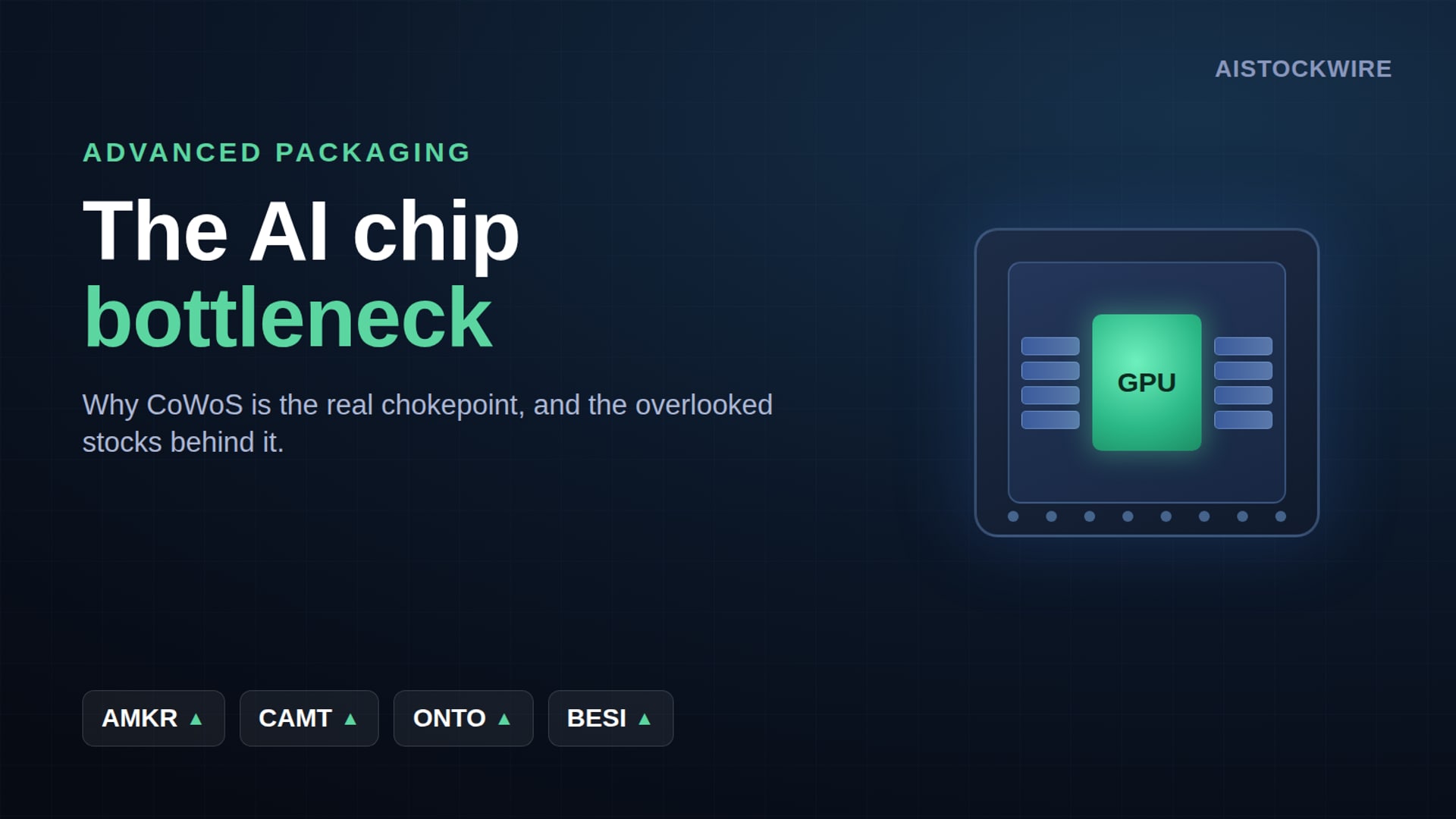
A modern AI accelerator is not one chip. It is a logic die (the GPU) sitting next to several stacks of high-bandwidth memory, or HBM, all wired together so data can move between them fast enough to feed the model. Getting those pieces close enough and connected with enough wires is the job of advanced packaging. TSMC's version is called CoWoS, short for Chip-on-Wafer-on-Substrate: the GPU and the HBM stacks are placed side by side on a thin slab of silicon called an interposer, which acts like an ultra-dense circuit board. Without it, you cannot build a Blackwell or an MI300. This is why people in the industry say the bottleneck moved "from the front end to the back end," from making the chip to packaging it. We explained the manufacturing side in our piece on what a chip foundry is; packaging is the step right after.
Our HBM memory stocks page sorts the names into makers, packaging, equipment and interface silicon.
Why it is the real bottleneck
The numbers are stark. TSMC's CoWoS capacity has been sold out through 2025 and into 2026, with management describing it as very tight. Nvidia (NVDA) alone has locked up around 60 percent of it, and the top three customers control more than 85 percent. TSMC has responded with one of the fastest capacity build-outs in its history, scaling CoWoS from about 35,000 wafers a month in late 2024 toward roughly 130,000 a month by the end of 2026. Even so, the supply-and-demand gap is only expected to narrow from about 20 percent to 10 percent by year-end, not close. This is the same pattern we have written about across the AI shortage cycle: the constraint keeps moving to whatever part of the chain is hardest to build, and right now that is packaging and the HBM that goes with it.
The stocks that actually own this
Here is the catch, and the opportunity. TSMC owns the CoWoS technology and does the bulk of the packaging in-house, so the purest way to own this boom is TSMC stock itself. It reports its next quarterly earnings in mid-July, which will be one of the most closely watched reads on AI packaging demand all year; you can follow it on our earnings calendar. But the more interesting, less crowded plays are the companies that supply the tools and capacity the whole industry needs, the picks and shovels behind the picks and shovels. All prices are approximate and as of late June 2026.
- Amkor Technology (AMKR), about $78, market cap around $19 billion. Amkor is the world's number two contract packaging company (an "OSAT," for outsourced assembly and test) and the largest one based outside Asia. It does the advanced packaging that companies do not do in-house. Its first quarter 2026 revenue jumped about 27 percent to $1.68 billion. The bigger story: Amkor is building a $7 billion advanced-packaging campus in Arizona under a 10-year partnership with TSMC, with Apple and Nvidia already signed up as lead customers. It is, in effect, becoming TSMC's packaging partner for a U.S.-based supply chain.
- Camtek (CAMT), about $175, market cap around $8 billion. Camtek, based in Israel, makes the inspection and measurement machines that check every advanced-packaging and HBM line for defects. It is a key supplier to the memory and chiplet makers. It did a record $496 million of revenue in 2025, roughly half of it AI-related, it holds an estimated 40 percent of the HBM inspection market and serves all three major memory makers, and it recently landed over $105 million of multi-system AI orders for 2027.
- Onto Innovation (ONTO), about $322, market cap around $16 billion. Onto is the U.S. equivalent: process-control tools (metrology and inspection) for both leading-edge chips and advanced packaging. It posted a record $292 million in first-quarter 2026 revenue and raised its full-year growth outlook to more than 30 percent, citing the surge in AI demand across both the chip and the packaging side.
- Besi (BESIY), about $340 for the U.S. ADR (the company, BE Semiconductor, is listed in Amsterdam and is worth roughly 23 billion euros). Besi is the purest bet of the group: it is the front-runner in "hybrid bonding" equipment, the next generation of packaging. Its first-quarter 2026 orders more than doubled from a year earlier, and it runs gross margins above 60 percent.
The next chapter: hybrid bonding
That last name points at where this is heading. Today's packaging mostly connects chips with tiny solder bumps. As accelerators get denser and the industry moves to the next memory standard, HBM4, those bumps are not fine enough, and the industry is shifting to hybrid bonding, which fuses chips together directly with copper-to-copper connections at sub-10-micron precision. It is early (hybrid bonding is still a small slice of the market), but it is the fastest-growing slice, and Besi sells the machines that do it, at roughly $1.5 million to $2.5 million each. The broader advanced-packaging market is forecast to grow from about $52 billion in 2025 to around $90 billion by 2031.
The risks worth knowing
None of this is a free lunch. First, these are cyclical businesses. The semiconductor-equipment industry has always been boom and bust, and the same AI capex wave lifting them can roll over. Second, the shortage is the bull case, and it is slowly easing: as TSMC's capacity catches up and that supply gap narrows, the pricing power that makes packaging so lucrative right now could soften. Third, demand is concentrated in a handful of customers, above all Nvidia, so a slowdown in AI spending hits these names hard. And after big runs, several of them trade at rich valuations that already price in a lot of growth.
The bottom line: advanced packaging is the quiet chokepoint of the entire AI buildout, the step that decides how many accelerators actually ship, and it is far less crowded than the names everyone already owns. TSMC controls the core technology, but the equipment makers, Amkor, Camtek, Onto and Besi, sell the tools and capacity that the whole industry has to have. If you believe AI infrastructure keeps growing, this is one of the more direct ways to own the part of the chain that has been holding everything up. Just remember it is a cyclical, AI-dependent trade, not a bond. For the full layout of the AI trade, see our AI stock map.
Nothing here is investment advice. Prices, market caps and figures are approximate and as of late June 2026, and they change. Semiconductor and equipment stocks are volatile and cyclical. Do your own research.
Cover: AIStockWire illustration.
This is general market commentary and opinion, not investment advice. Markets can go down as well as up, and you can lose money. Always do your own research and consider speaking with a licensed financial professional before making any investment decision.