Key points
- Software has outperformed chips since June
- A Goldman specialist sees a stock picker's market
- Goldman's strategists expect the AI earnings boost to fade
- I think strong results could bring buyers back to chips
Chip stocks dominated the AI trade in the first half of this year. The iShares Semiconductor ETF (SOXX) gained 112.8% through June, while the iShares software ETF (IGV) fell 14.3%.
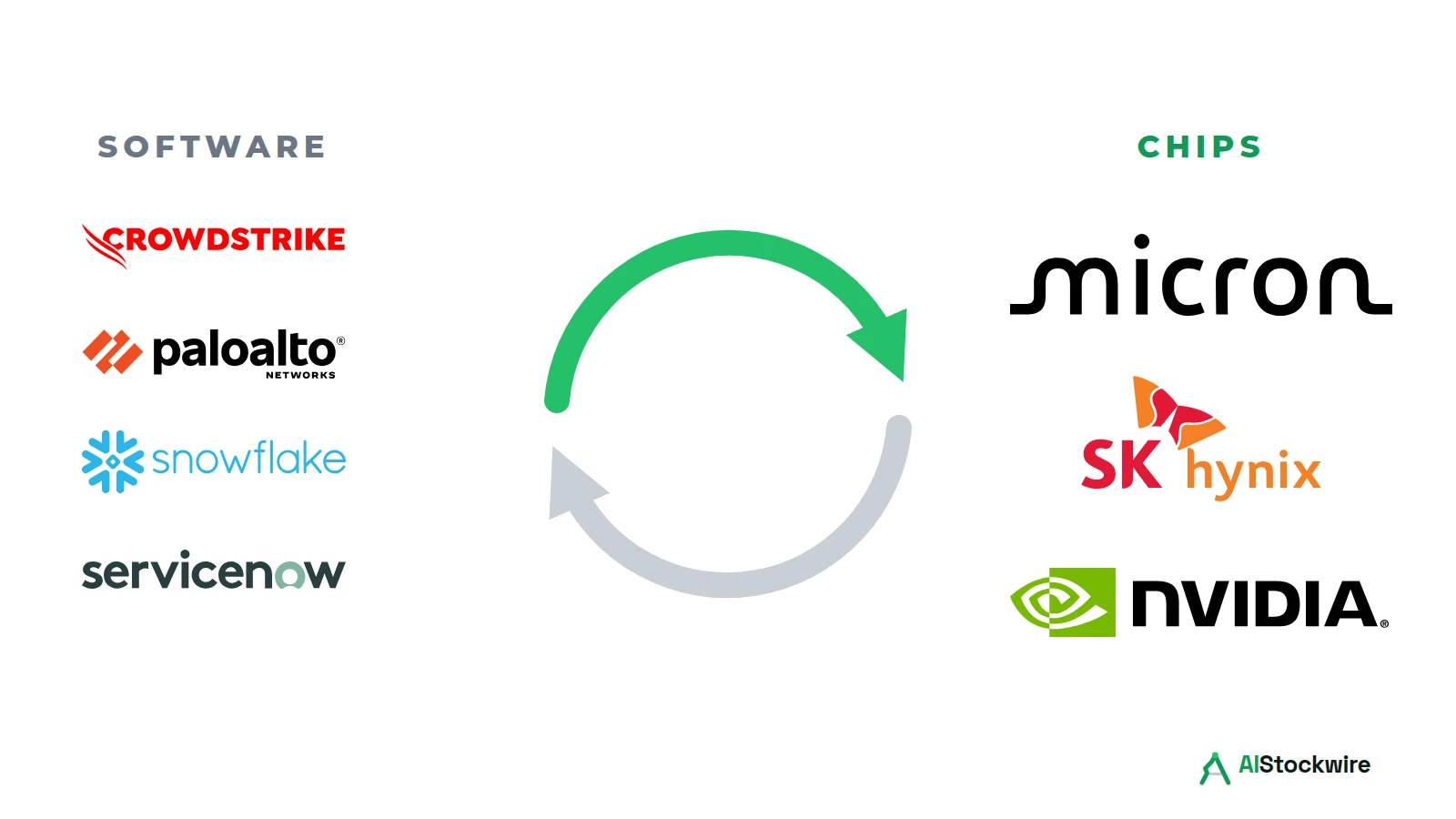
Since then, software has pulled ahead. From June 30 through Oct. 2, IGV rose 19.7% while SOXX fell 8.1%, a gap of 27.8 percentage points. First Trust's cybersecurity ETF (CIBR) gained 16.5% over the same period. I think earnings season could bring buyers back to chips, but companies will have to deliver the results and guidance to justify it.
| ETF | Dec 31 to June 30 | June 30 to Oct 2 |
|---|---|---|
| Semiconductors (SOXX) | +112.8% | -8.1% |
| Software (IGV) | -14.3% | +19.7% |
| Cybersecurity (CIBR) | +25.8% | +16.5% |
| S&P 500 (SPY) | +9.5% | +3.1% |
Price returns from Yahoo Finance closing prices, not including dividends. The first column starts from the December 31, 2025 close.
Goldman Sachs has a name for it. Peter Callahan, a US tech, media and telecom sector specialist in Goldman's FICC and Equities business, called it "much more of a stock picker's market" on the firm's The Markets podcast, recorded September 30.
"For the first couple of years when people said AI, they just said semiconductors, kind of CapEx beta," he said. "In the last couple of months, you've really started to see more focus up the stack." He named infrastructure software, security software, data infrastructure and agentic commerce.
The easy money in AI is over. For two years you could own the chip group and let it do the work for you. Now you have to be right about which company.
I've been watching this since August
None of this showed up out of nowhere. In August, I wrote that the AI trade was rotating to a new sector almost every week. On September 21, the Nasdaq closed at a record on a day when 30 S&P 500 stocks hit new 52-week lows and only seven hit new highs.
Callahan raised the same concern about market breadth. "There's a lot more dispersion, which could be euphemism for bad market breadth, right?" he said. I respect a guy who says that out loud on his own firm's podcast.
Goldman's strategists see the AI earnings boost fading
AI investment accounts for almost half of the S&P 500's earnings growth this year, according to Goldman research published September 23. The biggest US cloud companies are on track to spend $800 billion on capital expenditures, up 94% from 2025. That spending flows into revenue for chipmakers and other suppliers.
But Goldman expects spending growth to slow while depreciation charges on the equipment keep climbing. By 2028, it expects AI investment to become a small drag on S&P 500 earnings growth. Chipmakers face another limit: memory producers' gross margins are around 80%, more than twice their historical average. "Margin expansion has accounted for a large share of recent semiconductor earnings growth, but that boost should fade going forward," wrote Ben Snider, Goldman's chief US equity strategist.
That's the part I wouldn't ignore. Today's spending is lifting suppliers' profits while adding costs that buyers will recognize for years. Goldman expects productivity gains from using AI to become more important as the spending boost fades. Snider still expects earnings growth to "decelerate, not collapse," and Goldman has a 12-month S&P 500 target of 8,700.
I think earnings send the money back to chips
My call is about the next earnings season. I think strong chip results and guidance can bring buyers back, even if Goldman's longer-term warning proves right. I'm expecting beats across the high-beta names, the ones that move the most in both directions. Callahan is watching semiconductors heading into earnings too. "I'll be watching for semiconductors into 3Q earnings to hopefully find its footing again," he said.
Micron's latest report is one reason I'm leaning that way. Micron (MU) beat revenue and earnings estimates on September 30 and forecast another record quarter. Some of that rotation may already be underway, too. SOXX rose 11.3% in September.
Not everybody's on board. Michael Burry just swapped his Nvidia (NVDA) and Micron shorts for put options, betting the AI bubble bursts within a year. He did the same with the iShares Semiconductor ETF, the same SOXX in my table. I think he's early.
A rotation back to chips still won't bring back the easy money, though. Callahan said the Nasdaq's valuation multiple has compressed about 20% this year with the 10-year Treasury yield above 5.25%, which puts "more pressure on earnings to do the heavy lifting rather than multiple." In a market like that, beating estimates may not be enough. Guidance has to give investors a reason to expect more growth.
Third-quarter earnings start in the middle of October. Callahan called them the "numerical measuring stick" for whether the AI spending is paying off. This time the answer comes one company at a time.
I am not a financial advisor, and nothing here is investment advice.