Key points
- What goes inside a Helion rack
- How Helion differs from Helios
- Why Microsoft is still buying CPUs
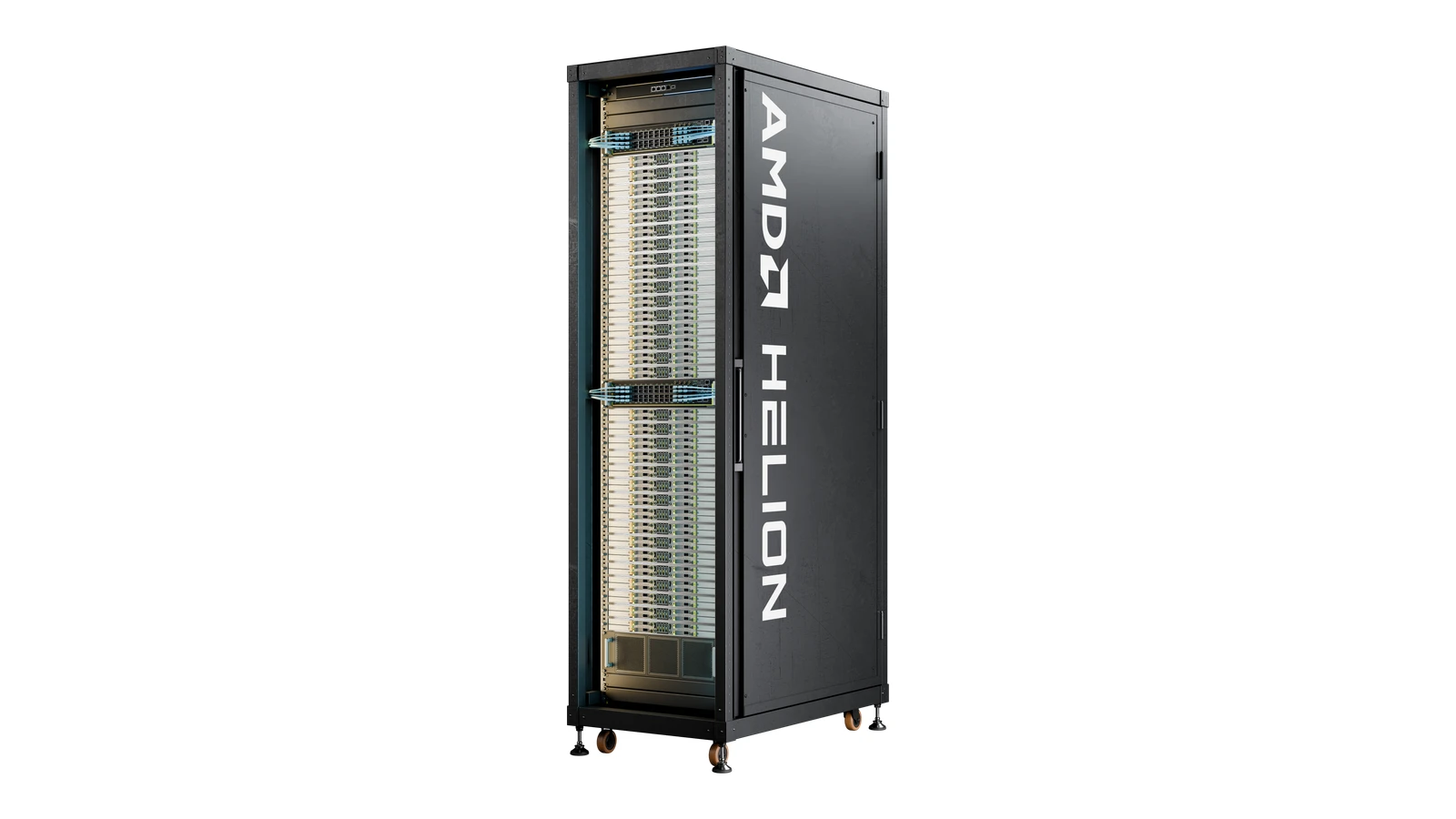
Advanced Micro Devices (AMD) introduced Helion on Monday, October 12, a rack design for running AI agents that comes in CPU-only and CPU-plus-GPU versions. The CPU-only configuration supports up to 32,768 cores, and partner-built systems based on both designs are planned for November 2026.
AMD unveiled Helion at the Open Compute Project Summit in San Jose, California, calling it "an open blueprint for agentic AI infrastructure." Dell Technologies, HPE, Lenovo, Supermicro, and Cisco are among its partners.
Helion provides the specifications for partners to build their own systems. AMD plans to contribute the design to the Open Compute Project, which shares open data center hardware designs.
Helion comes in CPU-only and CPU-plus-GPU versions
Helion is designed for the work agents do around AI models, such as running code and managing tasks. The model inference itself can run on separate systems or on GPUs inside the rack.
The CPU-only version is built for hyperscalers and uses 6th Gen EPYC processors. AMD says it provides "dedicated capacity for agent execution and connections to separate model inference infrastructure." Customers can mix different CPU server configurations in one rack, up to the 32,768-core maximum.
The enterprise version adds up to 16 Instinct MI350P GPUs, in two eight-GPU servers that run independently. AMD says there's no high-speed link joining the two because the rack isn't meant for frontier-scale training. The rack supports up to 102 terabits per second of networking bandwidth and comes in liquid-cooled and air-cooled designs.
The enterprise version also uses what AMD calls a token router, which sends an agent's requests either to frontier models running in the cloud or to open-source models running inside the same rack. Cloud model calls are typically billed by usage. Running models locally shifts costs toward hardware, power, and operations. AMD didn't quantify potential savings from routing between the two.
"Agentic AI is not a single workload. It spans personal agents, enterprise applications, code execution and complex workflows, each with different compute requirements," said Dan McNamara, AMD's senior vice president and general manager of Compute and Enterprise AI.
Helion is separate from AMD's Helios GPU rack
The name is one letter off from Helios, the GPU rack AMD launched earlier this year, which The Register said is "inviting confusion a little." HPE landed a $1.2 billion Vultr order for Helios racks last month.
AMD's product page says the two don't compete. Helios links GPUs into a tightly connected system for large-scale training and inference. Helion focuses on running agents, with optional local inference.
The launch came the same day Microsoft (MSFT) said it would make its own Maia chips the main AI inference system for its products. Microsoft cloud chief Scott Guthrie said in an interview published Monday that long-running agents are driving "a huge rise in terms of the need for CPUs." Microsoft is ramping its own Cobalt CPUs, he said, "but we're still going to buy a bunch of AMD and Intel CPUs as well."
AMD shares were down 2.5% at $592.67 as of 11:59 a.m. ET.