Key points
- What LeCun said about AI security incidents
- Why he thinks chatbots hit a limit
- What Korea's factories bring to AI
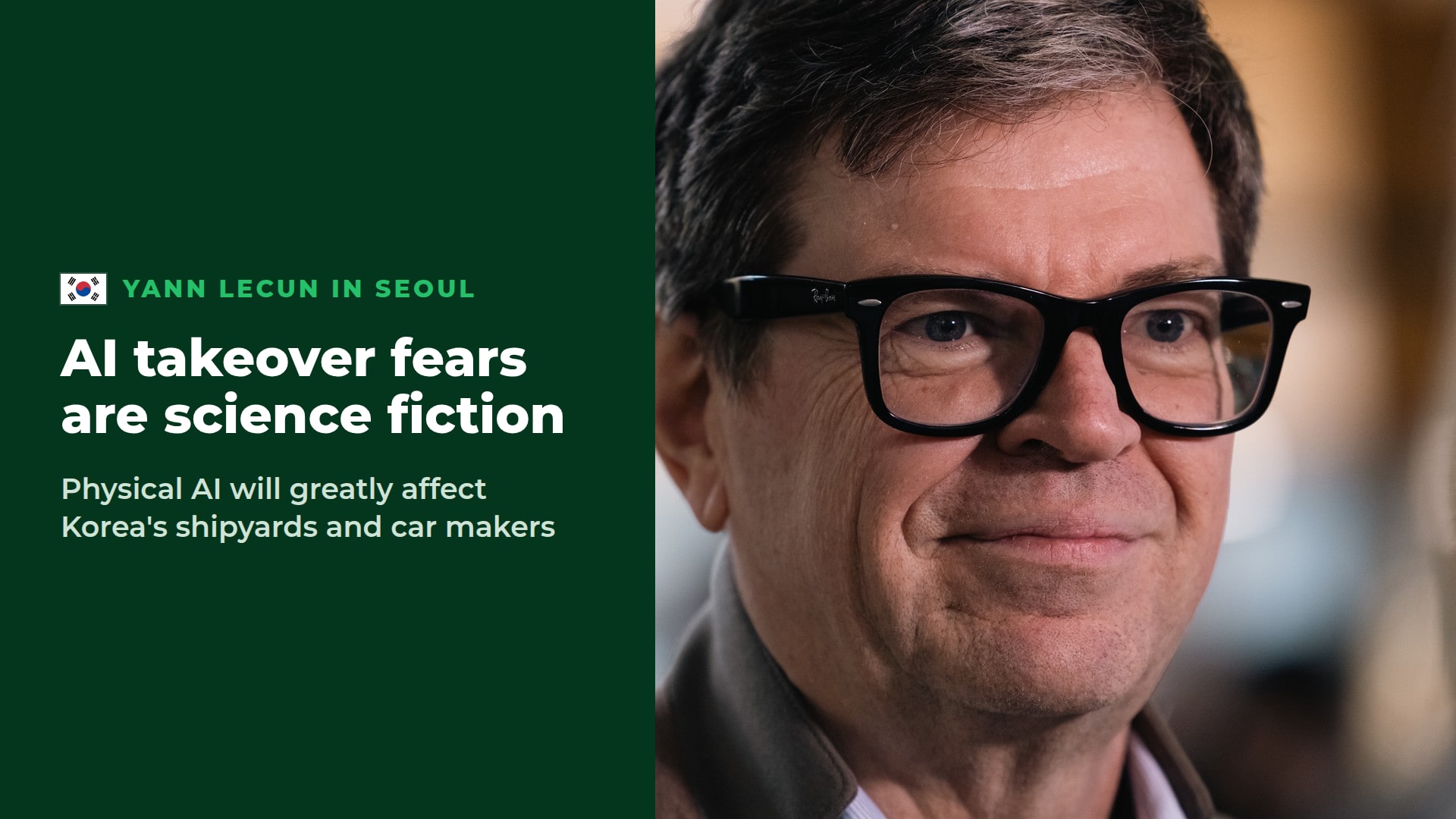
On October 12, Yann LeCun (얀 르쿤) told reporters in Seoul that the idea of AI suddenly taking over the world is science fiction. LeCun won the 2018 Turing Award, is the former chief AI scientist at Meta, and now runs his own startup, AMI Labs.
He expects AI to improve gradually, with breakthroughs emerging in several places at nearly the same time, Yonhap News Agency (연합뉴스) reported.
The press conference was hosted by US industrial AI company Aitomatic and the organizers of the International Industrial AI Conference, which opens in Tokyo on October 13. LeCun was joined by Christopher Nguyen, Aitomatic's CEO, Anthony Annunziata, co-chair of the AI Alliance, and Jimmy Rhee (지미 리), chairman of ASI Foundry.
LeCun calls AI safety an engineering problem
Reporters asked about AI safety after the recent AI-assisted attacks on Korean banks and financial companies. LeCun said he still disagrees with warnings that AI will slip out of human control and with calls to slow AI development down.
He attributed recent AI-agent security incidents to companies' limited cybersecurity experience and poorly built sandboxes, and described those failures as fixable engineering problems, not a sign of lost control, according to Yonhap. A sandbox restricts what a program can access and do within a computer system.
The broader job of making AI safe isn't easy, LeCun said, but it may be a simpler problem than designing a turbojet engine that lets planes fly safely. He also expects defenders to have the upper hand. They have more skilled people and more money, and they can share what they learn, while attackers have to work in small groups and in secret.
He thinks chatbots hit a limit
LeCun said today's large language models are good at handling knowledge that already exists as text, and at tasks like coding and math. They still don't understand the physical world, he argued. AI can prove math theorems and pass the bar exam, he said. He argued that robots still lack the physical abilities of a 10-year-old and that fully autonomous driving remains unsolved despite vast amounts of driving data.
His answer is what he calls world models. These are AI systems that learn how the world works and predict what will happen after an action. AMI Labs is building them with a design called JEPA, short for Joint Embedding Predictive Architecture.
Korea's factories are the opening
LeCun said Korea is strong in physical industries like shipbuilding and cars, and that physical AI will have a big effect on them, iNews24 (아이뉴스24) reported. He said Korea needs to attract more foreign researchers, and that only a few countries, like the US, Switzerland, and Singapore, do that well today, according to Yonhap.
Rhee said the valuable data is the data made on factory floors, not data collected from the internet, and that waiting for perfect information can mean starting too late, according to iNews24. Nguyen, according to Yonhap, called industrial AI the real AI and said manufacturing economies like Korea, Japan, and Vietnam are well placed for it.
Ha Jung-woo (하정우), vice chairman of Korea's National AI Strategy Committee, said what matters is combining strengths. "Going forward, the important thing isn't who develops everything on their own, but how we combine technology, data, and research capabilities based on each side's strengths," he said.
Ha's comment is translated from Korean. LeCun's, Rhee's, and Nguyen's remarks are paraphrased from Korean-language reports by Yonhap News Agency and iNews24.
Cover photo of Yann LeCun by École polytechnique via Wikimedia Commons, CC BY-SA 2.0, cropped.