Key points
- Bain says AI needs $6 trillion in annual revenue
- New markets would have to cover most of it
- Bain leaves part of the gap unexplained
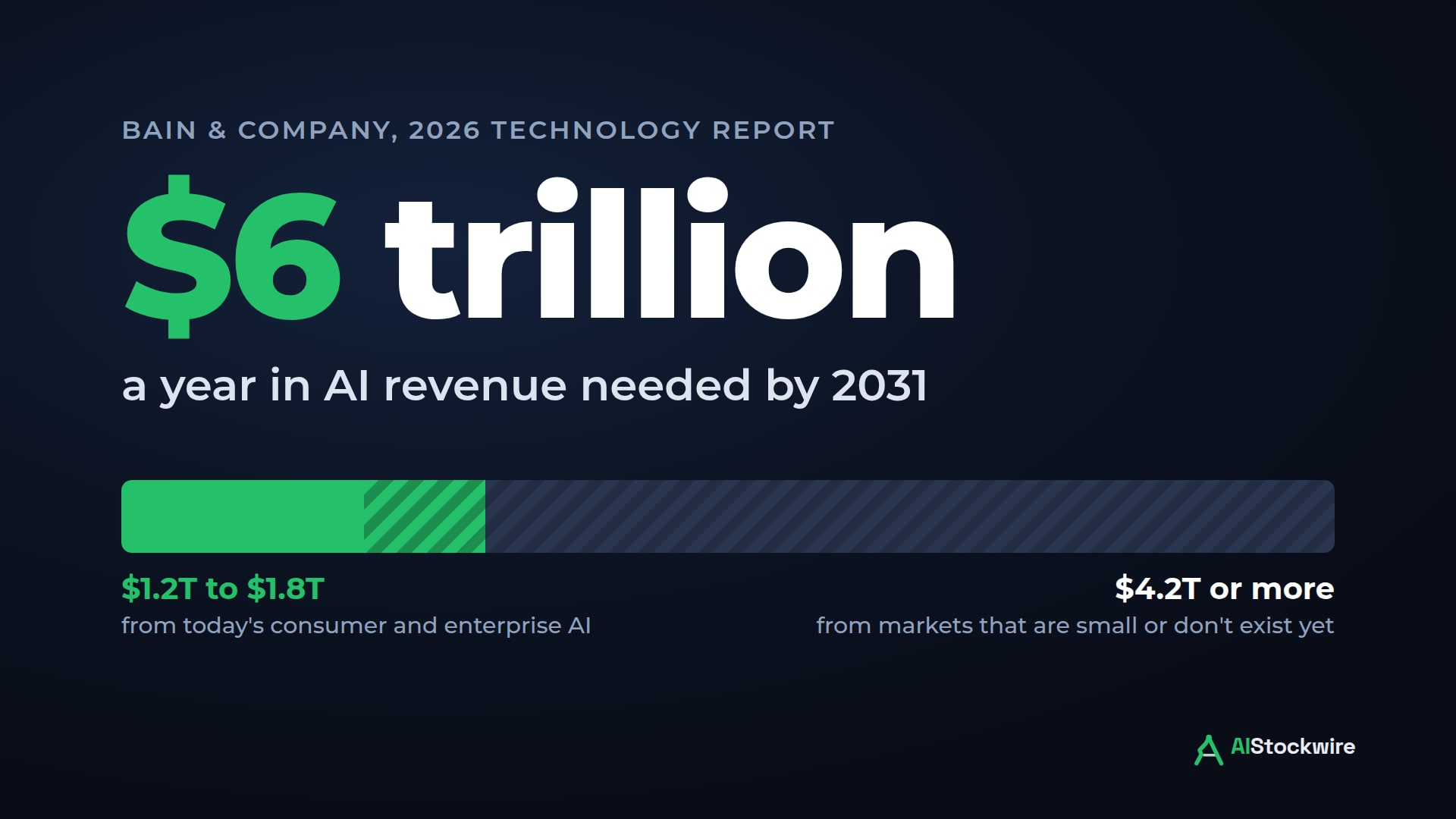
The AI industry would need close to $6 trillion in annual revenue by 2031 to fund its infrastructure buildout, Bain & Company estimated in its 2026 Technology Report, published Tuesday. Bain expects consumer and enterprise AI to bring in $1.2 trillion to $1.8 trillion of that.
That leaves at least $4.2 trillion a year to come from markets that are small today or don't yet exist. "Productivity gains from existing enterprise and consumer applications won't be enough," the report says.
How did Bain get to $6 trillion?
It starts with spending. Bain estimates annual spending on AI infrastructure could reach $1.5 trillion by 2031, covering new data centers and compute as well as upgrades to installed GPUs, memory, and networking gear.
Bain then assumes capital spending runs at about 25% of industry revenue, which Bain calls "an ambitious but reasonable percentage based on trends among cloud providers." Divide $1.5 trillion by 25%, and you get $6 trillion.
Spending by the largest cloud providers is already accelerating. Capital expenditures at Microsoft (MSFT), Alphabet (GOOGL), Amazon (AMZN), Meta Platforms (META), and Oracle (ORCL) could reach $780 billion in 2026, Bain says, nearly five times the level of three years earlier.
Why did the number triple in a year?
Bain used the same math last year. Its 2025 report said $500 billion of annual data center spending would correspond to $2 trillion in annual revenue, with a 2030 horizon. The ratio was the same 25%.
The spending estimate tripled, while the forecast horizon moved from 2030 to 2031. Using the same 25% ratio, Bain's implied revenue requirement tripled too.
Where would the revenue come from?
Consumer AI subscriptions and advertising could generate $200 billion to $400 billion by 2031. Enterprise AI could add $1 trillion to $1.4 trillion in revenue to providers, from software development, sales, marketing, customer service, and IT operations.
Bain names four places the rest could come from. Chatbot ads and AI replacing traditional search could bring $100 billion to $200 billion or more. Autonomous vehicles, trucks, drones, and other industrial automation make up a $400 billion opportunity. Physical AI, including digital twins and robotics, could be worth $900 billion, assuming a 10% cut in R&D and manufacturing costs.
The fourth category is new products, such as AI-driven drug discovery, mental health support, and materials science. Bain gives estimates for three of those categories but leaves new products unquantified. The three it sizes add up to about $1.4 trillion to $1.5 trillion or more, against a gap of at least $4.2 trillion.
What does Bain say needs to happen?
Funding the buildout sustainably would require adding approximately 1% to the annual global GDP growth rate, according to the report. "The question is whether the applications arrive in time to pay for it," Bain wrote.
Suppliers are already securing commitments that stretch into the next decade. Micron (MU) disclosed Wednesday about $150 billion in contracted future revenue from customer agreements running through 2030 and beyond. We've mapped how money loops between AI labs and their suppliers, and compared today's AI market with the 2000 bubble.