Key points
- Anthropic has four investor-and-supplier loops
- Nvidia hardware is named in only one of them
- Most of the money in is conditional
- Only two loops disclose the money going back
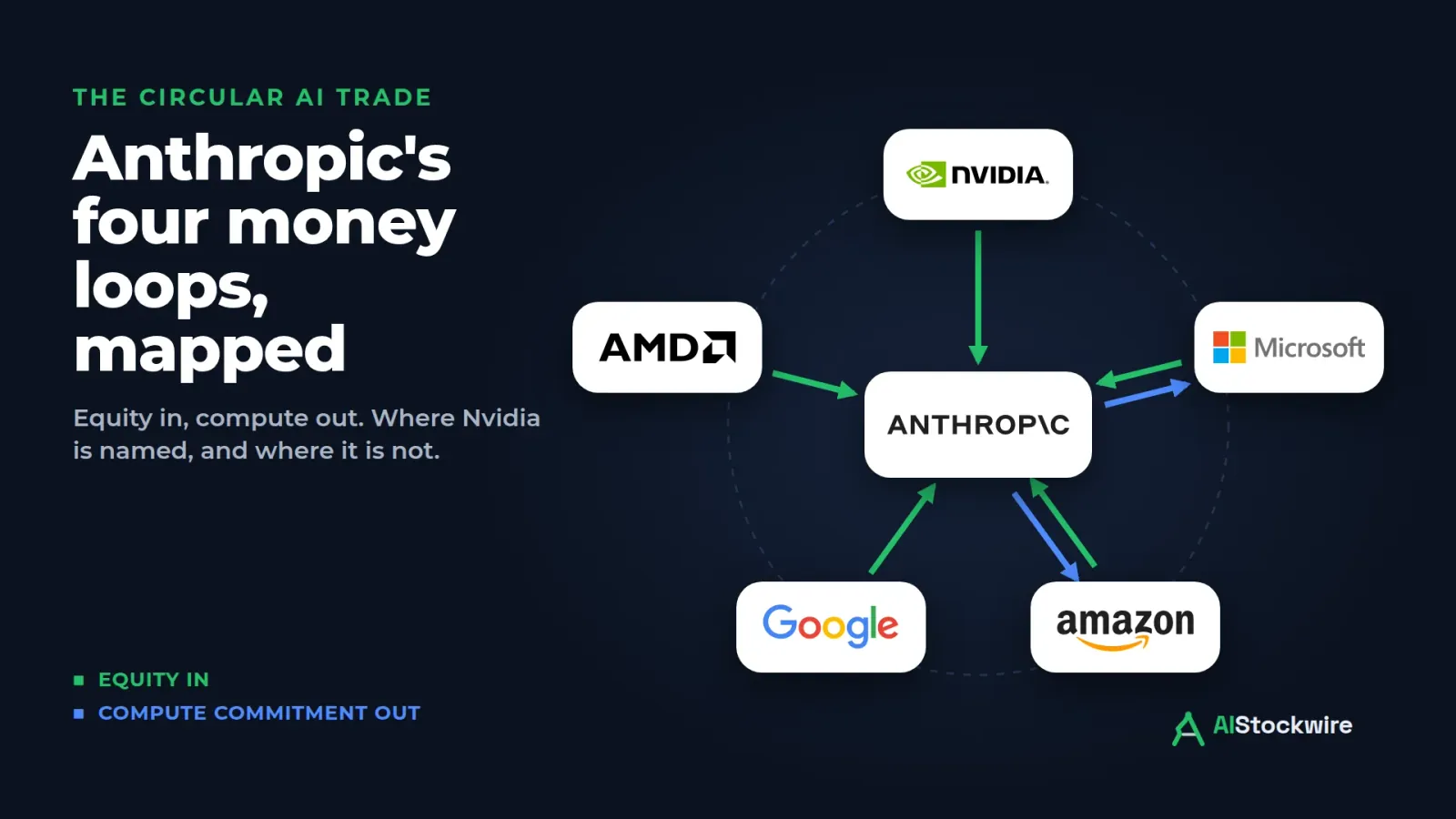
The circular AI trade, as usually described, goes like this: Nvidia (NVDA) invests in an AI lab, the lab rents computing from a cloud provider, and the cloud provider buys Nvidia chips to supply it. Anthropic is the cleanest place to test that description, because the company has published the terms of four such arrangements in eight months. Nvidia hardware is expressly named in only the Microsoft arrangement, and only two of the four disclose a dollar figure for what Anthropic buys back.
This piece maps all four with the disclosed figures, then names the point in each loop where the money stops being circular. The figures come from the companies' own announcements, with one estimate from The Information flagged as such.
The loop that matches the description
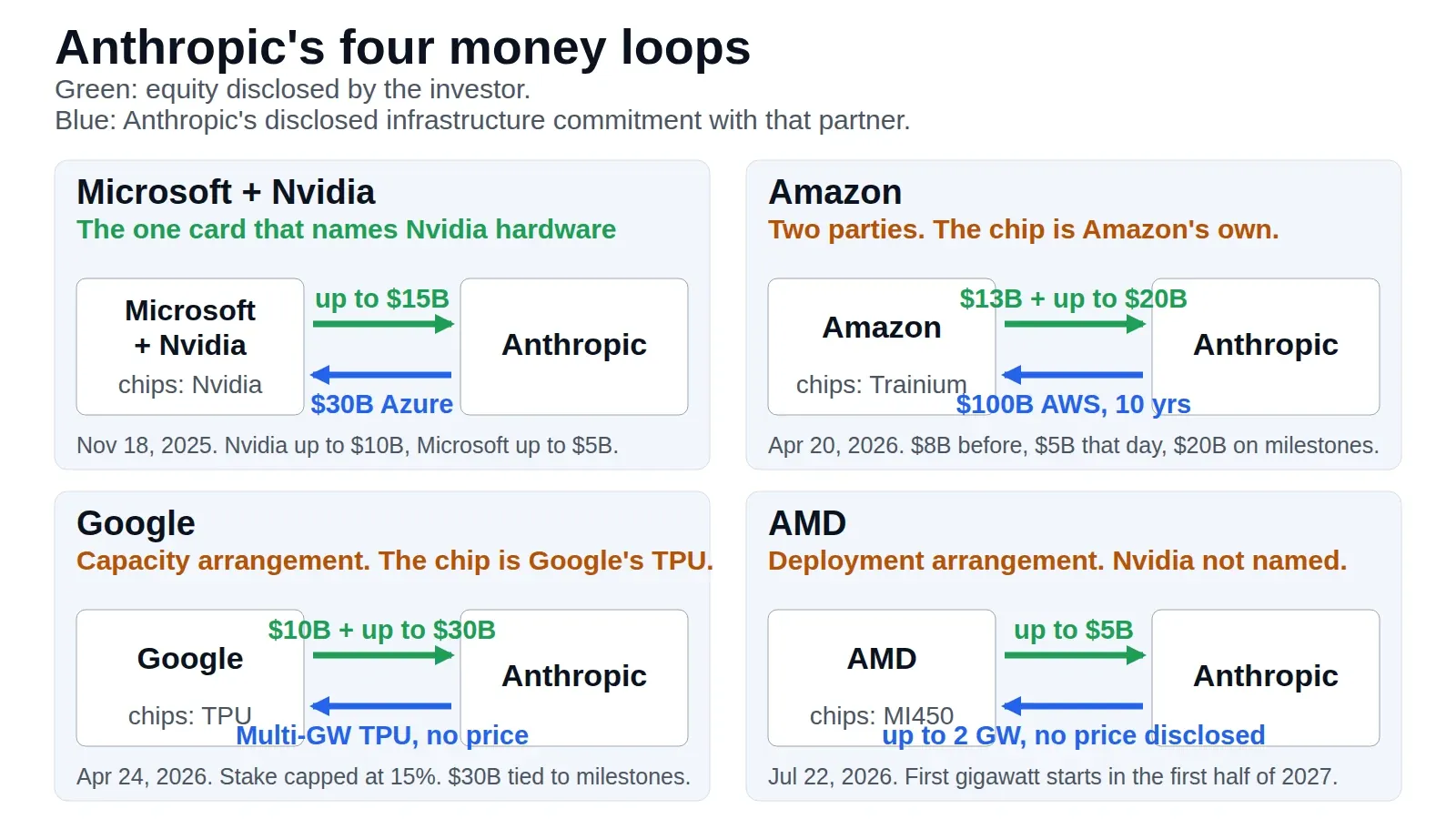
On November 18, 2025, Anthropic, Microsoft and Nvidia announced a three-way arrangement. Nvidia committed to invest up to $10 billion in Anthropic. Microsoft (MSFT) committed up to $5 billion. Anthropic "has committed to purchase $30 billion of Azure compute capacity and to contract additional compute capacity up to one gigawatt," the announcement said, on Azure systems that run Nvidia's Grace Blackwell and Vera Rubin chips.
That's the textbook loop. Nvidia puts money into a customer, the customer sends twice as much to a cloud, and the cloud spends part of that on Nvidia hardware. Nothing about the arithmetic is hidden: up to $15 billion goes in, and $30 billion comes back out as a purchase commitment.
Two details keep it from being as circular as it reads. The $15 billion is "up to" on both halves, and Nvidia's November 2025 quarterly filing said there was "no assurance" it would reach definitive agreements on its planned investments, naming the Anthropic commitment alongside OpenAI and Intel. The $30 billion Azure purchase, by contrast, is a commitment Anthropic works through as it uses the capacity, not a bill due at signing.
Three loops with no Nvidia in them
Amazon (AMZN) is Anthropic's largest investor and one of its two largest suppliers, and the chip underneath is Amazon's own. On April 20, 2026, Anthropic said Amazon was investing $5 billion that day, with up to $20 billion more in the future, on top of the $8 billion Amazon had already put in. In the same announcement Anthropic committed "more than $100 billion over the next ten years to AWS technologies, securing up to 5GW of new capacity," and said it already ran Claude on more than one million of Amazon's Trainium2 chips.
Google parent Alphabet (GOOGL) followed four days later. CNBC reported Google would invest $10 billion immediately and up to $30 billion more on performance milestones, with its stake capped at 15%. Google Cloud will make 5 gigawatts of capacity available to Anthropic over five years, on Google's TPUs, which Broadcom (AVGO) helps build. That's a capacity arrangement. Neither company has disclosed a price, or a dollar amount Anthropic is obligated to pay.
Advanced Micro Devices (AMD) closed the set on July 22, 2026. AMD committed to a strategic equity investment of up to $5 billion, and the two companies agreed to deploy up to 2 gigawatts of AMD's Instinct MI450 chips, with the first gigawatt starting in the first half of 2027. That's a deployment arrangement, not a disclosed purchase obligation. No dollar value was attached to the chips.
In each of these three, the investor and the chipmaker are the same company. There's no third party for the money to circle back through. Amazon's equity dollars return as AWS revenue, and the hardware AWS buys to serve Anthropic is hardware Amazon designed. The same structure holds for Google and TPUs, and for AMD and MI450, though in those two cases the public disclosures do not let a reader calculate the money flowing back. Nvidia hardware is not named in any of the three.
Where each loop breaks
A loop is only circular if the money on both sides can be seen. The table shows what each side has disclosed.
| Investor | Equity disclosed | Anthropic infrastructure commitment |
|---|---|---|
| Microsoft + Nvidia | Up to $15B | $30B Azure purchase commitment |
| Amazon | $13B invested; up to $20B more | More than $100B AWS commitment over 10 years |
| $10B invested; up to $30B more | Multiple GW of TPU capacity; no price disclosed | |
| AMD | Up to $5B | Up to 2 GW of MI450 deployment; no price disclosed |
The equity side is conditional, staged or capped with "up to" in every row. The infrastructure side splits in two. Microsoft and Amazon carry a dollar purchase commitment Anthropic is publicly obligated to pay. Google and AMD carry a capacity arrangement, and the public disclosures do not let a reader calculate the money flowing back. Of the $93 billion of equity across the four announcements, about $23 billion was described as paid at the time of announcement, and about $70 billion depends on milestones the companies have not published or on "up to" terms. Anthropic's side includes $130 billion of stated purchase commitments to Microsoft and Amazon alone, and the Google and AMD figures would come on top of that.
That asymmetry is the first break, and Microsoft and Amazon are the two rows that show it. The circular description assumes the investment funds the purchase. In those two cases the purchases are larger than the investments and less conditional, so the difference has to come from somewhere else. Anthropic told investors its annualized revenue run rate topped $65 billion by the end of July 2026, CNBC reported, up from about $9 billion at the end of 2025. Customers who are not also investors are the part of the loop that makes it stop being a loop. Meta Platforms (META), which holds no Anthropic stake, projected internally that it could spend up to $10 billion a year on Anthropic's models, according to the New York Times.
The second break is the chip, and Google and AMD are the rows that show it. Nvidia's exposure to Anthropic runs through Microsoft's $30 billion and through whatever Nvidia hardware the private clouds in Anthropic's supplier list buy. The Amazon, Google and AMD arrangements are built around chips Nvidia doesn't sell. The Information's estimate puts Anthropic's total compute agreements at as much as $517 billion over about a decade, with Amazon and Google carrying more than $300 billion of it. Anthropic has not confirmed that total, but the split it implies is the point: the majority of Anthropic's compute spending is a two-party arrangement between Anthropic and a chipmaker that is also its shareholder, and Nvidia is outside it.
The third break is timing. Google's TPU capacity starts in 2027. AMD's first gigawatt starts in the first half of 2027. Amazon's $100 billion is spread over ten years. A loop drawn as arrows on one page suggests money moving at once. The announcements describe money moving across a decade, against milestones on one side and usage on the other.
What this framework does with the next announcement
Every new AI financing deal can be placed on the same diagram by asking three questions. Who invested, and is the figure paid or "up to"? What infrastructure commitment did the recipient disclose with that investor, and is it a dollar amount, a capacity figure or nothing? Whose chip is in the box, and is that chipmaker also the investor?
Nvidia's arrangement with OpenAI, the other loop that gets drawn most often, answers those questions differently from any Anthropic leg. Nvidia put $30 billion of equity into OpenAI in February 2026 as a direct stake. On August 17 it signed residual value guaranties capped at $105 billion covering about 4.25 gigawatts of OpenAI's data center leases, triggered only if OpenAI misses lease payments. That's a guarantee, not a purchase commitment, and it sits on Nvidia's side of the loop rather than OpenAI's. Nvidia is also weighing up to $10 billion more in Anthropic, this time as an anchor investor in the IPO, Reuters reported on September 11. Anthropic's public filing, expected in late September, should give the first full account of how much of the equity above has actually been funded.