Key points
- Facebook capped us at two link posts a month
- Meta's $499 Max plan offers unlimited links
- Ads still fund most of the buildout
Meta (META) is asking businesses to pay up to $499 a month for extra tools across Facebook, Instagram, and WhatsApp. For some Facebook Pages, the pitch includes something more basic: the ability to keep posting links.
I run a publishing site, so this caught my attention. It also raised a question: how much can subscriptions contribute to Meta's AI buildout? Even an ambitious sales scenario would cover only a fraction of its infrastructure spending.
Meta launched Meta One on Sept. 15. Its creator and business plans range from Essential at $14.99 a month to Advanced at $49.99, Expert at $149, and Max at $499. Essential includes a verified badge and impersonation protection. Advanced adds "links in organic posts and reels," according to Meta's announcement.
That feature matters because Meta has been testing restrictions on outside links since December. Some Facebook Pages and profiles in professional mode were limited to two link posts a month unless they paid for Meta Verified.
"This is a limited test to understand whether the ability to publish an increased volume of posts with links adds additional value for Meta Verified subscribers," a Meta spokesperson said at the time.
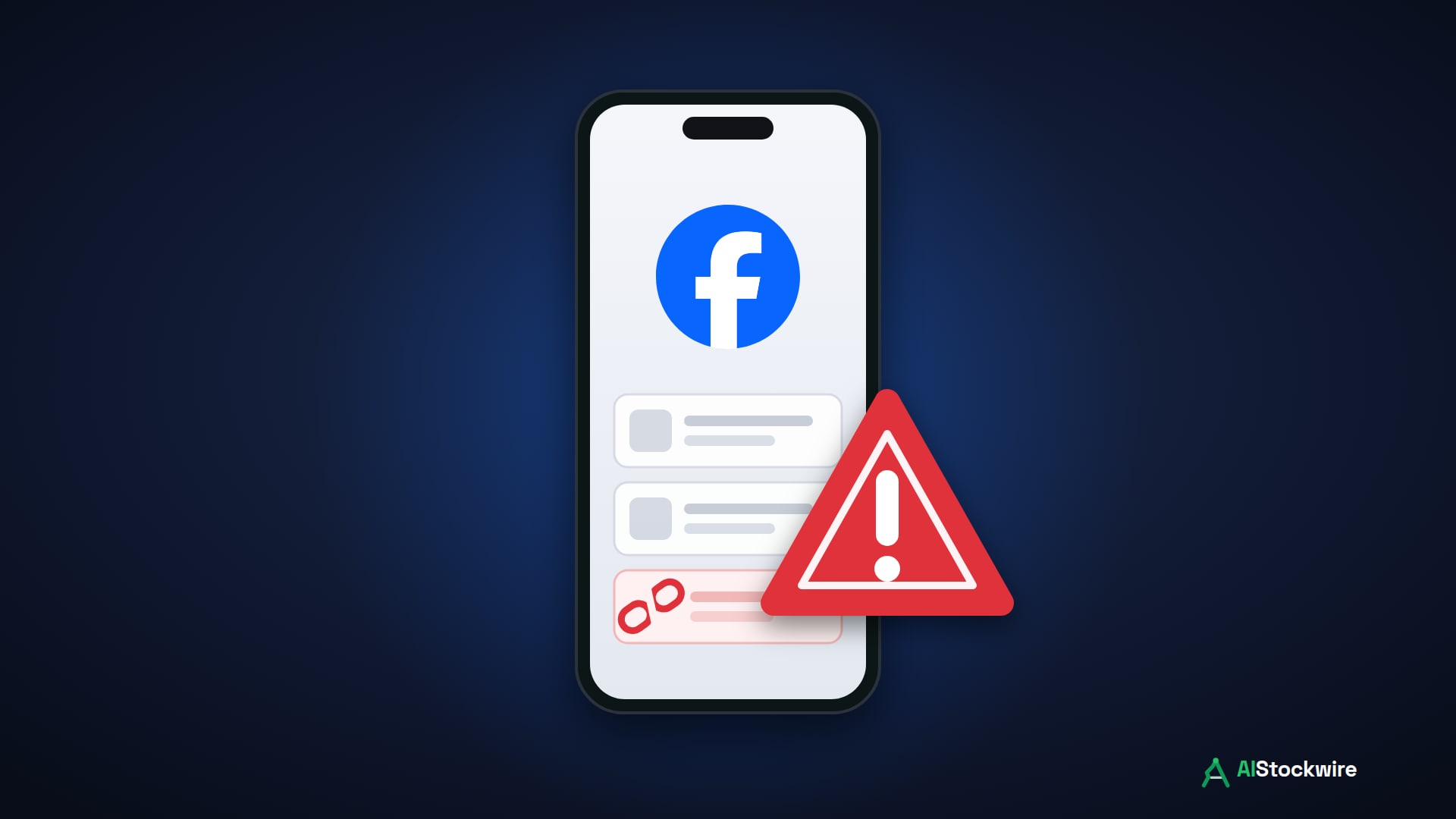
Facebook now limits our account to two link posts a month. When the test began in December, TechCrunch reported that news publishers were exempt. Our account is subject to the cap, and after my second link post, Facebook showed me this notice.
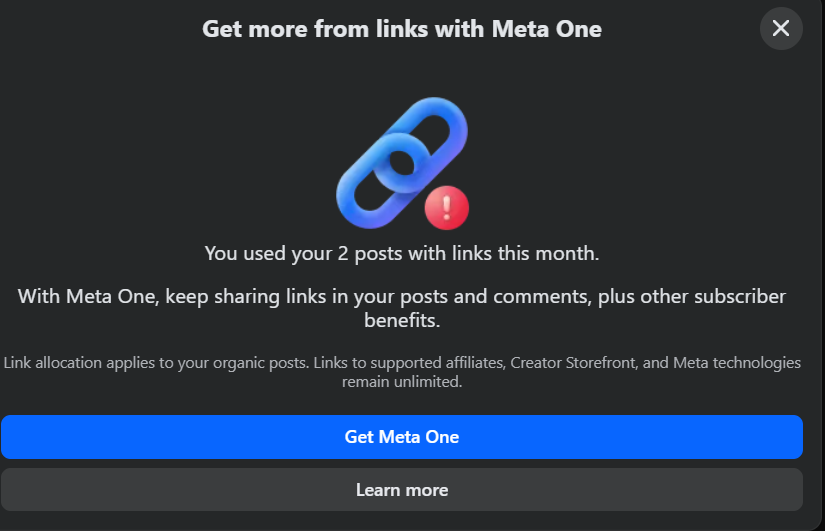
The notice says Meta One lets me "keep sharing links in your posts and comments." The December test had excluded comments, but Meta's help page now counts links in Page comments toward the limit, except extra links under a post that already has one. Links to "supported affiliates, Creator Storefront, and Meta technologies remain unlimited," the notice says.
Meta's help page on Page links lays out the allowance by plan. Essential at $14.99 stays at two posts or comments with links a month. Advanced at $49.99 allows eight, Expert allows 20, and Max is unlimited. We publish more than 10 articles a day, so only Max would cover our output.
| Plan | Monthly price | Posts or comments with links per month |
|---|---|---|
| Free | $0 | 2 |
| Essential | $14.99 | 2 |
| Advanced | $49.99 | 8 |
| Expert | $149 | 20 |
| Max | $499 | Unlimited |
Link allowances from Meta's Facebook Help Center, which says the limits may not apply to all Pages. Prices from Meta's plans page, per Facebook Page.
Consumer plans range from $2.99 a month for WhatsApp Plus to $19.99 for the Premium bundle. Muse, Meta's AI agent, has separate paid plans at $20 and $100 a month.
Now, about Meta's $145 billion spending plan
Meta expects to spend $130 billion to $145 billion on capital projects this year, including principal payments on finance leases. In the second quarter alone, that figure was $31.08 billion. Operating cash flow was about $31.9 billion, which left free cash flow of $784 million, down 91% from a year earlier.
Ads pay for almost all of it. Meta made $196.2 billion from advertising in 2025, about 98% of its $201 billion in revenue. Meta spent $72.2 billion on capex that year and still generated $43.6 billion in free cash flow. This year, Meta has made $114.4 billion from ads through June, and capex has reached $50.9 billion. Free cash flow for the first half is down to $13.2 billion, and nearly all of it came in the first quarter.
| Period | Ad revenue | Capex | Free cash flow |
|---|---|---|---|
| 2025 full year | $196.2B | $72.2B | $43.6B |
| Q1 2026 | $55.0B | $19.8B | $12.4B |
| Q2 2026 | $59.4B | $31.1B | $0.8B |
| First half 2026 | $114.4B | $50.9B | $13.2B |
Capex includes principal payments on finance leases. Source: Meta's quarterly earnings releases.
Everything else from the apps, which Meta reports as Family of Apps other revenue, came to $1.007 billion in the second quarter, up 73% from $583 million a year earlier. On the earnings call, CFO Susan Li said that growth was "driven primarily by WhatsApp paid messaging and subscriptions revenue."
Borrowing and outside partners cover part of the rest. Meta's long-term debt stood at $83.7 billion on June 30, against $90.3 billion of cash and marketable securities. For its biggest campuses, Meta brings in outside owners. Funds managed by Blue Owl own 80% of the Hyperion campus in Louisiana, with Meta keeping 20% and leasing the buildings. In July, BlackRock raised $12.5 billion of debt for Meta's El Paso campus, with the bonds backed by 20 years of Meta's rent payments. Meta has also looked at borrowing in Korean won.
My math on Meta One
For publishers that post links throughout the day, Max is the only tier with enough allowance. For sites that get real traffic from Facebook, losing it could cost more than $499 a month, so I think plenty of them will pay.
Here's the back-of-the-envelope case I started with. Say 5 million businesses pay the full $499 monthly price for Max. That's about $2.5 billion a month, or roughly $30 billion a year. Add $500 million a month from consumer plans, and you get $36 billion a year in gross revenue, before any costs.
That's real money, and it would still equal only about a quarter of this year's capex at the top of Meta's range.
This is a hypothetical revenue scenario, not an estimate of current sales. Meta reported 15 million subscriptions and trials on Sept. 15, while the plans were still rolling out. Meta hasn't disclosed how many businesses are paying for Max, so the earlier count doesn't tell us how the $499 tier is doing. Before Meta One launched, Family of Apps other revenue was running at about $4 billion a year, or about 3% of this year's capex budget.
Analysts expect it to grow, just not to data-center scale. Truist has projected subscriptions could become a $20 billion business by 2030, with about 360 million paying subscribers. BNP Paribas estimates $13.5 billion in subscription sales by 2028. Instagram head Adam Mosseri described the goal more narrowly: "Subscriptions let us build things we otherwise couldn't, like features that are too specialized or too costly to bring to everyone."
Put all of that together, and Meta One could become a substantial revenue source, but even the optimistic subscription estimates remain well below Meta's infrastructure budget. Advertising is still Meta's main source of revenue. The third-quarter report will be the first financial update since Meta One launched, though the other-revenue line won't isolate its contribution. Meta shares closed at $725.18 on Wednesday, down 1.8%.