Key points
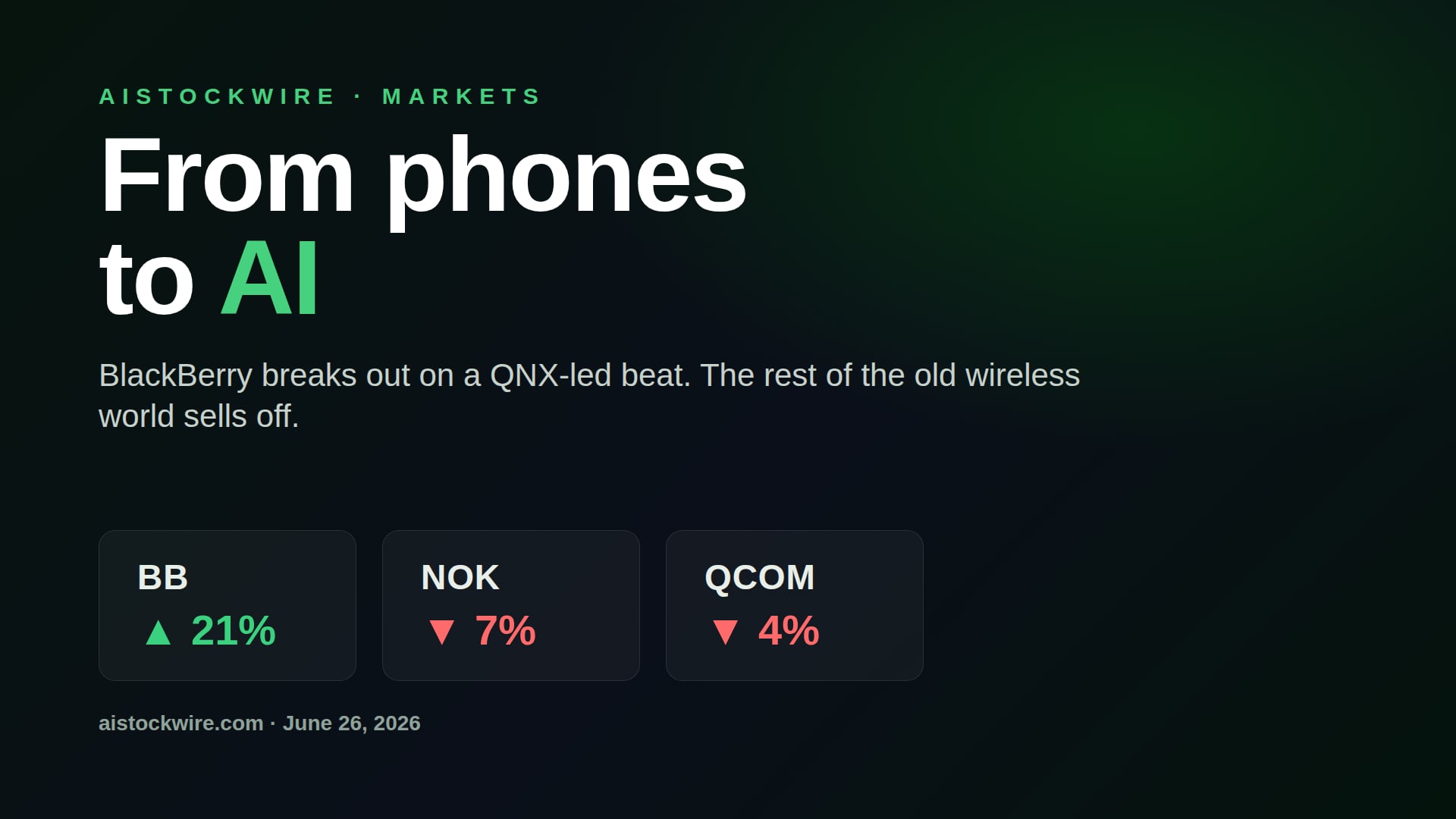
- BlackBerry (BB) jumped about 21% on June 25 and rose another 7% on June 26, trading near $11 after a fiscal first-quarter beat.
- Revenue was $152.9 million, up 26% from a year earlier and well above the $138 million analysts expected.
- QNX, its car-software unit, brought in $72.3 million with a backlog close to $1 billion, and management raised full-year guidance.
- The same day, Nokia (NOK) fell about 7% and Qualcomm (QCOM) about 4% in a broad chip selloff, with Skyworks (SWKS) and Qorvo (QRVO) also lower.
- Not every old phone name dropped: Apple (AAPL), Sony (SONY) and Motorola Solutions (MSI) closed higher, so the phone-to-AI trade is not moving as one.
For most of the last decade, BlackBerry (BB) was the company people pointed to when they wanted a story about missing the future. It owned the smartphone, then it did not. On Thursday it had its best day in years, and it had nothing to do with phones.
BlackBerry shares jumped about 21% on June 25 after the company reported fiscal first-quarter results, and they added roughly another 7% on June 26 to trade near $11. The driver was not nostalgia. It was QNX, the embedded operating system that now runs inside cars, and a set of numbers that beat what Wall Street had penciled in.
What BlackBerry actually reported
Revenue came in at $152.9 million for the quarter, up 26% from a year earlier and well ahead of the roughly $138 million analysts were looking for. Adjusted earnings were $0.04 a share, a penny better than the $0.03 consensus, and adjusted EBITDA more than doubled to $36.3 million.
The piece investors cared about most was QNX, the automotive and industrial software business. It posted $72.3 million in revenue, up 26%, with its own profit up about 52%. Management put the QNX backlog at close to $1 billion, which is the part that turns a single good quarter into a multi-year story. The company also raised its full-year outlook, guiding to $594 million to $621 million in revenue and $0.16 to $0.20 in adjusted earnings per share, plus about $100 million in operating cash flow and a larger buyback.
The phone-to-AI pivot, explained
Here is the simple version of why this matters. BlackBerry stopped making phones years ago. What it kept was the unglamorous software that has to work every time: the code that runs a car's dashboard, its driver-assistance features, and the safety functions that cannot crash. As cars turn into computers on wheels, that software is where a lot of the on-device, or edge, AI in a vehicle lives. QNX is now in more than 200 million cars. That is the pivot in one line. The phone is gone, and the company sells the operating system underneath the next thing.
It is the same move, with a different ending so far, that the other old phone names have been trying for years.
Why Nokia, Qualcomm and the chip names fell the same day
While BlackBerry climbed, most of the rest of the old wireless world had a rough Friday. Nokia (NOK) fell about 7% to around $12.94. Qualcomm (QCOM) dropped about 4% to roughly $196.58. The Apple radio-chip suppliers, Skyworks (SWKS) and Qorvo (QRVO), slid about 3% and 2%, and Ericsson (ERIC) was down about 1%.
Most of that was not company news. It was a broad semiconductor selloff. Chip stocks fell across the board on June 26 on worries about how much the AI buildout is costing, with Intel, Arm, Marvell and Sandisk all lower, and a report that OpenAI may push its IPO into next year added to the sour mood. In Asia, SK Hynix dropped more than 8% and Samsung about 9%. Qualcomm and the radio-chip names got swept up in that, the way most semiconductors did.
Nokia's drop was a little different. After a strong run this year on its networking and AI-infrastructure story, the stock had already been pulling back for weeks, and Friday looked more like profit-taking and a valuation reset than a fresh disaster. There was no new guidance cut. Its next real test is the July 23 earnings report.
So is "phone to AI" one trade? No.
This is the part worth being honest about. It would be clean to say the old phone makers are all sinking while BlackBerry wins, but that is not what the tape showed. Apple (AAPL) closed up about 2%, helped by a bounce in the megacaps and its on-device AI push. Sony (SONY), another former phone maker that reinvented itself around camera sensors, gaming and AI, rose about 2%. Motorola Solutions (MSI), which left consumer phones years ago for public-safety radios and AI-driven video, gained about 1.5%.
So the lesson is not "phones bad, AI good." It is that each of these companies is now its own bet on a specific corner of AI. BlackBerry is a bet on software inside cars. Qualcomm is a bet on AI moving onto the phone and into the car. Nokia is a bet on the network that AI runs over. They do not have to move together, and on June 26 they did not.
The cohort at a glance
| Company | Ticker | Price | June 26 | The pivot |
|---|---|---|---|---|
| BlackBerry | BB | $11.10 | +7.3% | Phones to QNX car software and secure messaging |
| Nokia | NOK | $12.94 | -7.4% | Phones to 5G and AI networks |
| Qualcomm | QCOM | $196.58 | -4.1% | Phone chips to AI, auto and IoT |
| Skyworks | SWKS | $67.79 | -3.1% | Radio chips for the iPhone |
| Qorvo | QRVO | $93.69 | -1.8% | Radio chips for the iPhone |
| Ericsson | ERIC | $10.95 | -1.0% | Telecom gear and AI networks |
| Apple | AAPL | $280.66 | +2.0% | Phones plus on-device AI |
| Sony | SONY | $19.74 | +2.2% | Phones to sensors, gaming and AI |
| Motorola Solutions | MSI | $403.04 | +1.5% | Phones to public-safety radios and AI |
Prices as of midday June 26, 2026.
Bottom line
BlackBerry's quarter was a genuine beat, and the QNX backlog gives it something it has not had in a long time: a reason to own it that points forward instead of back. That is why the stock moved. The rest of the old phone world falling on the same day was mostly the broader chip selloff, not a verdict on any one of them. If there is a takeaway, it is that the companies that survived losing the phone did it by becoming something specific, and the market is now grading those second acts one at a time.
For more on the selloff that hit the rest of the chip group that day, see our coverage of the memory selloff in Korea and our look at whether the AI trade has gotten ahead of itself. You can also track filings for BlackBerry (BB), Nokia (NOK) and Qualcomm (QCOM).
This article is for general informational purposes only and is not investment advice. Always do your own research and consider speaking with a licensed financial professional before making any investment decision.