Key points
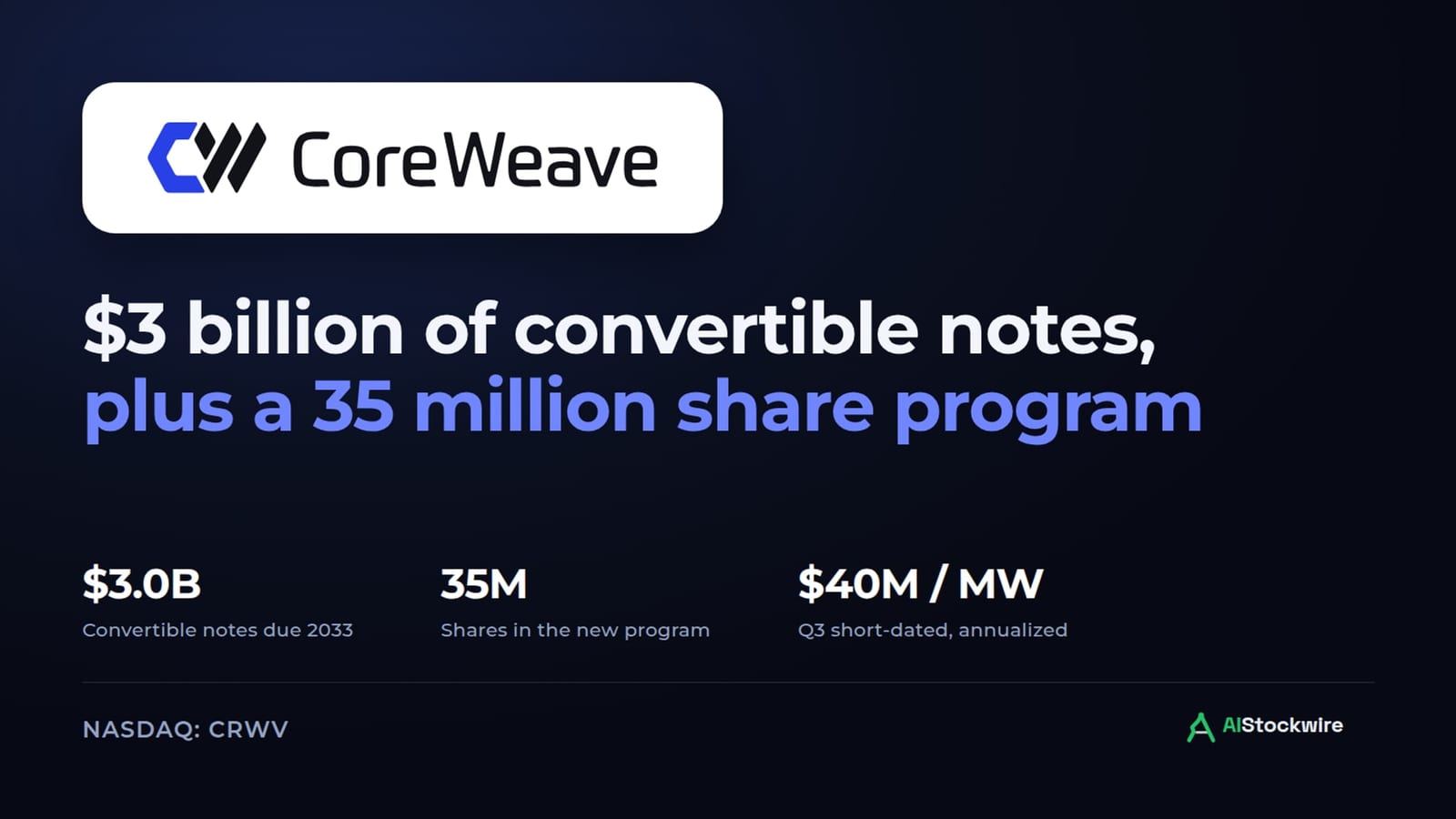
- CoreWeave (CRWV) plans a $3 billion convertible offering
- A 35 million share stock program lands the same day
- Q3 short-term contracts imply about $40M in annualized revenue per MW
- Its existing senior notes pay 8.5% to 9.75%
CoreWeave (CRWV) said Thursday it plans to sell $3 billion of convertible senior notes due 2033, and disclosed in the same filing that it has set up a program to sell as many as 35 million of its shares. Including the note option, the two programs represent about $6.4 billion of potential gross proceeds if all 35 million shares sell at Wednesday's closing price.
In the slide deck it put in front of the note buyers, the company said it is charging more for computing capacity than it was three months ago. The stock fell on the news. Shares traded at $78.85 as of 10:13 a.m. Eastern Thursday, down 5.4% from Wednesday's close of $83.35, with volume already past the 30-day average before midday.
The debt and stock offerings
The notes go to qualified institutional buyers in a private offering, and the initial purchasers get an option to buy another $500 million within 13 days of the first issue. They mature on April 1, 2033. CoreWeave can settle conversions in cash, in Class A stock, or in a mix of the two, at its own election. The interest rate and the initial conversion rate will be set when the offering prices, so neither is public yet, according to the press release.
The rate is the part worth watching, because CoreWeave's straight debt is expensive. The new notes will be guaranteed by the same subsidiaries that guarantee its 9.250% senior notes due 2030, its 9.000% and 9.750% notes due 2031, and its 9.625% and 8.500% notes due 2032. Its two existing convertible issues, due 2031 and 2032, both carry a 1.75% coupon.
CoreWeave plans to use part of the proceeds for options designed to reduce potential dilution from conversions, up to a specified share price. These capped call transactions sit alongside the notes and do not change the conversion price written into them. The rest of the money is for general corporate purposes. The company has not said where the cap will sit. On the $3.5 billion convertible it priced in April, the coupon came in at 1.75%, the conversion price at about $119.60, and the cap price at $230.00, which was 150% above the stock at the time.
The share program is the second half of it. CoreWeave signed an equity distribution agreement Thursday with 11 banks, among them Goldman Sachs, J.P. Morgan and Morgan Stanley, covering up to 35,000,000 shares sold into the market over time. That is about 6.3% of the 551.5 million shares outstanding, and worth roughly $2.9 billion at Wednesday's close, by our arithmetic. The sales agents take a commission of up to 2.0%. CoreWeave said it expects to agree with the note buyers that it will not sell any stock under the program until at least 30 days after the purchase agreement for the convertible is signed.
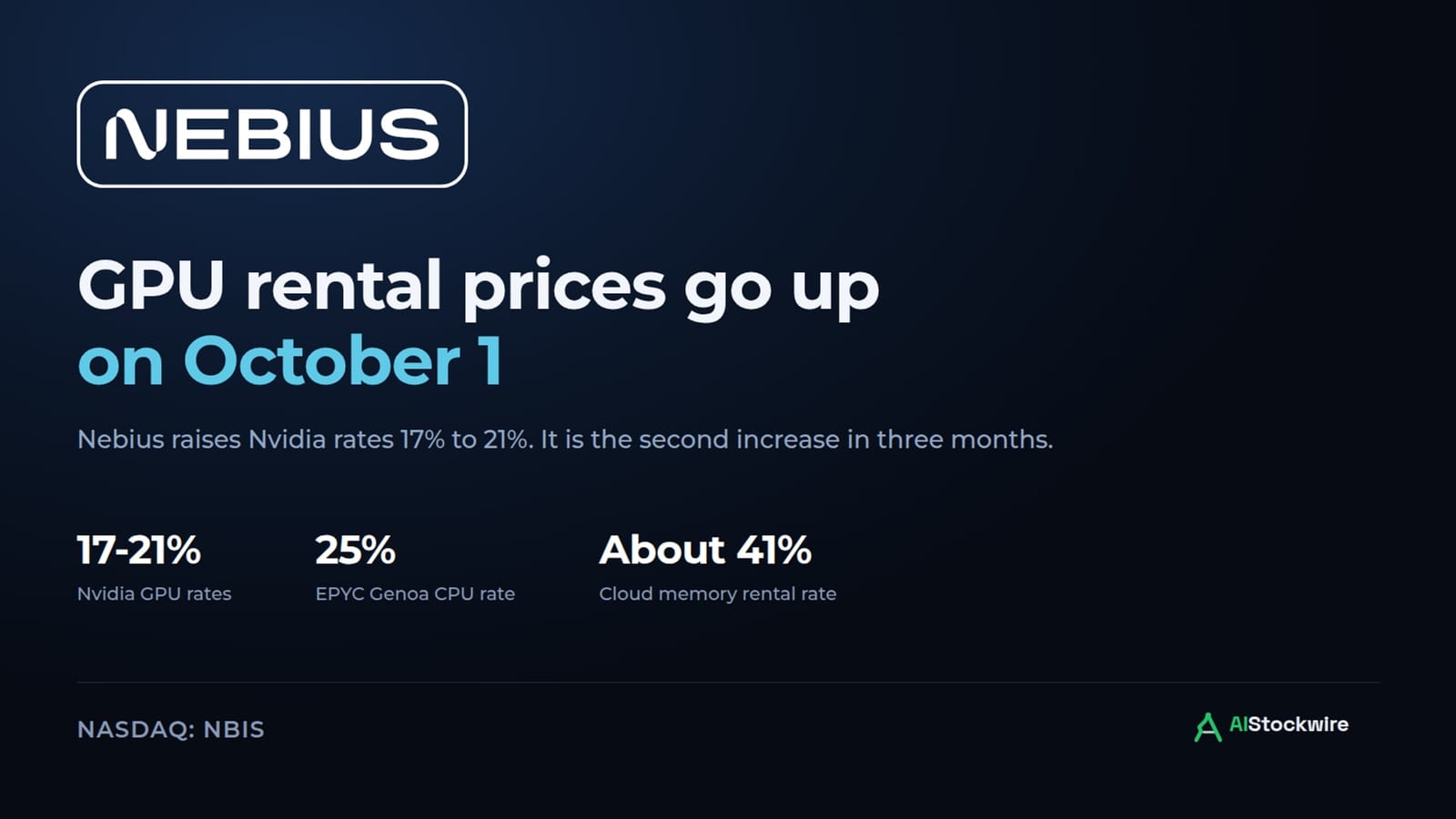
The agreement also allows collared forward sales, where a bank borrows and sells CoreWeave stock now and CoreWeave hands over its own shares later at a price fixed somewhere between a floor and a cap. Proceeds from either route go to general corporate purposes, which the filing says may include "repayment of indebtedness, payment of operating expenses, capital expenditures, investments in the Company's subsidiaries, acquisitions, and support of its objective of migrating its enterprise credit profile toward investment grade." Nebius (NBIS) went to the same well in August, and its stock fell about 9% on a $4.5 billion convertible.
What the investor deck reveals
The argument CoreWeave is making to the people buying this paper is that the capacity it is borrowing to build is getting more expensive to rent. The deck it furnished with the offering carries pricing figures the company has not put in a press release. It gives the recent range for signed short-dated contracts, meaning three to six months, in the third quarter as about $40 million per megawatt. That is an annualized number: a footnote defines it as annualized revenue divided by the power needed to run the clusters for those contracts. It is not $40 million collected over the three to six months the contract runs, and it is not the price on a multi-year take-or-pay deal, which is what most of the company's committed business is.
The deck also says prices across CoreWeave's product lines rose about 70% in July 2026, and that contracts signed in the second quarter carry an expected contribution margin about 25% higher than recent quarters. The deck does not say whether that 25% is a relative increase off the old margin or a move of 25 percentage points, and the two would mean very different things. Both figures are company estimates presented to prospective investors.
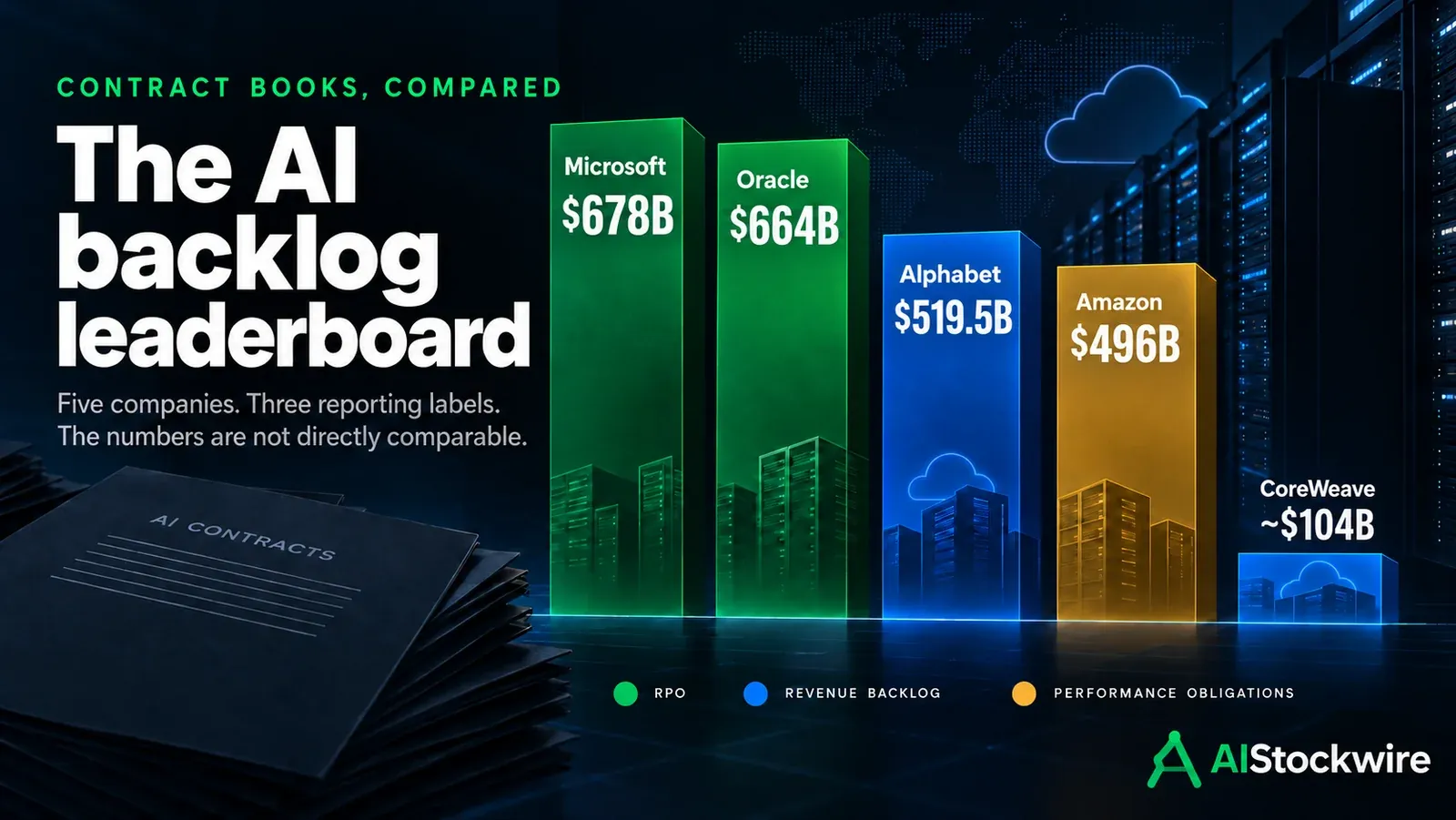
Revenue backlog was $104.2 billion as of June 30, up 246% from a year earlier, and the deck says that figure leaves out more than $25 billion of net new customer commitments added early in the third quarter. Backlog is not revenue. CoreWeave defines it as remaining performance obligations plus other amounts it expects to recognize under committed customer contracts, subject to delivery and to service being available. On capacity, the deck counts 51 active data centers, about 1.5 GW of active power as of June 30, and about 4.2 GW of total contracted power as of August 11.
The spending behind the fundraising
CoreWeave added nearly 500 MW of capacity in the second quarter and raised more than $14 billion across debt, convertibles and equity in the same three months. Capital expenditures were $9.352 billion in the quarter and $16.139 billion over the first half. Second-quarter revenue was $2.575 billion, up 112% from a year earlier, and the net loss was $626 million. Total debt stood at $38.6 billion at the end of June.
Higher contract prices and a growing backlog do not eliminate the need to finance construction. The company still has to fund the equipment and facilities needed to deliver that capacity. CoreWeave has been busy on the customer side too, including a multibillion-dollar cloud deal with Hudson River Trading in August whose terms neither side disclosed. The stock has not followed. At $78.85 it is about 49% below its 52-week high of $153.20, set on October 10, 2025, and about 30% above its July 29 low of $60.55, by our arithmetic. The company's market value is about $43.5 billion.