Key points
- Microsoft (MSFT) reports $678B of commercial RPO
- Amazon (AMZN) reports $496B, contracts over one year only
- Oracle (ORCL) has not updated its 12% conversion figure
- Alphabet (GOOGL) changed its backlog definition in Q1 2026
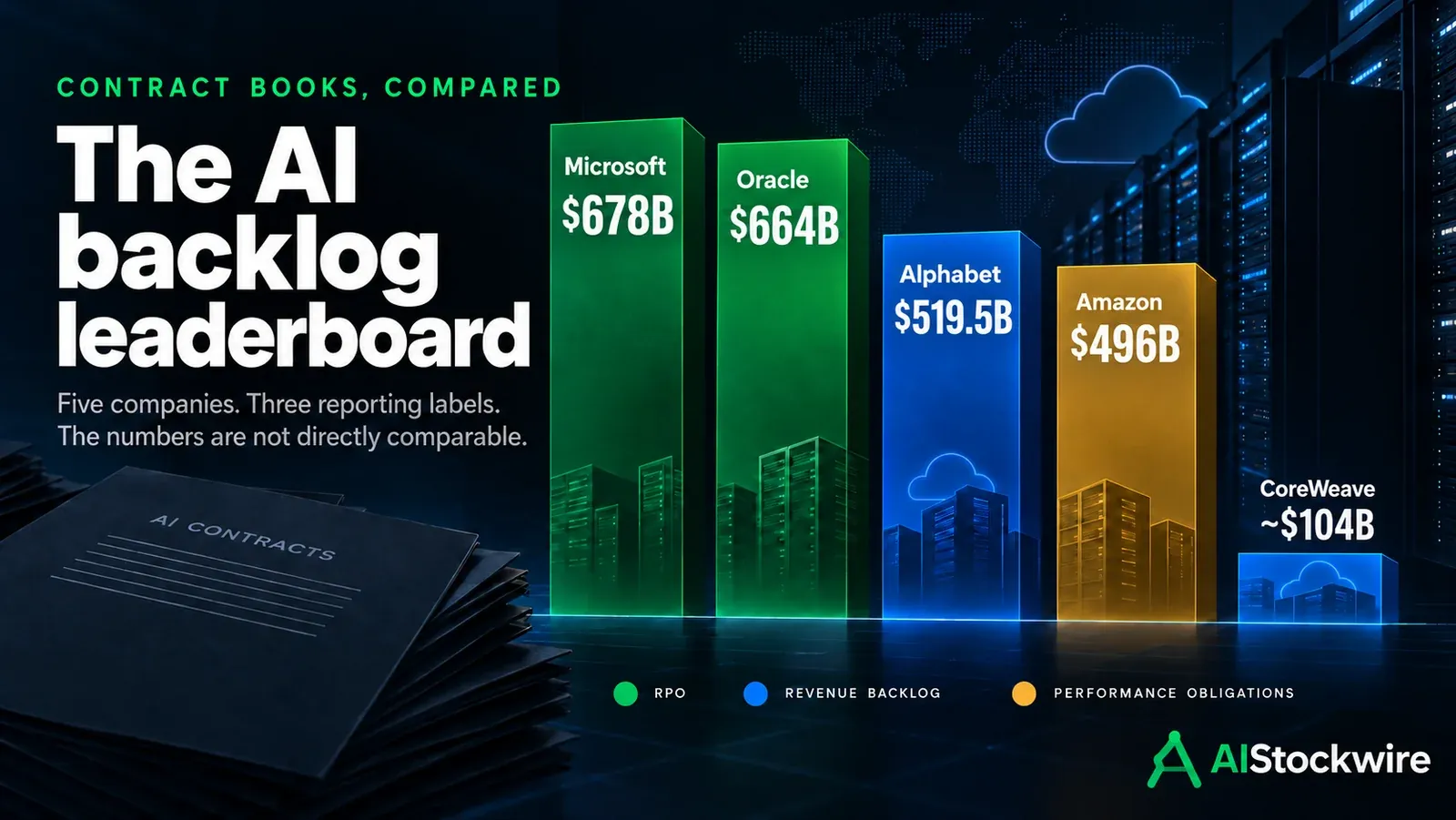
The largest reported contract books among the cloud and AI-infrastructure companies on our AI backlog tracker belong to Microsoft (MSFT) at $678 billion, Oracle (ORCL) at $664 billion, Alphabet (GOOGL) at $519.5 billion, Amazon (AMZN) at $496 billion and CoreWeave (CRWV) at about $104 billion. These are company-wide figures rather than AI-only ones, and the five companies do not label them the same way.
What the three labels actually mean
Remaining performance obligations, or RPO, is the accounting term, and it is governed by revenue-recognition rules. RPO is the transaction price allocated to contracted goods and services that a company has not yet delivered or recognized as revenue. Companies reporting it also disclose how much they expect to convert and over what period. The level of assurance varies with the document, though. An annual report is audited, while a quarterly filing and an earnings release are not audited in the same way. Microsoft's FY2026 10-K, for the year ended June 30, 2026, puts commercial RPO at $678 billion. Oracle's first-quarter 8-K for the quarter ended August 31, 2026, reported on September 10, puts company-wide RPO at $664 billion.
Backlog is the older industrial word, and it is not a defined accounting term. A construction firm or a shipbuilder uses it for signed work not yet delivered, so a backlog figure is only as good as the definition in the filing that carries it. Alphabet and CoreWeave both use the word, and both are describing unrecognized performance obligations rather than a different economic concept. Alphabet makes the equivalence explicit in its Q2 2026 10-Q, which reports $519.5 billion of remaining performance obligations, the figure it calls revenue backlog, of which $513.9 billion relates to Google Cloud. CoreWeave's Q2 10-Q shows $103.7 billion of RPO. Its August 11 earnings release puts revenue backlog at approximately $104 billion, which adds other amounts the company expects to recognize under committed customer contracts.
Amazon uses neither word. Its Q2 2026 10-Q reports $496 billion of performance obligations from contracts with original terms longer than one year, and the phrase remaining performance obligations does not appear in it. That one-year cutoff is what to watch when setting the figure beside the others, because contracts shorter than a year sit outside it.
What the five companies actually report
| Company | How the filing describes it | Latest | Period |
|---|---|---|---|
| Microsoft (MSFT) | Commercial remaining performance obligations | $678B | FY26 Q4, ended Jun 30, 2026 |
| Oracle (ORCL) | Remaining performance obligations | $664B | FY27 Q1, ended Aug 31, 2026 |
| Alphabet (GOOGL) | Revenue backlog | $519.5B | Q2 2026, ended Jun 30, 2026 |
| Amazon (AMZN) | Performance obligations, contracts over one year | $496B | Q2 2026, ended Jun 30, 2026 |
| CoreWeave (CRWV) | Revenue backlog | About $104B | Q2 2026, ended Jun 30, 2026 |
A contract book is not a year of revenue
This is the part that gets misread most often. These are amounts expected to be recognized over the remaining contract periods, and the companies that disclose a conversion schedule are describing something much slower than a headline implies.
Oracle needs the most care here. Its FY2026 annual report expected about 12% of its then-current RPO to convert to revenue within one year. Oracle has not supplied an updated percentage for the $664 billion balance reported in its latest results, and the composition of that balance changed sharply during the quarter, so the older percentage should not be carried across to the new number. Microsoft's disclosure runs faster, with a weighted average duration of about 2.3 years and roughly 30% expected within twelve months. Alphabet expects just over half of its backlog within 24 months, and CoreWeave expects 41% in the first 24 months.
Amazon discloses the slowest book of the group. Its weighted average remaining life is 6.4 years, against 4.0 years in the year-ago filing, when the comparable figure was $195 billion. The same 10-Q separately describes two expansions, a $38.0 billion OpenAI commitment expanded by $100 billion over eight years, and an Anthropic expansion of more than $100 billion over ten years.
Three traps worth knowing before you compare them
Alphabet's year-over-year move isn't comparable. The company changed the definition in the first quarter of 2026 to include contracts with an original expected term of a year or less. The year-ago figure of $108.2 billion excluded those, so only the sequential move from $467.6 billion is clean.
Microsoft reports two numbers. Commercial RPO is $678 billion and total company RPO is $684 billion. Both are correct and they cover slightly different books, so a comparison only works if you know which one you've got.
CoreWeave's $129 billion headline is not a CoreWeave disclosure. Several outlets have run it by adding commitments announced early in the third quarter to the reported backlog. CoreWeave's own release rules that out in a footnote, saying the figure does not include more than $25 billion of net new customer commitments added in early Q3. The company reported approximately $104 billion as of June 30, alongside approximately 3.7 gigawatts of contracted power.
Each figure is based on signed customer contracts, but none is guaranteed revenue. Recognition still depends on delivery, contract terms and, in some cases, customer commitments that can change.