Key points
- Nvidia's GB300 NVL72 rack draws up to 142 kilowatts, well past what ASHRAE recommends for air alone, about 50 kilowatts.
- Vertiv (VRT) stopped disclosing its backlog figure in Q2 2026, even as it raised full-year guidance to $13.8-14.2 billion.
- Modine's (MOD) $4 billion deal is guaranteed capacity through 2029 with one customer, not a booked order.
For most of the last decade, a server rack ran on 5 to 15 kilowatts of power, and a row of fans could keep it cool. AI hardware has pushed rack density into a different range. Nvidia's GB200 NVL72 packs 72 Blackwell GPUs into one rack and draws about 120 kilowatts. The newer GB300 NVL72 can reach close to 142 kilowatts. ASHRAE's guidance for AI data centers advises against using air alone above about 50 kilowatts per rack. In some older facilities, the practical limit is closer to 20 kilowatts because of the building's design—not because 20 kilowatts is a universal ceiling for air cooling.
Whichever figure applies, racks drawing 120 to 142 kilowatts are beyond what rows of fans were designed to handle. Nvidia ships both systems with liquid cooling.
The next generation will demand more. Nvidia's roadmap includes Kyber, a rack planned for 2027 that CEO Jensen Huang said during the company's March 2025 conference would draw about 600 kilowatts. At that scale, cooling is part of the computing architecture rather than a routine facilities expense. It also creates a supply chain of its own.
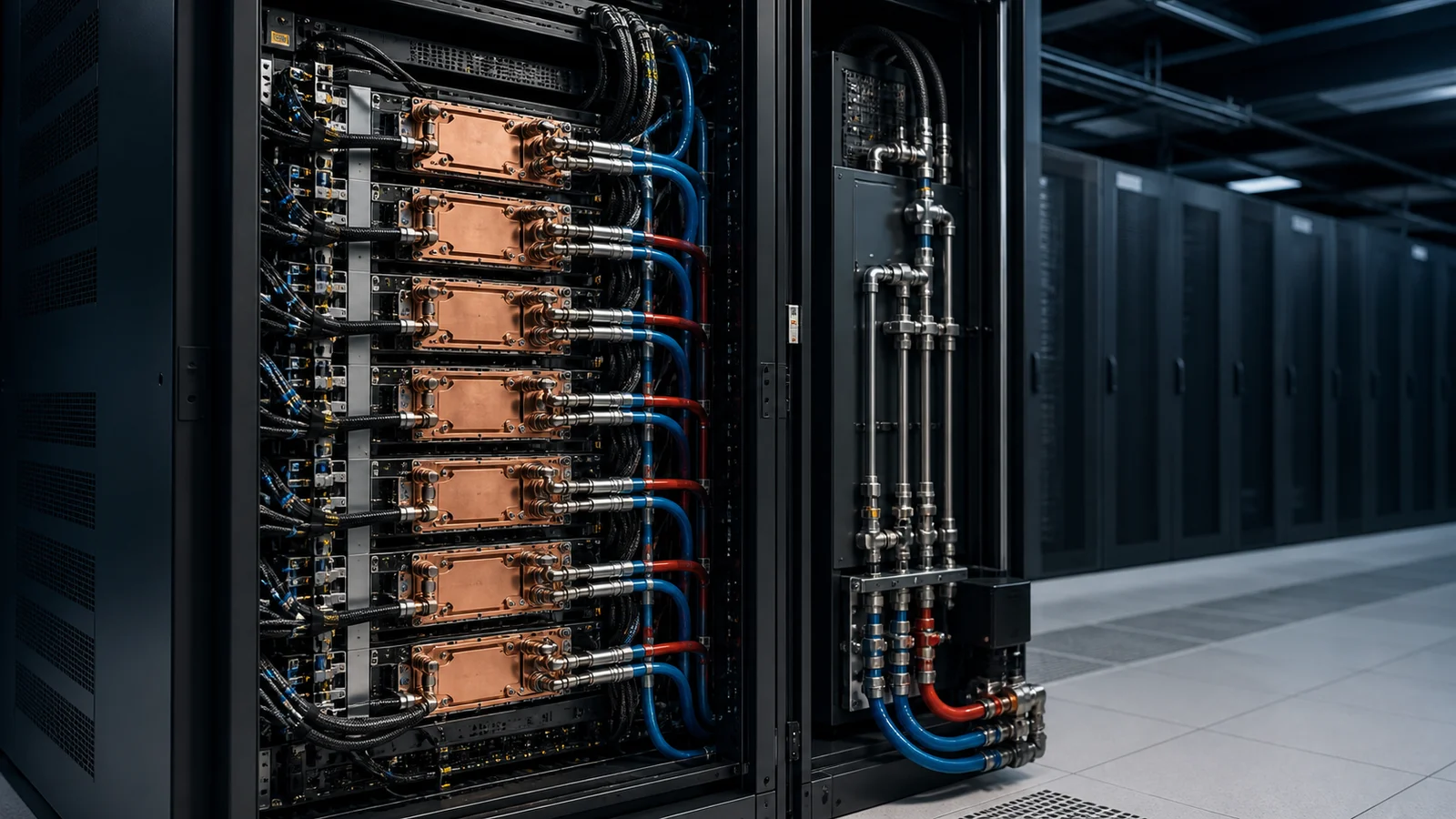
Two cooling designs are competing for that business. Direct-to-chip systems place cold plates on processors and carry heat away through a closed liquid loop. That is the design used in most GB200 and GB300 installations today. Immersion systems take a different route, submerging entire boards in non-conductive fluid. The choice depends on retrofit costs, maintenance and the design of the data center; immersion is not simply the next stage after direct-to-chip.
In either case, the system needs pumps and heat exchangers to move heat from the equipment to the building's water loop. Coolant distribution units, or CDUs, perform that function, making them one of the principal pieces of the emerging liquid-cooling market.
What each company sells
| Company | Cooling products | Business signal |
|---|---|---|
| Vertiv (VRT) | Liquid cooling plus power for the rack; bought PurgeRite in 2025 | Companywide backlog of $15B at end of 2025; stopped disclosing backlog starting Q2 2026 |
| nVent Electric (NVT) | Coolant distribution units, enclosures and racks | Q2 2026 sales up 53% (47% organic, 5 points from acquisitions); $2.5B in companywide remaining performance obligations |
| Modine (MOD) | Airedale chillers and data-center cooling systems | Guaranteed capacity to supply over $4B of Airedale product 2027-2029 to one customer, who paid $165M upfront; not a booked order |
| Johnson Controls (JCI) | Silent-Aire CDUs, from 500 kilowatts to 10 megawatts and up | Building out a scalable liquid-cooling line |
| Ecolab (ECL) | Bought CoolIT, a direct-liquid-cooling maker, for $4.75B (July 2026) | Targeting a $4B high-tech business by 2030 |
| Munters (Nasdaq Stockholm: MTRS) | Data-center cooling systems | Won an AI cooling order worth about 2 billion Swedish kronor |
| Schneider Electric (Paris: SU) | Bought 75% of CDU maker Motivair for $850M | Pairing cooling with its power portfolio |
Munters and Schneider trade in Stockholm and Paris. American investors generally have to use foreign shares or ADRs to own them; the other companies are listed in the United States.
The table also contains two numbers that should not be mistaken for pure measures of AI-cooling demand. Vertiv's $15 billion backlog covered its entire power-and-cooling portfolio, not liquid cooling by itself, and the company has not reported a comparable total since the first quarter of 2026. The same issue applies to nVent's $2.5 billion of remaining performance obligations. That figure covers the whole company. Infrastructure, the segment driving much of the growth, represented 58% of year-to-date sales, compared with 45% in 2025, but the filing does not identify how much of the $2.5 billion came from cooling.
How the three compare as stocks
Vertiv, nVent and Modine all sell into the same rack-density shift. They differ on exposure, growth composition, margin trend and customer concentration.
| Company | AI-cooling exposure | Recent growth | Margin trend | Customer concentration |
|---|---|---|---|---|
| Vertiv (VRT) | Combines cooling and power equipment, giving it the broadest offering of the three | Q2 2026 net sales up 24% (18% organic); full-year 2026 guidance raised to $13.8-14.2B | Adjusted operating margin expanded to 22.6% in Q2 2026, up 410 basis points | Analysts estimate Meta, Microsoft and Amazon together near 45-50% of revenue; Vertiv does not break this out itself |
| nVent (NVT) | Sells CDUs and enclosures through a broader electrical-infrastructure portfolio | Q2 2026 sales up 53% (47% organic), driven by data center demand | Operating margin in the mid-teens; company does not report a cooling-only margin | Not broken out; sold through OEMs and system integrators rather than a handful of named hyperscalers |
| Modine (MOD) | Airedale gives it the most concentrated cooling exposure of the three | Data Centers segment revenue up 90% in its most recent quarter | Segment adjusted EBITDA margin fell to 14.8% from 22.1% a year earlier as component costs and ramp-up costs bit; company targets recovery to 19-20% | The $4B Airedale capacity agreement is with a single, unnamed customer |
Each stock trades at a premium to the broader industrial group. The exact multiple varies by data provider and moves with the share price day to day, so check a live quote rather than a number printed here.
What could go wrong, company by company
The risks are not the same for each name.
- Vertiv: Its valuation is high relative to industrial peers. The company also stopped supplying the backlog figure investors had used to track demand, and it still has to integrate PurgeRite and other recent acquisitions. Heavy exposure to a small number of hyperscalers would leave Vertiv vulnerable to any pullback in their capital spending.
- nVent: Acquisitions contributed about a tenth of its 53% sales growth. The company does not say how much of its $2.5 billion in remaining performance obligations comes from cooling rather than other electrical-infrastructure products. Investors therefore have limited visibility into how much of nVent's higher valuation rests specifically on AI cooling.
- Modine: Its largest announced agreement reserves capacity through 2029; it does not guarantee $4 billion of booked revenue. The entire arrangement is tied to one unnamed customer. Meanwhile, the Data Centers segment's adjusted EBITDA margin has already fallen by more than seven percentage points as Modine expands production. A delay or spending pause by that customer could affect both revenue and the new capacity Modine is building.
Forecasts for the category offer little certainty. Estimates place the liquid-cooling market at about $5 billion today and anywhere from $16 billion to $19 billion by 2030. Such a wide range shows that analysts have not settled on the pace of adoption.
Nor is every company associated with liquid cooling a direct AI investment. Asetek, once widely treated as a liquid-cooling story, earns most of its revenue from gaming and withdrew its guidance after major customers canceled orders.
This is not a recommendation to buy or sell any of the stocks. It shows how a physical constraint inside AI data centers may become revenue for Vertiv, nVent and Modine, and why the numbers behind those three stories should not be treated as equivalent.
Sources: The AI power equipment stocks. Inside the AI hardware stack, layer by layer. Nvidia, GB200 NVL72 design and GB300 NVL72 components; GTC March 2025 keynote (Kyber roadmap). ASHRAE, AI data center retrofit and modernization guidance. Vertiv, Q2 2026 earnings release and 2025 10-K. nVent, Q2 2026 Form 10-Q. Modine, Airedale capacity agreement announcement. Ecolab, CoolIT acquisition close (July 2026); Schneider Electric, Motivair stake.
New suppliers are courting the biggest buyers too. LG signed a partnership with Microsoft that could put LG cooling equipment in Microsoft data centers, though no orders have been announced.
This is general market commentary and opinion, not investment advice. Markets can go down as well as up, and you can lose money. Always do your own research and consider speaking with a licensed financial professional before making any investment decision.