Key points
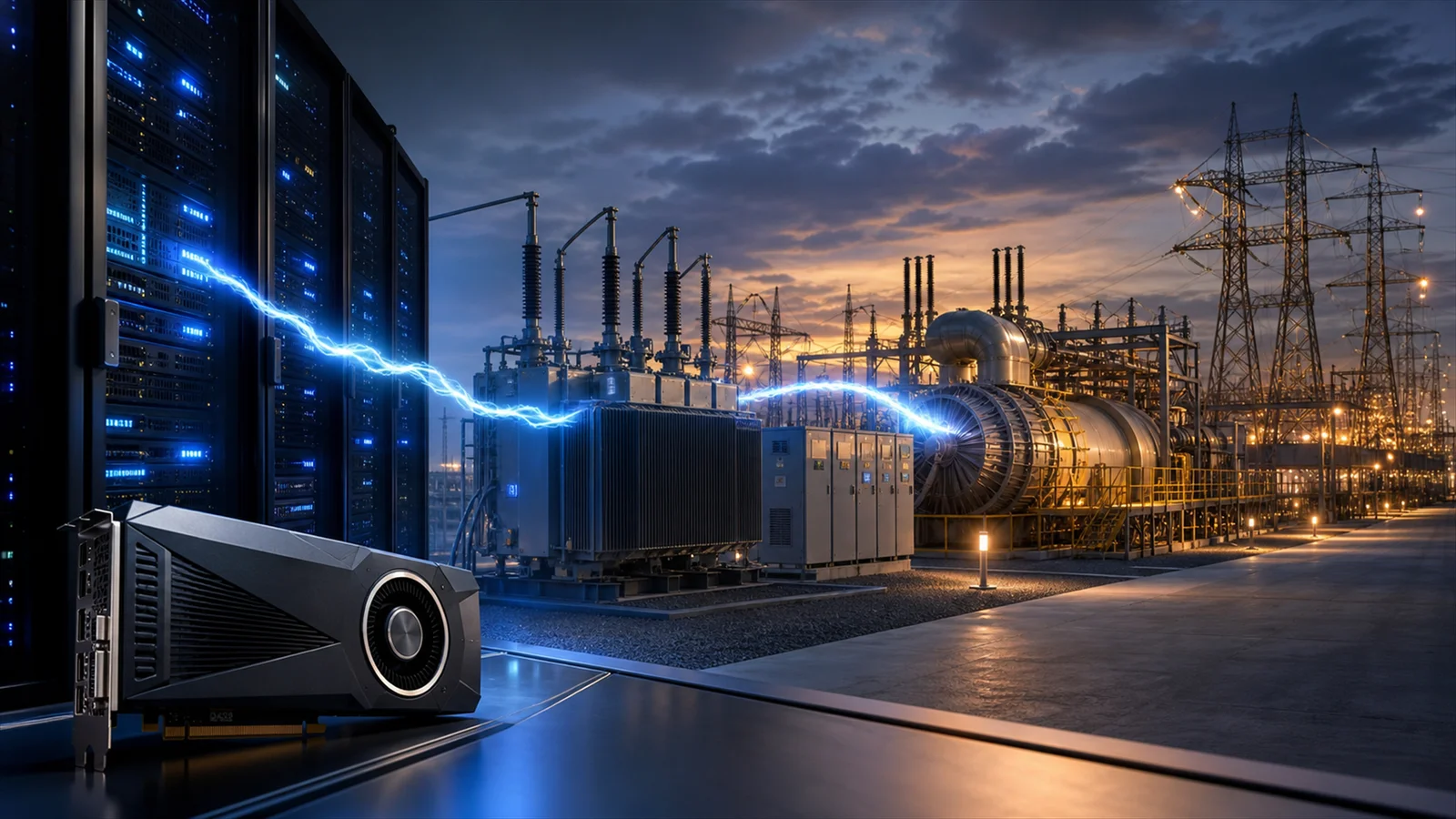
- The toughest part of expanding AI infrastructure is no longer obtaining the chip. The bottleneck has shifted to electricity and the physical systems required to produce that power and deliver it to a server rack.
- Orders for new heavy-duty gas turbines now stretch years into the future, while a large power transformer may require two to three years to manufacture. Those delivery schedules form the core of the investment argument for this group.
- This page maps the public companies that sell into the shortage: GE Vernova, Vertiv, Eaton, Quanta Services, Powell Industries, nVent, Hubbell and MasTec, with what each one makes and how big its order book has gotten.
- For the power that actually gets generated, the nuclear, gas, and solar names, see our separate AI power piece. Any ticker here can be run through our stock score tool.
For most of the past two years, investors treated AI primarily as a semiconductor trade. That framing no longer captures the whole buildout. An Nvidia (NVDA) GPU can arrive before the power needed to operate it, and that mismatch increasingly determines when a data center is able to open.
The scale of the demand is difficult to miss. US data centers consumed roughly 192 terawatt-hours of electricity in 2024, equal to 4.7% of national use. Lawrence Berkeley National Laboratory projects that the share could reach between 9.5% and 15% by 2030. Power prices have moved alongside that demand. PJM, the grid operator serving 13 states, holds an annual auction for future generating capacity. Its clearing price climbed from $28.92 per megawatt-day for 2024 to 2025 to $329.17 for 2026 to 2027. Analysts say data center demand explains most of the increase.
Even when the money is there, the wait is long. About 2,300 gigawatts of power projects were sitting in interconnection queues at the end of 2024, and the typical project now takes more than four years to connect, according to Berkeley Lab. New gas turbines are booked out further than that.
We've already covered the companies that generate the power, the ones behind why electricity became the binding constraint on the whole trade. This piece is about the layer in between: the turbines, transformers, switchgear and crews that carry electrons the last mile to the rack. It's a less crowded corner of the AI trade, and the order books show why.
What each company sells
Eight public names cover most of this layer. The first column is what they make for a data center. The second is the size of the order book each one last reported.
| Company | What it sells into a data center | Order book, as reported |
|---|---|---|
| GE Vernova (GEV) | Gas turbines, grid transformers, high-voltage switchgear | $176B total backlog; 116 GW of gas orders and slot reservations (Q2 2026) |
| Vertiv (VRT) | Power distribution, UPS, and liquid cooling at the rack | About $15B backlog (end of 2025) |
| Eaton (ETN) | Electrical switchgear, busway, power distribution | Record backlog about $24B; data-center revenue up 65% (Q2 2026) |
| Quanta Services (PWR) | Builds the transmission lines and substations that feed the site | Record backlog $53.4B (Q2 2026) |
| Powell Industries (POWL) | Custom switchgear and electrical systems | Record backlog $2.4B, including a single data-center award over $400M (2026) |
| nVent Electric (NVT) | Enclosures, racks and liquid-cooling hardware | Sales up 53%, backlog about $2.5B (Q2 2026) |
| Hubbell (HUBB) | Grid and utility components, connectors, enclosures | Bought DMC Power for $825M to push into data-center power |
| MasTec (MTZ) | Builds power-delivery infrastructure | 18-month backlog $21.4B (Q2 2026) |
Each backlog number comes from the company's latest report. Because the totals change from quarter to quarter, they should be read as a snapshot rather than a live tally.
The order book creates the advantage
The clearest case is GE Vernova. It spun out of General Electric in 2024 and now sells the three things a new data center campus needs most: gas turbines, grid transformers and high-voltage switchgear. On its July 2026 report the company said gas-equipment orders and paid slot reservations had reached 116 gigawatts, and that it was already taking reservations for turbine deliveries in 2031. A new heavy-duty turbine order placed today lands four to five years out.
The transformer wait is nearly as long. Wood Mackenzie put large power transformer lead times above two years in 2024, up from under one year in 2021. Medium-voltage switchgear has stretched too. When a piece of equipment takes years to arrive, the company holding the order book is selling something a rival can't simply undercut on price.
That is why a backlog matters more here than in most of the market. An order book that runs into 2029 or 2031 is revenue these companies can already see, which is rare for industrial equipment. It's also why several of these stocks stopped trading like slow utilities and started trading like AI names.
What could go wrong
A reserved production slot is not the same as delivered equipment. A slowdown in AI construction could lead customers to postpone or cancel early orders and reservations before they become shipments. If that happens, today's apparently durable backlogs would begin to shrink. Every company in the table carries that risk.
Price is the other problem. Several of these stocks already carry years of growth in the multiple. GE Vernova and Vertiv have both sold off hard on quarters that looked fine on the surface, because the bar Wall Street set was higher than the print. And this is still cyclical, capital-heavy equipment, where margins swing with steel, copper, and labor. A long backlog lowers the risk. It does not remove it.
None of this makes the group a buy or a sell. It maps where a data center dollar goes once it leaves the chip budget. Every name above links to its live SEC filings, and our stock score tool grades each one's actual numbers, profits, debt, insider activity, and dilution, in about ten seconds.
Sources
- Related coverage: AI's power problem, and the generation stocks behind it
- Related coverage: Inside the AI hardware stack, layer by layer
- Lawrence Berkeley National Laboratory, United States Data Center Energy Usage Report: 2025 Update
- PJM, Base Residual Auction results (capacity auction clearing prices)
- Lawrence Berkeley National Laboratory, Queued Up 2025 edition (interconnection queue data)
- GE Vernova, second-quarter 2026 results (July 2026)
- Wood Mackenzie, power transformer lead-time analysis
- Company backlog figures from each firm's most recent quarterly report, via SEC EDGAR
This is general market commentary and opinion, not investment advice. Markets can go down as well as up, and you can lose money. Always do your own research and consider speaking with a licensed financial professional before making any investment decision.
Quanta showed what that demand does to a quarter. It raised guidance and rose 17.3%, while Sterling Infrastructure reported nothing and rose 17.4%.