Key points
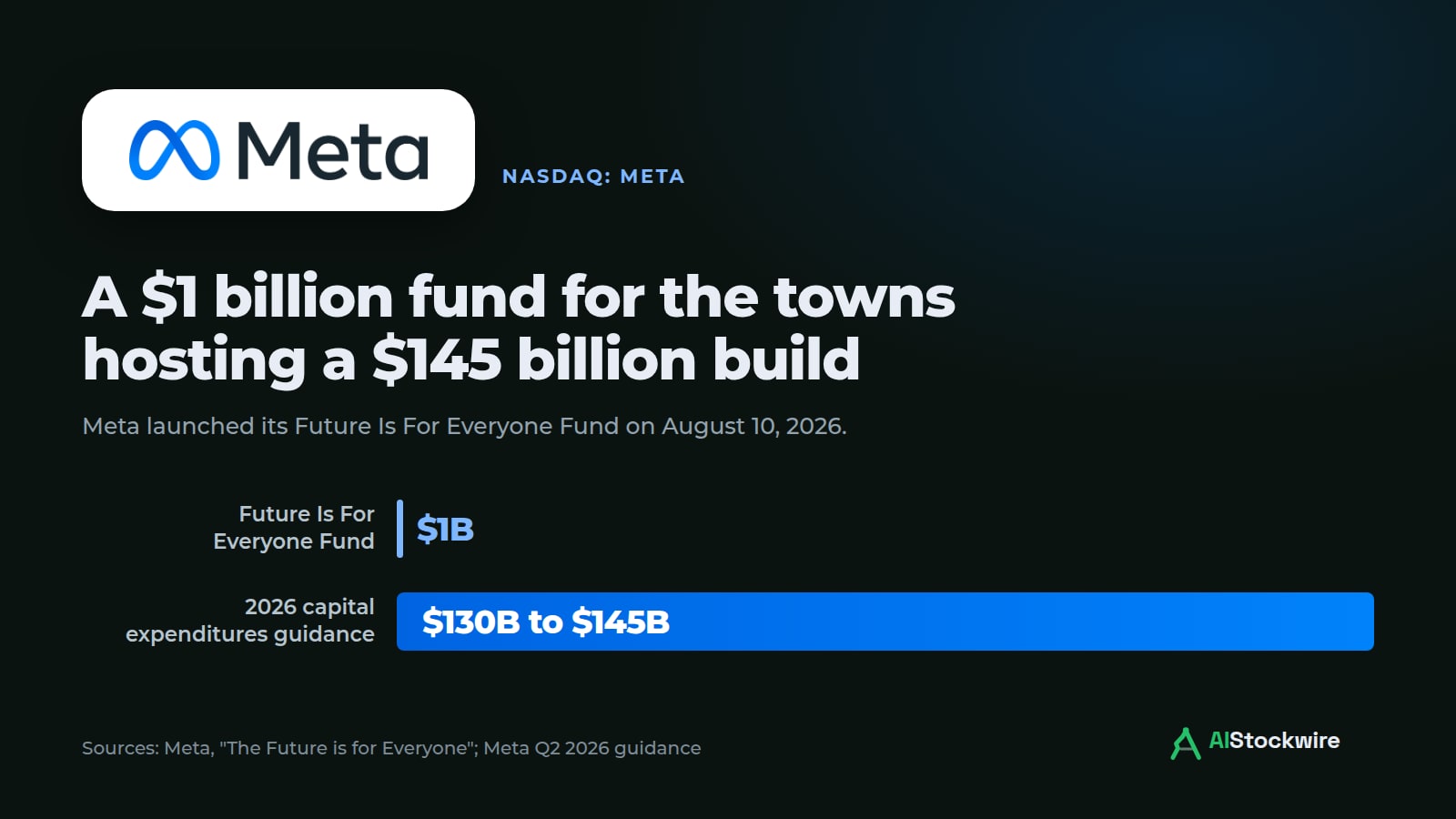
- Meta (META) launched a $1 billion Future Is For Everyone Fund for US data center communities on August 10.
- Meta's 2026 capex guidance is $130B to $145B, so the fund is under 1% of one year's build.
- 71% of Americans now oppose a data center near them, up from 42% in September 2025, per Embold Research.
Meta (META) said Monday it's launching a fund to put money directly into the American communities where it builds data centers. The company put the size at $1 billion.
The announcement arrived inside a long essay from chief executive Mark Zuckerberg called "The Future is for Everyone: The Path to a Positive AI Future," published Monday on Meta's site. The essay doesn't name a dollar amount anywhere. It says this:
"Sustainable infrastructure development means that communities must benefit significantly from each project. This includes high-paying local jobs, investment in schools and public services, ensuring energy prices don't rise, and taking care of the environment. As tax revenue grows, this also benefits teachers, law enforcement, fire departments, and more. We call these local benefits our community compact, and we are launching a Future Is For Everyone Fund to support each community we work in directly."
The $1 billion figure came from Meta separately, and Fox Business reported it Monday morning.
What Meta is spending on data centers
| Meta figure | Amount |
|---|---|
| Future Is For Everyone Fund | $1 billion |
| 2026 capital expenditures guidance | $130 billion to $145 billion |
| US infrastructure commitment through 2028 | At least $600 billion |
| Hyperion data center, Richland Parish, Louisiana | $27 billion |
Meta narrowed its 2026 capital expenditures guidance to $130 billion to $145 billion on its second-quarter call. That lifted the floor from $125 billion. Revenue for the quarter was $60.8 billion, up 28 percent. Diluted earnings per share came to $6.18. At a White House dinner last September, Zuckerberg said Meta would put at least $600 billion into US infrastructure through 2028.
What happened in Richland Parish
Zuckerberg's example in the essay is a school district in northeast Louisiana. "For example, in Richland Parish, Louisiana, where Meta is building a large data center, teachers received a $50,000 bonus this year because of the increased tax revenue from our investment," he wrote. "The superintendent told us that teachers are now moving there from across the country and he believes it will become one of the nation's best school districts."
The checks were real, and bigger than that. Certified employees got end-of-year payments of up to $50,935 this year and classified employees up to $17,472, according to the Shreveport-Bossier Advocate. Last year the maximum was $10,200.
It's sales tax. Richland Parish voters passed a one-cent sales tax in 1968. That single tax brought in $16.2 million of the school board's $36.5 million this fiscal year. Crews building the $27 billion Hyperion campus near Holly Ridge pay it on construction materials. The parish's first payment was $22.4 million, more than it used to collect across an entire year.
Home prices in the parish rose over the same stretch. The median house in Richland Parish sold for about $105,000 in November 2024 and about $295,000 in May 2026. Redfin puts that at almost 63 percent higher year over year.
Local opposition to data centers
Embold Research polled 4,118 registered voters between May 15 and May 28 and found 71 percent opposed to a data center near them. That's 55 percent strongly opposed against 21 percent in support. The same pollster found 43 percent support and 42 percent opposition in September 2025. Robinson Meyer of Heatmap News wrote that "the public has swung 49 points against data centers in just nine months, underscoring the heightened political salience of the facilities and the AI industry that they embody."
Data Center Watch counted 75 projects worth about $130 billion blocked or delayed in the first quarter of 2026. That matches its tally for all of 2025. Active local opposition groups reached 833 in March, up from 396 at the end of 2025. More than 300 state-level data center bills were filed in the first six weeks of the year. Lawmakers in 14 states introduced statewide moratorium proposals. New York froze new data center approvals for a year in July. TeraWulf (WULF) was that session's biggest decliner.
Peter Kafka of Business Insider had already argued that Meta should spend money on these towns instead of running ads about AI. He wrote Monday that the announcement skips the mechanics: "There's no mention of how many communities or people this is meant to help, or over what period the money is meant to be spent." He put Meta's annual profit at about $60 billion.
Kafka quoted technology columnist Max Read on the wider problem: "The low-trust environment cultivated over the past couple decades by the tech industry's flagship companies has now created real obstacles to its ambitions."
The essay makes two specific promises past the fund. On power, Zuckerberg wrote that "we help keep electricity prices low by building our own energy-generating infrastructure wherever we invest." On water, he said Meta is "committed to being water-positive, meaning that we'll restore more water than we use in the watersheds where we operate by 2030." In high-stress areas he put the goal at 200 percent. Residents in several US towns have already filed complaints over data center water draw. He also described a free trades-training program, America's Workforce Academy, that guarantees jobs where Meta builds.
He argued the record already favors operators who stay: "We see that communities we invest in over the long term are more supportive of development than communities where speculators start building with minimal investment in the community."
In Cheyenne, Wyoming, the Board of Public Utilities traced a discharge of the rare bacterium Cupriavidus gilardii to Goat Systems LLC. The contractor was working on Meta's 715,000-square-foot campus in the High Plains Business Park. Samples turned up the bacterium in February 2026. It reached the city's wastewater and irrigation system, and Cheyenne's drinking water supply was unaffected. Follow-up testing found none left at either treatment plant.
META traded at $592.61 at 3:20 p.m. Eastern Monday, close to Friday's $592.10 close. Meta separately signed on to Texas Governor Greg Abbott's data center standards the same morning.
Hyperion is scheduled to stay in development until 2030. Richland Parish Schools superintendent Sheldon Jones wrote to the district that the payments track the construction period: "We anticipate elevated bonuses for the duration of the Hyperion construction project."
Market data as of August 10, 2026. This article is for informational purposes only and is not investment advice.