Key points
- CXMT is now in the DRAM ETF at 2.52%, a $627.5M total return swap, days after its Shanghai listing.
- GigaDevice, the fund's first Chinese holding at 2.91% in June, has slipped to 1.51%.
- Samsung 26.39%, Micron (MU) 24.54% and SK Hynix 22.77% are still about three-quarters of the fund.
- DRAM closed at $50.37 on July 31, down from a record $80.72 close on June 22.
The Roundhill Memory ETF, which trades under the ticker DRAM, has spent its short life as a clean bet on the AI memory boom: Korea's SK Hynix and Samsung up top, then the storage and flash names underneath. In late June it did something new. It added GigaDevice Semiconductor, a Beijing chipmaker, at a 2.91 percent weight. It was the first Chinese company the fund had ever held. And if your first instinct is "good, finally some cheap China exposure," the numbers are about to surprise you.
What GigaDevice actually is
GigaDevice is not really a DRAM company, at least not mainly. It is the world's number two maker of NOR flash, a kind of memory used in cars, appliances and industrial gear, with about 18.5 percent of that market. It also makes microcontrollers, sensors, some NAND flash, and a slice of specialty DRAM. It is one of China's larger listed chipmakers, trading in Shanghai and, since January, in Hong Kong, where it jumped nearly 40 percent on its first day. So it earns a place in a memory fund, but it is a flash-and-controllers story far more than a DRAM one.
The part that flips the "cheap China" idea
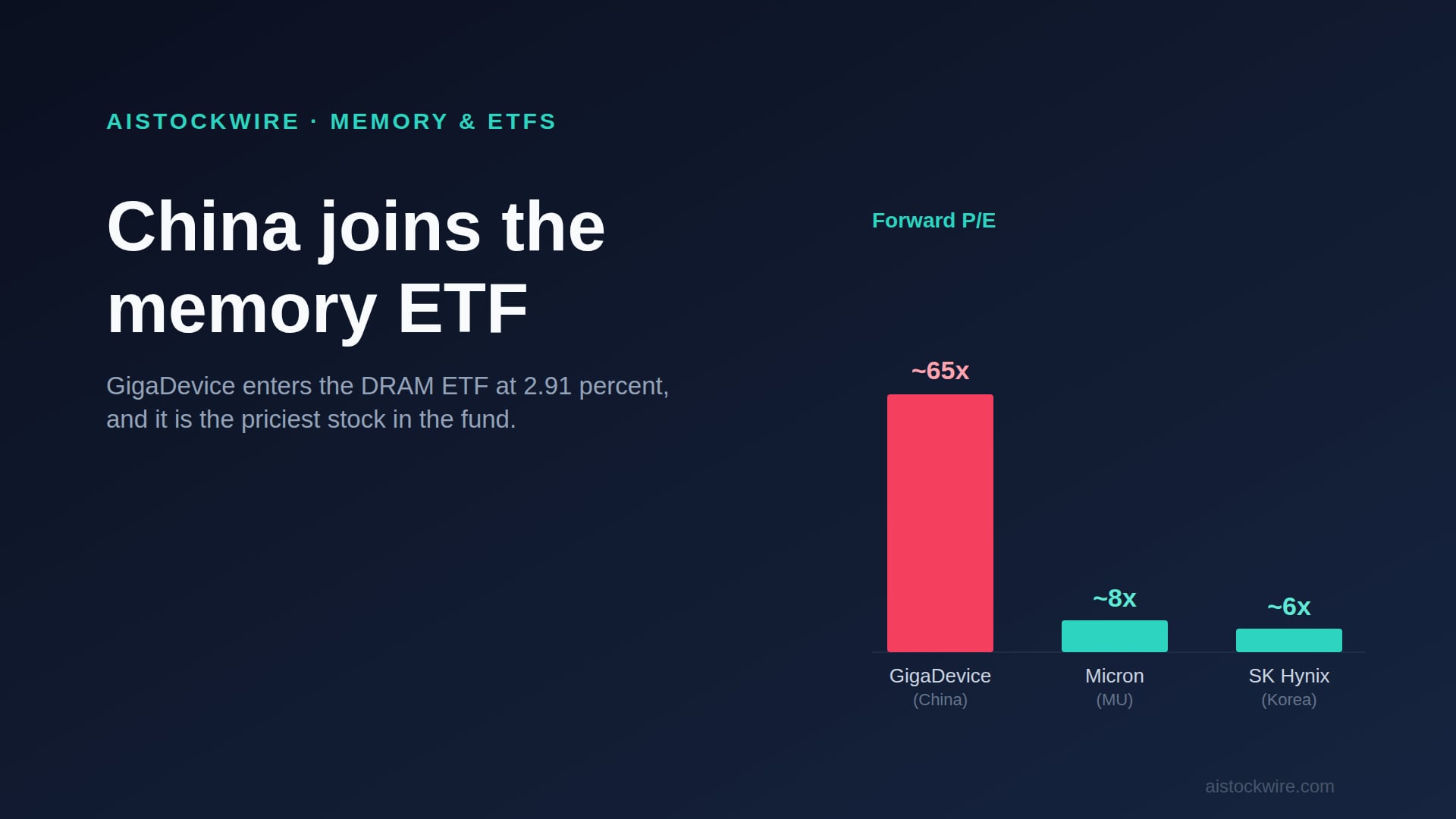
Here is where it gets interesting. The assumption that Chinese tech is the cheap option does not hold for this stock at all. GigaDevice trades at a trailing price-to-earnings ratio well north of 100, and even on next year's expected earnings it sits around 65 times. Compare that with the giants that make up most of the fund. Micron (MU) and SK Hynix both trade for about 20 to 25 times trailing earnings, and single digits looking forward. The newest and smallest name in the basket is also, by a wide margin, the most expensive one in it.
Why so pricey? China's drive for chip self-sufficiency has turned its domestic semiconductor names into momentum favorites, and mainland retail investors will pay almost anything for a company tied to that story. You are not buying a discount here. You are buying a national-priority narrative at a steep premium.
Cheap chips, expensive stock
The confusing part is that the "cheap" instinct is half right, just pointed at the wrong thing. Chinese memory is cheap where it actually counts, on the price tag of the chips themselves. Makers like GigaDevice, and the bigger CXMT, win market share by undercutting everyone else on older-generation DRAM and flash. That is exactly the kind of pricing pressure that can eat into the fat margins the rest of the fund is enjoying right now. So you end up with an expensive equity wrapped around a cheap product, and the cheap product is a threat to the 90 percent of the ETF that is not Chinese. That is a strange thing to own inside one ticker.
CXMT, the bigger China name, is now in the fund too
If you actually wanted Chinese DRAM, GigaDevice was never the main event. That title belongs to CXMT, or ChangXin Memory Technologies, China's largest DRAM maker, which held 7.67 percent of the global DRAM market in 2025 according to its IPO prospectus. When this article first ran, CXMT was private and the fund had no clean way to own it, which was a big part of why GigaDevice got the call instead.
CXMT priced its Shanghai STAR Market IPO at 8.66 yuan a share and raised 57.92 billion yuan, about $8.6 billion. It listed on July 27 under the code 688825 and closed its first session at 49 yuan, up 465.82 percent, passing Industrial and Commercial Bank of China as the most valuable company listed on the mainland.
The fund did not buy the shares. Roundhill's holdings file dated August 2 carries a line reading CXMT CORPORATION-SWAP-GOLD-L, a total return swap on 78.4 million CXMT shares worth $627.5 million, at a 2.52 percent weight and maturing in May 2027. It is the same instrument and the same counterparty tag the fund already uses for part of its Samsung and SK Hynix exposure. The file dated July 23, four days before the listing, had no CXMT line in it.
GigaDevice and CXMT are not strangers
Here is the twist that is easy to miss: these two are joined at the hip. Both were founded by the same person, Zhu Yiming, who started GigaDevice in 2005 and later founded CXMT in 2016, where he is chairman. GigaDevice was an early backer of CXMT, and the two now run a clear division of labor: CXMT manufactures the DRAM, and GigaDevice handles the product development and the selling. GigaDevice has even put about $825 million of DRAM purchases from CXMT and its parent company to a shareholder vote this year. That relationship was the entire case for holding GigaDevice as a stand-in for CXMT. As of the August 2 file the fund holds both, and the stand-in is the smaller of the two.
What else is in the fund
The headline weights here are a little deceptive, because the fund leans heavily on swaps. Buying shares of giants like Samsung and SK Hynix directly is harder than it sounds when they are foreign-listed, so the ETF picks up much of that exposure through total-return swap contracts backed by Treasury bills. Once you count those swaps next to the direct shares, three giants still take about three-quarters of the fund between them. Here are the ten largest positions from the August 2 file, which lists 23 lines and $24.55 billion in assets.
| Position | Weight | Value |
|---|---|---|
| Samsung Electronics | 26.39% | $6.57B |
| Micron (MU) | 24.54% | $6.11B |
| SK Hynix | 22.77% | $5.67B |
| Seagate (STX) | 5.05% | $1.26B |
| Western Digital (WDC) | 4.98% | $1.24B |
| Sandisk (SNDK) | 3.76% | $936.5M |
| Kioxia | 3.14% | $781.7M |
| CXMT (swap) | 2.52% | $627.5M |
| Nanya Technology | 1.92% | $476.8M |
| GigaDevice | 1.51% | $376.0M |
The Samsung and SK Hynix rows above combine Seoul-listed shares with the swaps written on them. SK Hynix also has a separate 0.49 percent line in the US-listed ADR (SKHY). Another 14.47 percent of the fund sits in a government money-market fund, which is collateral behind the swaps rather than a memory position, and Winbond, Phison and Macronix fill out the bottom at under 1 percent each.
GigaDevice has gone from 2.91 percent to 1.51 percent since June and now sits below CXMT, the company it was bought as a proxy for. The ETF has gathered $24.55 billion since its April 2 debut, when it opened at $27. It closed at $50.37 on July 31, down from a record close of $80.72 on June 22 and down 13.6 percent from $58.30 on July 23, the last session before the CXMT listing.
So is it a good addition?
On balance, adding a Chinese name is defensible and probably overdue. China is building memory capacity at a pace nobody can afford to ignore, and a fund that calls itself the memory ETF looks incomplete with no China in it at all. GigaDevice is a real leader in its niche and an easy, liquid way to get that exposure without wrestling with A-share access yourself.
The caveats are just as real. At under 3 percent, it barely moves the fund either way, so do not expect it to change your returns. You are adding the single most expensive stock in the basket, priced in a market with its own rules around foreign ownership and sitting in the middle of a US-China chip fight that can flare up without much warning. And the CXMT connection no longer does the work it did in June. GigaDevice was an indirect, second-hand line to China's DRAM champion. The fund now owns the champion itself, at a bigger weight, so the proxy argument for GigaDevice has largely gone.
None of this is investment advice. But if you own DRAM, or you are weighing it, the GigaDevice add is a small, smart-sounding move with a big asterisk: the cheap-China trade and the expensive-China stock are not the same thing, and this is the expensive one.
This is general market commentary and opinion, not investment advice. Markets can go down as well as up, and you can lose money. Always do your own research and consider speaking with a licensed financial professional before making any investment decision.