Key points
- A Fed official questions AI's growing financial risks
- The buildout could top earlier investment booms
- Rising bond yields add pressure
Kansas City Fed President Jeffrey Schmid asked Friday whether AI is becoming "too big to fail." I wouldn't take that as reassurance.
"Where we have to start to really synthesize what's happening in the AI and the data center build-out is are we moving to a too-big-to-fail AI ecosystem," he said, according to Reuters. "You worry a little bit about how do we understand what's inside... Is there anything systemic?"
"Too big to fail" can sound like a promise that someone will step in if things go wrong. I read Schmid's question as concern about how far the damage could spread.
The phrase became a defining part of the 2008 crisis, when Washington rescued financial institutions because their collapse threatened the wider economy. That's the distinction worth remembering: protecting the financial system doesn't mean protecting everyone who invested in it.
How big is big?
I wanted to put a number on Schmid's concern. A paper presented at Brookings this week offers one: $10.3 trillion in AI investment from 2025 through 2032. That's the scenario modeled by Columbia Business School professor Stijn Van Nieuwerburgh, averaging 3.63% of US GDP a year. The historical comparison is what caught my attention:
| Buildout | Years | Average yearly spending, share of GDP |
|---|---|---|
| AI (projected) | 2025 to 2032 | 3.63% |
| Railroads | 1870 to 1890 | 2.24% |
| Highways | 1956 to 1973 | 1.13% |
| Telecom and fiber | 1996 to 2003 | 1.10% |
| Canals | 1836 to 1841 | 0.66% |
| Electrification | 1905 to 1925 | 0.50% |
"At an average of 3.63 percent of GDP per year, the projected buildout would be larger relative to the economy than the major U.S. canal, railroad, electrification, highway, and telecommunications investment booms," Van Nieuwerburgh wrote.
The telecom line is the one I keep coming back to. That buildout averaged 1.10% of GDP. In the paper's AI scenario, the share is more than three times as large. It gives some scale to the comparison I made in my column on the warning signs from 2000 this week.
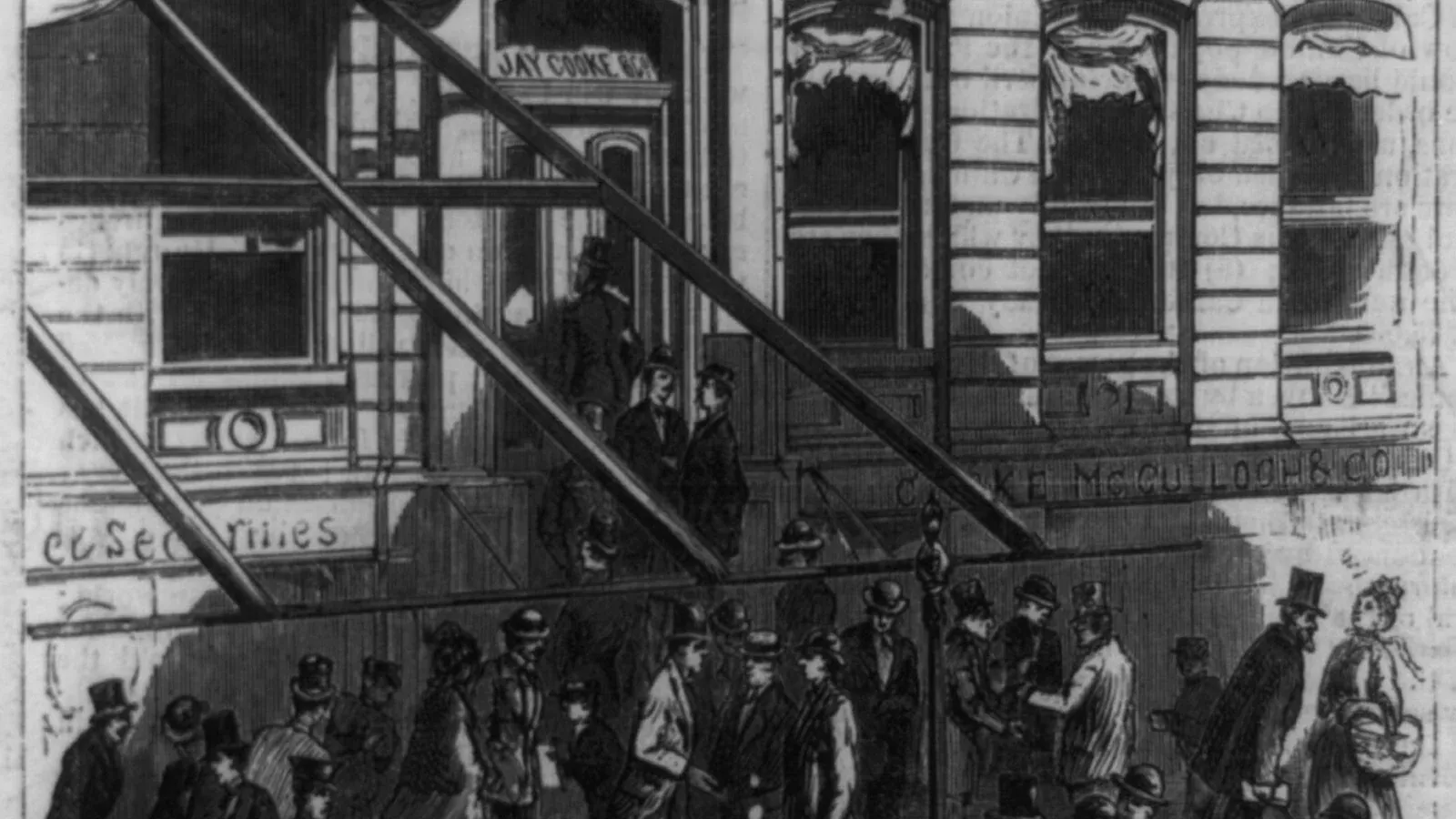
Railroads come closest on average spending, and they offer their own cautionary history. Jay Cooke & Company failed in 1873 after struggling to sell bonds for the Northern Pacific Railway, helping trigger a financial panic.
But size alone doesn't tell us how this ends. The paper describes a scenario, not a forecast, and stops short of finding systemic risk comparable to earlier credit booms. The averages also smooth out the peaks: railroad investment exceeded 4% of GDP in individual years, while the AI scenario reaches 5.1% in 2032.
What interests me more is who carries the risk. The paper looks at exposure through banks, insurers, and private credit funds, including financing arrangements that can make shared risks harder to see. If several lenders depend on the same AI customers to repay them, trouble at those customers could spread. That's where Schmid's question becomes concrete.
Higher yields add pressure
Then there's the bond market. The 10-year Treasury yield topped 5.17% on Thursday, its highest since July 2007, CNBC reported. Two weeks earlier it was below 4.8%.
John Roque, head of technical analysis at 22V Research, counted 16 times since 1970 that yields rose this fast, and CNBC reported that each one was followed by some kind of financial disruption. "As sure as day follows night, when the 10-year Treasury yield rises, something gets knocked out," Roque told CNBC. "It just pays to be cautious." That historical pattern doesn't tell us what will break this time, or whether AI financing will be the weak point.
CNBC reported that traders pointed to private credit and heavily indebted AI data center projects as possible weak spots.
The Fed isn't easing up either. It raised rates a quarter point on September 16, to a range of 3.75% to 4%, and Schmid said in a speech two days later that he backed the move. "Inflation is my primary concern as I think about the correct course for monetary policy," he said.
Put all of that together, and "too big to fail" stops sounding like a safety net. In 2008, a lot of the banks survived and a lot of their shareholders still got crushed. The next things to watch are whether the Fed digs into who holds AI debt, where the 10-year yield goes, and regional banks, the group CNBC flagged. Our AI Bubble Index tracks the other side of this, from the commitment gap to insider selling.
I am not a financial advisor, and nothing here is investment advice.