Key points
- Ex-Groq engineers sue the board in Delaware
- They call Nvidia's deal a sale without a vote
- The case raises an unsettled legal question
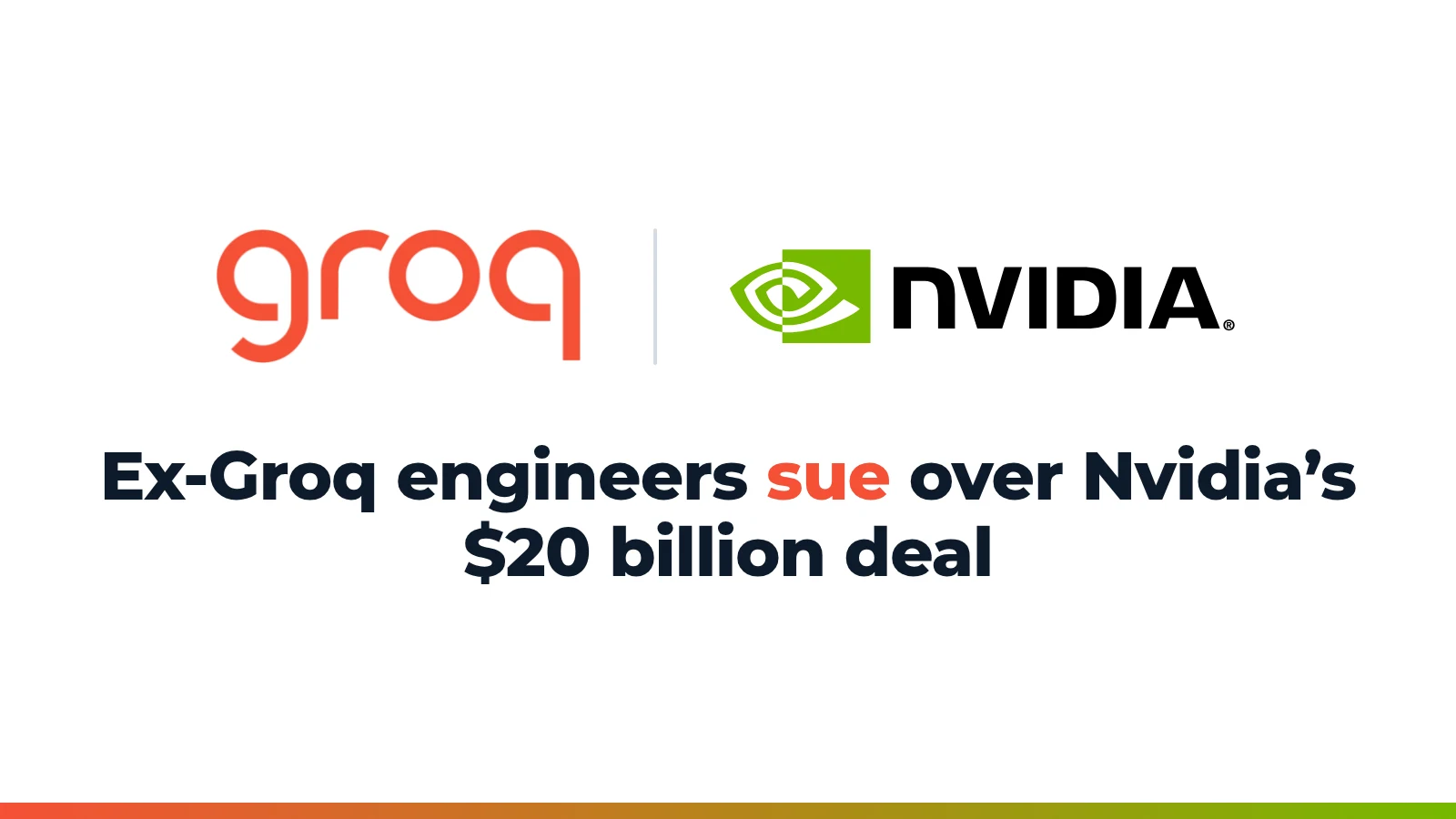
Two former Groq engineers have sued the startup's board, arguing that Nvidia's (NVDA) $20 billion deal for Groq's technology and engineers was a sale in everything but name and left other stockholders shortchanged. Benjamin Serebrin and Joshua Rubin filed the proposed class and derivative suit in the Delaware Court of Chancery on October 2, the Financial Times reported.
Groq has called the lawsuit "meritless" and said its agreement with Nvidia delivered "exceptional value," The Post reported. Nvidia declined to comment.
The deal was structured as a license, not an acquisition
Groq announced the arrangement on December 24, 2025, as a non-exclusive license of its inference technology. Groq founder Jonathan Ross, president Sunny Madra, and other senior executives joined Nvidia, while Groq said it would continue as an independent company.
The $20 billion came in two parts. A $17 billion licensing fee was shared among Groq's backers, and a separate $3 billion pool of Nvidia stock went to certain engineers who joined Nvidia, including Ross. The suit says Nvidia hired "nearly all" of Groq's engineers, estimated at as many as 200 people.
The Justice Department is also investigating whether the deal was structured to avoid antitrust review, The New York Times reported in September.
Former employees say they received less for their shares
Serebrin and Rubin had left Groq but still owned shares when the deal was announced. They allege that senior management and affiliated funds benefited at other stockholders’ expense.
The complaint says common stockholders were bought out cheaply, while Ross and other top employees joining Nvidia could "take a discount on those shares and be paid separately for following the technology to Nvidia."
Because the $17 billion fee was taxed as income to Groq before reaching stockholders, the complaint says the licensing structure cost roughly $3.5 billion through double taxation, according to Mogin Law’s summary of the complaint.
Nvidia later participated in a funding round that valued the remaining Groq business at $3.5 billion. The plaintiffs say that valuation was well above the one used to buy out their shares. Groq had shifted to AI cloud services and stopped designing its own chips.
The plaintiffs also criticize four funds represented on Groq’s board: BlackRock, Social Capital, Infinitum, and Disruptive. None is named as a defendant.
An unsettled question for Delaware courts
The suit names Groq's directors, officers, and successor entity as defendants. The plaintiffs argue that licensing the technology and hiring the team should trigger the shareholder protections that apply to a sale, including a vote and a duty to seek the best price.
"No Delaware decision has directly answered the question this case raises," they wrote.
That’s what I’ll be watching. Meta, Microsoft, and Google have struck similar licensing-and-hiring deals in AI. A ruling for the plaintiffs could give shareholders more grounds to challenge those arrangements.