Key points
- The AI chip boom depends on a handful of obscure materials that get almost no coverage, several controlled by a single company, country, or even one small town.
- Japan dominates the chemistry: it makes about 95% of the EUV photoresist that prints leading-edge chips, and one company, Ajinomoto, makes nearly all the ABF film that every AI processor is built on.
- Other chokepoints include high-purity quartz from Spruce Pine, North Carolina, neon gas long sourced from Ukraine, and gallium and germanium, where China controls most supply and has used export bans as leverage.
- The honest read: these are real concentration risks, but most cannot be invested in directly, and the industry has worked through several of them before.
Ask most people which companies the AI boom runs on and you will hear Nvidia (NVDA), TSMC (TSM), maybe Micron (MU) or Broadcom (AVGO). All true. But underneath those famous names sits a layer almost nobody talks about: a short list of obscure materials and components that the entire chip industry depends on, and that are often made by a single company, in a single country, or in one small town. If any of them seized up for long, it would not just dent a stock. It would slow the whole AI build-out. Here are the ones that matter, who controls them, and, just as important, how big the risk really is, because some of these stories are scarier in headlines than in reality. For the bigger map of the chip supply chain, see our explainer on chip foundries and the AI stock map.
1. ABF substrate: the film every AI chip is built on
Start with the strangest one. Before a finished AI processor reaches a server, the silicon die is mounted on a small platform called an IC substrate, which fans the chip's microscopic wiring out to something a circuit board can connect to. Those advanced substrates are built up in layers from a special insulating film called ABF, short for Ajinomoto Build-up Film. Yes, that Ajinomoto, the Japanese company best known for MSG seasoning. The film is a spin-off of its amino-acid chemistry, and it has a property that makes it nearly irreplaceable: it contains no woven glass, so lasers can drill the ultra-fine connections that dense chips need.
Here is the chokepoint. Ajinomoto makes essentially all of it, with estimates of its market share running from about 95 percent to over 98 percent (Convergence Analysis). The substrates themselves are made by a small group of companies, led by Ibiden (4062.T) and Unimicron (3037.TW), with Shinko (6967.T) and Austria's AT&S in the mix. More than 45 percent of substrate production sits in Taiwan. And AI makes it worse, because AI accelerators use far larger, higher-layer substrates than ordinary processors, so each one soaks up much more ABF. As the wafer and memory shortages ease, analysts increasingly call ABF substrate the next bottleneck in the chain. Ajinomoto, which trades in Tokyo as 2802.T and over the counter as AJINY, is expanding capacity, but slowly.
2. Photoresist: the chemistry Japan quietly owns
Making a chip means printing circuit patterns onto silicon with light, over and over. The light-sensitive coating that makes that printing possible is called photoresist, and it runs through one of the most concentrated supply chains on earth. Japan makes roughly 70 to 80 percent of all photoresist, more than 90 percent of the high-end kind, and around 95 percent of the EUV photoresist used to print the most advanced AI chips. Three Japanese firms, JSR, Tokyo Ohka Kogyo (4186.T) and Shin-Etsu Chemical (4063.T), account for more than 90 percent of that EUV segment.
It is not just resist. According to the Center for Strategic and International Studies, Japan holds more than half the global market in 14 of the 15 most critical chipmaking materials (CSIS). The world got a preview of what that concentration means in 2019, when Japan put export controls on three chemicals, photoresist among them, that South Korea's chip industry relied on. It was a political dispute, and it sent Korea scrambling for alternatives (USITC). One more wrinkle worth knowing: JSR, the world's largest photoresist maker, was taken private by a Japanese government-backed fund in 2024, so the single most important resist supplier is now effectively state-controlled.
3. High-purity quartz: the one small town that makes silicon possible
To grow the silicon crystals that become wafers, you melt silicon in a crucible made of extremely pure fused quartz. The molten silicon touches that crucible directly, so any impurity ruins the batch, which means only the purest quartz on the planet will do. And a startling share of that quartz comes from one place: Spruce Pine, a small town in the mountains of western North Carolina. Estimates run from about 70 to 90 percent of the world's high-purity quartz (NPR). Two private companies mine it there, Sibelco and The Quartz Corp, and together they control most of global supply.
The risk became real in 2024, when Hurricane Helene flooded the region and both operators halted work for a time before restarting. But here is the honest part, the part the scarier headlines skip: Spruce Pine is not literally irreplaceable. Synthetic quartz and lower-purity feedstock exist, they just cost more and yield less (Construction Physics). So treat this as a real concentration risk with no quick substitute, not a doomsday switch. There is also no clean way to invest in it directly, since the key players are private.
4. Neon gas: the chokepoint the industry actually managed
The deep-ultraviolet lasers that older lithography machines use run on a gas mix that is more than 95 percent neon. And for years, an outsized share of the world's neon, including roughly 90 percent of the US semiconductor-grade supply, was purified in Ukraine, much of it a byproduct of steelmaking (CSIS). When Russia invaded in 2022, two Ukrainian suppliers shut down and neon prices spiked several times over.
This one is worth studying because of how it ended, which was not in disaster. Chipmakers had stockpiled neon after a smaller scare in 2014, lithography tools were retooled to use and recycle less of it, buyers shifted to Chinese supply, and the newest EUV machines do not use neon at all. By 2023, prices had come back down and the feared shutdown never happened. It is the clearest example that a scary-looking chokepoint and an actual catastrophe are not the same thing.
5. Gallium and germanium: China's mineral lever
Two more materials sit further upstream. Gallium goes into the compound semiconductors used in fast chargers, 5G, radar and electric-vehicle power electronics; germanium goes into fiber-optic cable, infrared optics and some chips. China dominates both, producing roughly 98 to 99 percent of the world's primary gallium and somewhere between 60 and 77 percent of germanium (CSIS, drawing on US Geological Survey data).
And unlike the others, this chokepoint has openly been used as a weapon. China imposed export licenses on gallium and germanium in 2023, then banned exports of both to the United States outright in December 2024, after Washington tightened its own chip-equipment controls. Prices jumped and US buyers had to route material through third countries. In late 2025, China suspended that ban until November 27, 2026 as part of a trade truce, but it left the licensing system in place and kept restrictions on military end-users (CNBC). In other words, the chokepoint is paused, not removed, and the same lever hangs over rare-earth magnets, antimony and tungsten too. There are emerging non-Chinese recycling and recovery projects, but no established US-listed pure-play producer exists today.
What it means for investors
The uncomfortable pattern across all five is concentration. The film, the chemistry, the quartz, the gas and the minerals each run through a single company, a single country, or a single town. That is a hidden tail risk sitting underneath every AI hardware stock you own, from Nvidia to TSMC to the memory makers we covered in the memory giants piece. A serious disruption in any of these layers would ripple through all of them at once.
The frustrating part is that most of these chokepoints are hard to invest in directly. The standouts are foreign-listed, like Ajinomoto, Ibiden, Shin-Etsu and Tokyo Ohka, or outright private, like the Spruce Pine quartz miners, and the gallium and germanium plays are mostly early-stage recyclers and recovery projects, not producers. So the real value here is not a hot stock tip. It is understanding the risk: knowing that when a hurricane hits one Carolina town, or one government changes one export rule, the whole AI trade has a soft spot that the headlines about Nvidia never mention.
The honest bottom line
These are genuine concentration risks, and they are worth watching. But they are not all doomsday switches. The neon scare was managed. The quartz has imperfect substitutes. The gallium ban is, for now, suspended. The lesson is not to panic every time one of these names trends. It is to know they exist, to watch for the moments when one of them actually breaks, and to understand that the AI build-out, for all its trillion-dollar momentum, rests on a surprisingly thin and concentrated foundation.
This article is for general education, not investment advice. Figures are approximate and current as of mid-2026; market shares and export rules change over time. Several of the companies named trade only on foreign exchanges. Do your own research.
For a live example of the EUV chokepoint, China's Institute of Microelectronics built gate-all-around transistors without EUV in September.
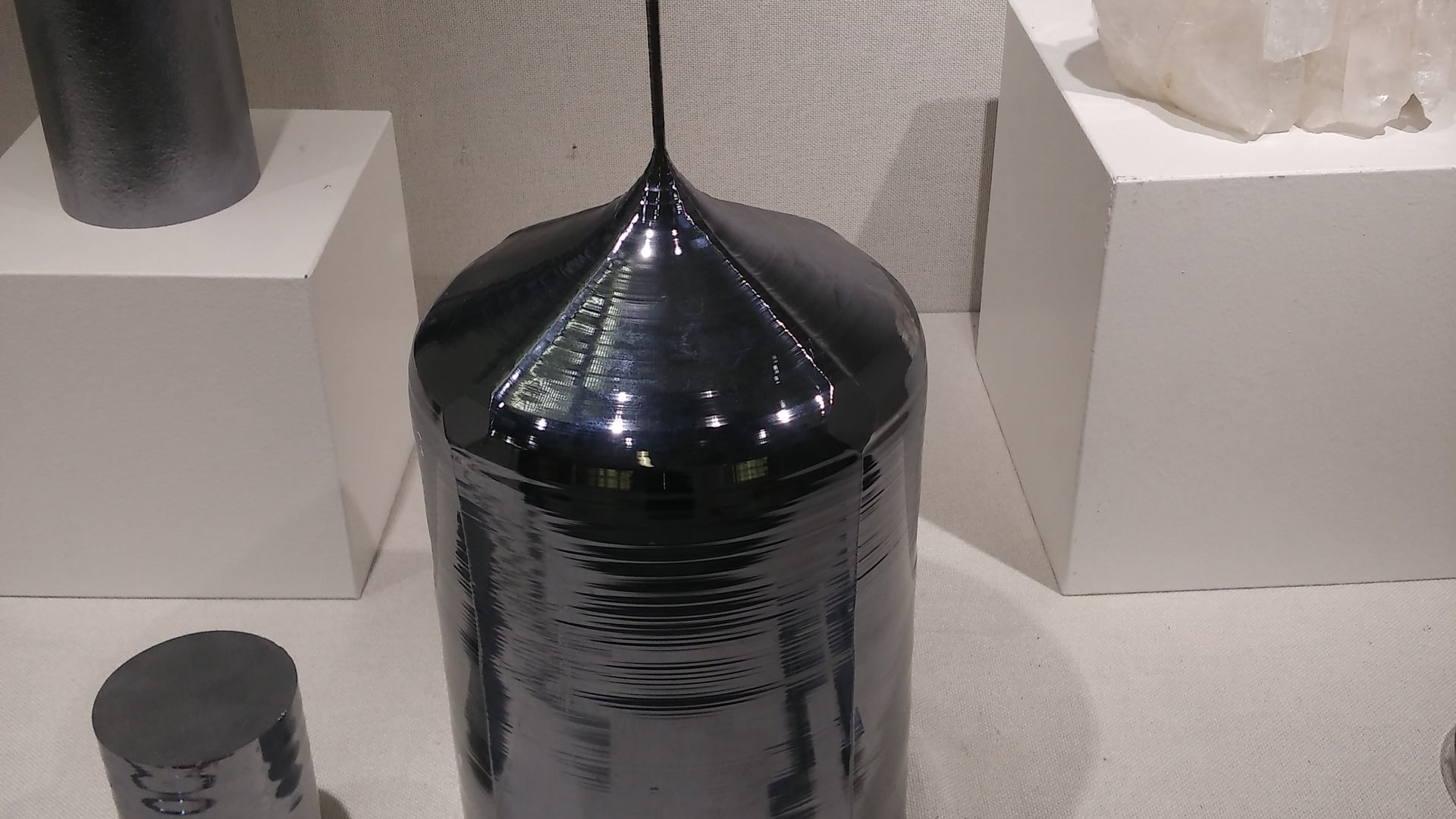
Cover photo: a monocrystalline silicon ingot, with silicon pieces and a quartz cluster, by ArticCynda / Wikimedia Commons, CC0 (public domain), cropped.