Samsung leaves its longtime hall as a record 932 Chinese companies bring TVs, appliances and humanoid robots to IFA 2026
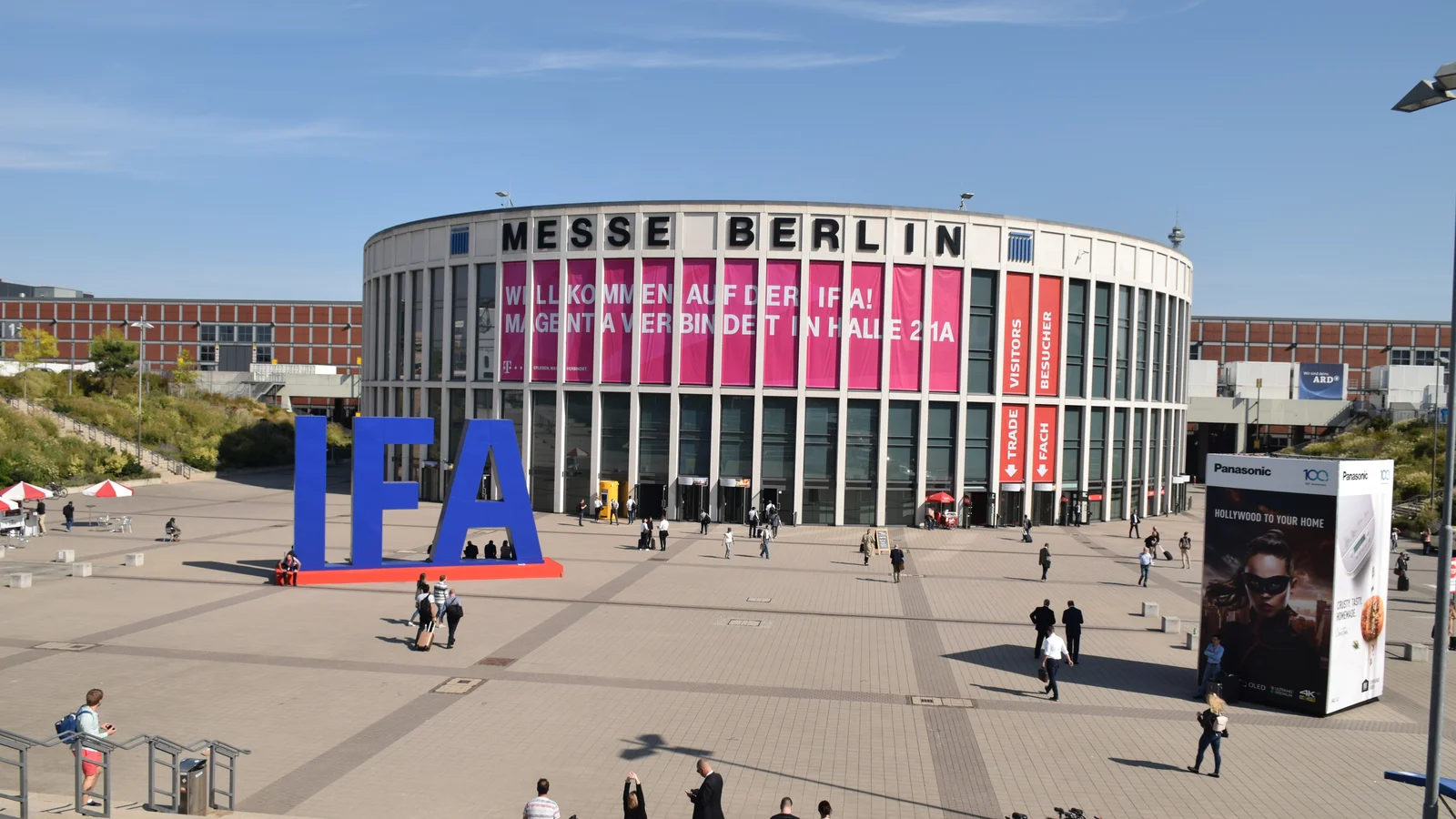
The south entrance of Messe Berlin during IFA 2018. Photo: Koky9999, CC BY-SA 4.0, via Wikimedia Commons.
Key points
- A record 932 Chinese companies are exhibiting at IFA 2026, nearly half of about 1,900 exhibitors
- Samsung moved off the Messe Berlin grounds for the first time since 1991, and Chinese firms took its old hall
- In Q1, Samsung held 31.3% of TV revenue but 18.5% of unit sales; TCL had 13.3% and 14.9%
- LG Electronics is up 119% in 2026 but 49% below its June 2 peak close of 392,500 won ($291)
On Friday, September 4, IFA 2026 opened in Berlin. It's the biggest home appliance show in Europe, and this year a record 932 Chinese companies are exhibiting, nearly half of the 1,900 or so exhibitors from 49 countries, according to Herald Economy (헤럴드경제) and EBN (이비엔). Newsis (뉴시스) put the increase at about 200 companies over last year.
The Chinese presence isn't only about the count. Xiaomi is at IFA for the first time, and Newsis reported that it took more than 3,300 square meters and put about 380 products on the floor, from phones to appliances to an electric car. Hisense and TCL built large booths around big TVs and smart home systems.
The robots got the most attention. AGIBOT and Unitree, the two Chinese companies at the top of the humanoid robot market, both came. Herald Economy reported that AGIBOT shipped 8,400 humanoid robots in the first half of the year, the most of any company, and Unitree 5,900. Newsis described IFA Next, the section for future technology, as practically a Chinese-only stage this year. Korea has its own push here, in the government physical AI project we covered this week.
Advertisement
Samsung leaves CityCube, and Chinese companies move in
Samsung Electronics (삼성전자) first exhibited at IFA in 1991, with a booth of 43 square meters. From 2014 it had CityCube Berlin, the fairground's largest hall, to itself. Last year its booth there covered about 6,000 square meters, the biggest of any exhibitor, Herald Economy reported.
This year the hall has no Samsung in it. The company moved its showcase, called Samsung CONNECT, to Humboldt Carré, a convention center in central Berlin, and ran it from September 2 to 6, opening two days before the show itself. Samsung's stated reason was closer contact with business customers, retail partners and media. Benjamin Braun, chief marketing officer of Samsung Europe, said in the company's announcement that "AI should deliver tangible benefits that people can see and experience in their everyday lives." Samsung is still the main sponsor of the IFA Creator Hub on the fairground, where it set up a Samsung AI escape room.
Into CityCube went dozens of companies, and the largest booth belonged to NAVEE (네이비), a Chinese electric scooter maker founded in 2021 that is part of the Dreame appliance group. XPENG (샤오펑), the Chinese electric car brand, showed cars and a flying car. Herald Economy's reporter wrote that the hall felt emptier than in past years, with much of it given over to business meeting space.
An industry official was quoted by Newsis as saying, "In the past, Samsung and LG Electronics set up large booths in IFA's main exhibition hall and stepped up their global marketing. Now Chinese companies have taken that spot."
Advertisement
Korean brands still control the premium TV market
The TV numbers show both sides. In the first quarter, Samsung had 31.3 percent of global TV revenue, its 21st straight year at the top, and LG Electronics (LG전자) had 14.8 percent, according to Omdia figures reported by ZDNet Korea. TCL was at 13.3 percent and Hisense at 10.6 percent. Count TVs instead of dollars and the picture changes. Samsung's share of units was 18.5 percent, down 0.7 point, while TCL's was 14.9 percent, up 1.2 points. The distance between them shrank from 5.5 points a year earlier to 3.6. LG was fourth in units at 10.2 percent.
So Chinese brands are winning on volume and the Korean brands are holding the expensive end. Even there the fight goes both ways. In the second quarter Samsung took the lead in mini LED TVs with 28.2 percent, after TCL had led the first quarter with 30.2 percent, and Hisense's share of the new RGB LED category fell from 77.2 percent at the start of the year to 42.9 percent once Samsung and Sony entered, according to Omdia data reported by Daily Bizon (데일리비즈온).
LG's earnings have not cracked yet
LG Electronics is the purer appliance stock of the two, and its reported results do not yet show a clear hit from Chinese competition. On July 30 it reported second-quarter revenue of 23.83 trillion won ($17.64B) and operating profit of 1.579 trillion won ($1.17B), up 147 percent from a year earlier. About 300 billion won ($222M) of that was a net one-off gain, including a refund of tariffs paid on last year's US shipments, so the gain from the business itself was smaller than the headline number. Its home appliance division had revenue of 7.076 trillion won ($5.24B), its first quarter above 7 trillion, and an operating margin of 9.7 percent.
The stock has had a stranger year than the results. LG Electronics closed at 201,500 won ($149) on Friday. That's up 119 percent from the end of 2025, and 49 percent below its peak close of 392,500 won ($291) on June 2, by our arithmetic from Korea Exchange price data. Samsung Electronics closed at 255,500 won ($189), up 113 percent for the year.
Meanwhile, IFA runs through September 8, and the organizers expect more than 220,000 visitors from 140 countries, according to EBN.
The industry official's comment is translated from Korean. Benjamin Braun is quoted from Samsung's English-language announcement. Won figures are converted at 1,350.4 won to the dollar, the Seoul close on September 4.
Advertisement