Korean company LaonPeople rose 30% after joining a 70.2 billion won physical AI project. It hasn't said how much of the money is its own.
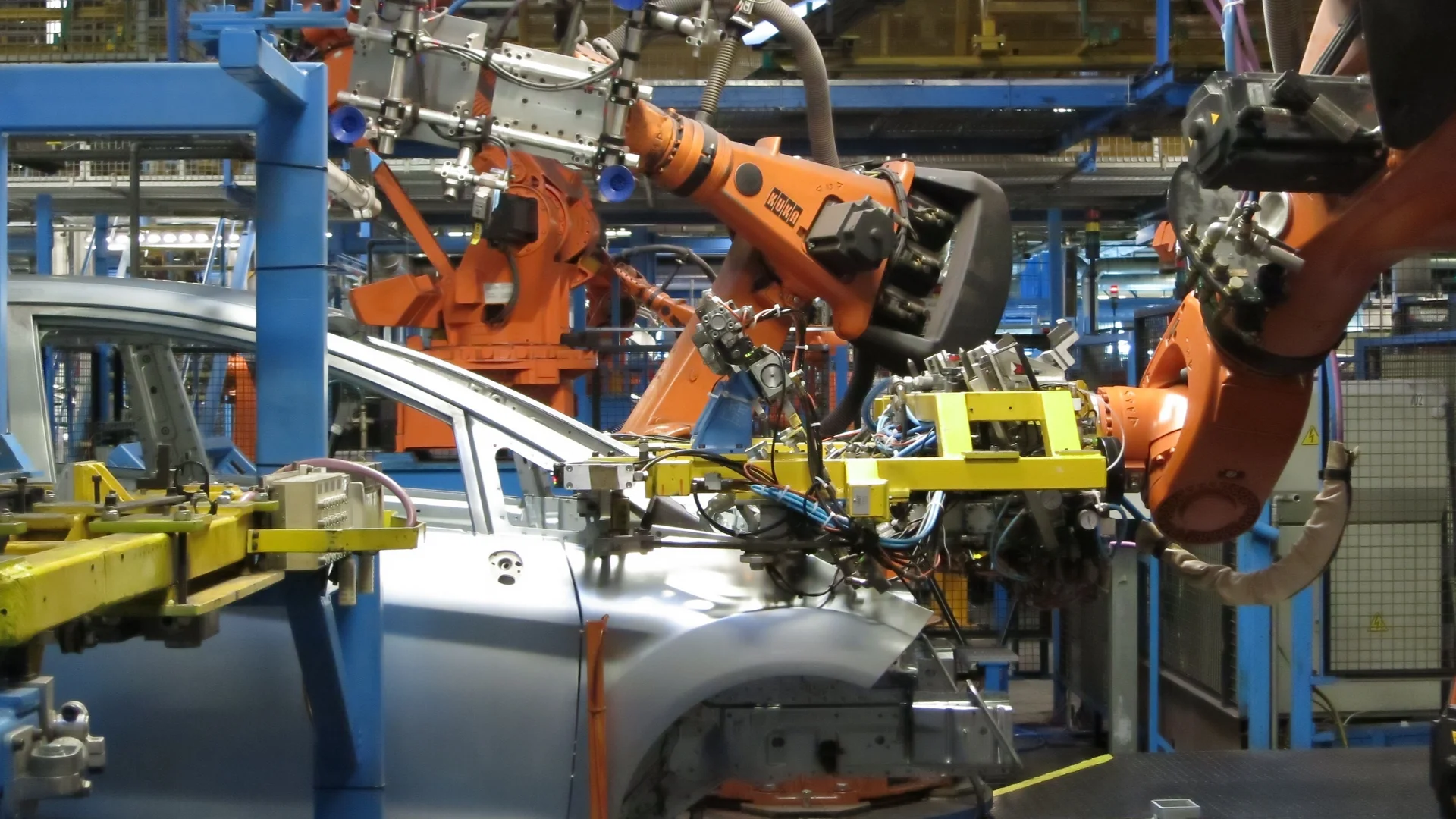
Robots on an automotive assembly line at Ford in Cologne, Germany. Photo: GillyBerlin / Wikimedia Commons, CC BY 2.0, cropped.
Key points
- LaonPeople closes at the 30% daily limit
- Picked for a 70.2 billion won physical AI project
- Fifteen groups share the money through 2030
- First-half revenue was 7.67 billion won
On September 3, LaonPeople (라온피플) closed at 3,220 won ($2.39 USD) on the Kosdaq, up 740 won and 29.84 percent, which is the most a Korean stock is allowed to rise in a day. The Kosdaq itself fell 1.71 percent. About 704,000 shares changed hands, against an average of about 101,000 a day over the previous month.
The reason was a government announcement. LaonPeople was selected as an implementing organization for the unmanned factory task in a Ministry of Science and ICT physical AI program. Its task is a specialized foundation model for physical AI in a software defined factory. The whole program is 70.2 billion won ($52M USD) over five years through 2030, and Korean press calls it the country's largest government project in physical AI, part of the public spending behind Korea's No. 3 ranking in the Stanford AI Index, according to Edaily (Korean language).
That 70.2 billion won is for a consortium of 15 companies, universities and research institutes, led by Jeonbuk National University and including NC AI. LaonPeople hasn't said what its own share of the budget is.
Advertisement
What LaonPeople is supposed to build
The goal of the program is a physical AI foundation model that can run a factory with no people in it, physical AI being the same phrase Nvidia uses for robots and machines that act in the real world. The model is meant to notice a production bottleneck or a machine failure as it happens, then reassign work and change the production plan on its own, which the Korean coverage describes as the brain of the factory.
LaonPeople's piece of that is the practical layer. It's building anomaly detection, predictive maintenance and process optimization for automotive parts plants and robot manufacturing lines, and an edge AI board that can plug directly into a robot and carry a vision language model and an AI agent on the device, according to HelloT (Korean language).
A LaonPeople official told the outlet that "As a company with industrial AI vision inspection technology, VLM technology, and experience and capability in agent based autonomous judgment all at the same time, LaonPeople is in a class of its own." That quote is translated from Korean.
The company's main business until now has been AI vision inspection for factories, the cameras and software that spot defective parts on a line. It sells an AI agent product for manufacturing under the name HI FENN, and it also has a golf business that sells AI golf sensors in North America and Australia.
Advertisement
The size of the company
The reason a consortium contract can move the stock 30 percent is how small LaonPeople is. Second-quarter revenue was 3.53 billion won ($2.6M USD), and revenue for the first half was 7.67 billion won ($5.7M USD), a little lower than a year earlier. The second quarter was the first in a year with a profit, an operating profit of 300 million won and a net profit of 1.07 billion won ($790K USD), an improvement of 3.58 billion won from the year-ago net loss. New orders in the first half were 10 billion won ($7.4M USD), up about 85 percent from 5.4 billion won a year earlier, HelloT reported in August (Korean language).
Nobody outside the consortium knows how the 70.2 billion won is divided. As a guide, an equal fifteenth of it would be about 940 million won ($700K USD) a year for five years, near 6 percent of the company's current annual revenue pace. The stock's 30 percent move assumes something well above an equal share.
The year before this was hard. In November 2025, LaonPeople announced a 25.5 billion won ($18.9M USD) rights issue, with 0.4 bonus shares for every share held to soften it for existing holders. Most of the money, 23 billion won, was to pay back a convertible bond early, and the stock fell about 15 percent the day it was announced. Its accumulated deficit at the time was 33.2 billion won, and cash had fallen from 38.5 billion won at the end of 2024 to 9.7 billion won by the third quarter of 2025, according to Newsis (Korean language). The shares ended August at 2,480 won ($1.84 USD).
In May, the company took part in two other government AI transformation projects, a 29.8 billion won ($22M USD) program with the Chungnam Technopark and a 22.8 billion won ($16.9M USD) program for a K-Display AX demonstration complex. Those also involve partners, so the same caution about the headline number applies.
The stock moved on the headline number. The number that will decide whether September 3 was justified is LaonPeople's share of it, and the company hasn't published that yet.
Advertisement