Key points
- Bae Jae-kyu, CEO of Korea Investment Management and known as the father of Korea's ETF market, told investors on Facebook to stop buying single-stock leverage ETFs, then deleted the post.
- His own firm sells the exact products he warned against, the ACE Samsung Electronics and ACE SK Hynix leverage ETFs.
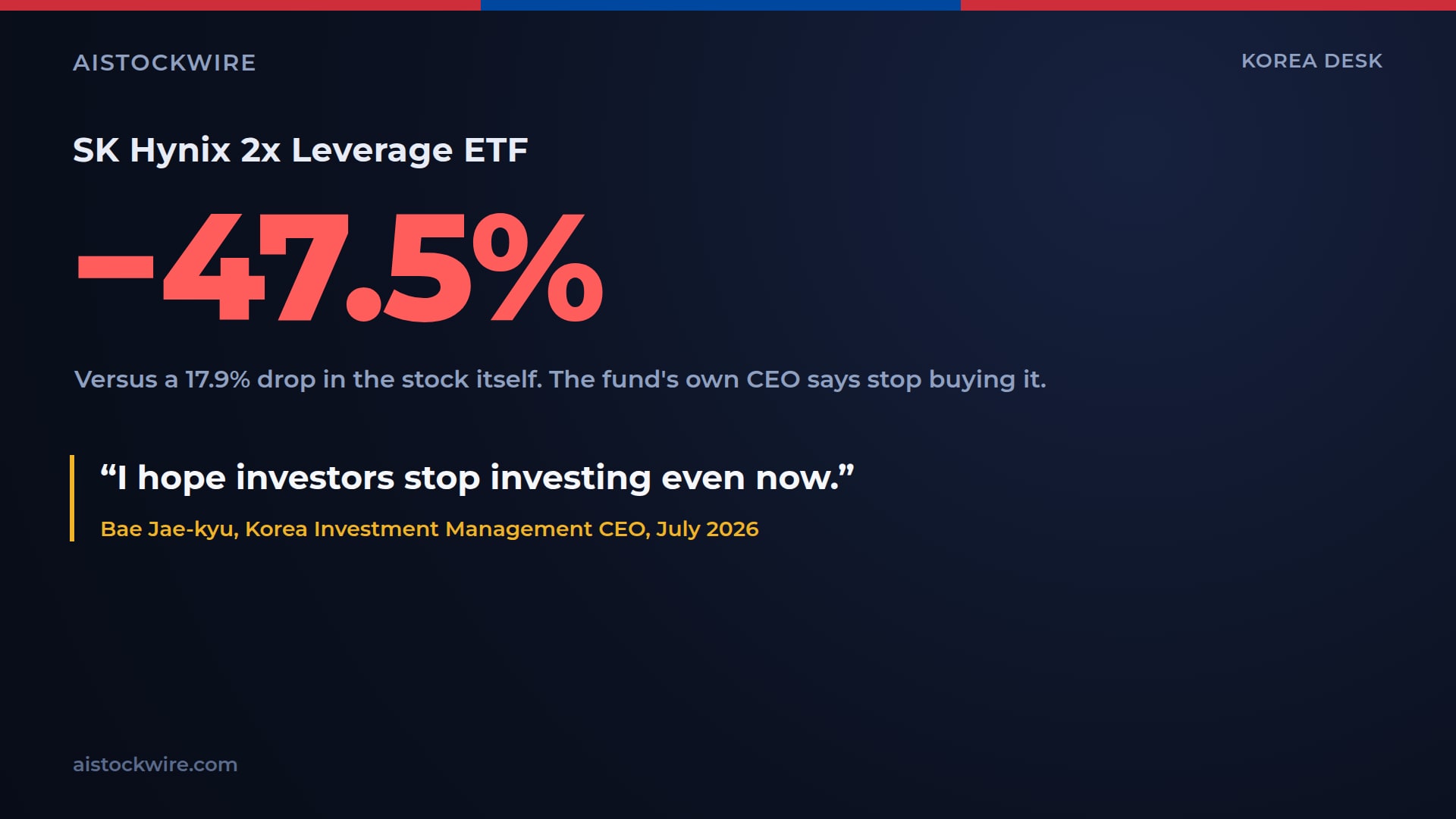
- SK Hynix fell 17.9% between May 27 and July 16, but its 2x leverage ETF lost 47.5%, far more than double.
- Lawmakers held a forum the same week, noting Korea's sell sidecar has triggered 38 times this year, versus 3 times in each of the last two years.
I did not expect to write the words "a fund company's own CEO told people to stop buying his fund," but that is what happened here this week. Bae Jae-kyu, chief executive of Korea Investment Management and widely credited as the person who built Korea's ETF market in the first place, posted on Facebook Monday telling investors to stop buying single-stock leverage and inverse ETFs. He deleted the post not long after. It was already seen and quoted by Korean media, and by Tuesday it was national news.
Prices, the exchange code and our full file on the company are on the SK Hynix page.
What he actually said
Bae did not soften it. He titled the post itself "Individual stock leverage and inverse 2x product performance analysis," then opened by apologizing: "As the head of an asset management company that operates individual-stock leverage ETFs, I am sorry to say this." He got to the point fast: "Don't invest in single-stock leverage or 2x inverse ETFs, that is the point of this post." Then he explained why, in plain terms: "Even if time passes and the original stock returns to where it was, there is a good chance the ETF price will not return to where it was. Especially when the underlying stock's volatility is as large as it is now, it is a structure where losses grow every day."
This is unusual for a reason beyond the bluntness. Korea Investment Management manages the ACE Samsung Electronics Single Stock Leverage ETF and the ACE SK Hynix Single Stock Leverage ETF, two of the exact products at the center of Korea's leverage ETF problem. Bae was not commenting on a rival's product. He was telling people not to buy his own company's.
The math behind the warning
Bae's core point is one I have touched on before, but his numbers make it concrete. Between May 27 and July 16, SK Hynix shares fell 17.9%. A fund that simply doubled that move would be down 35.8%. The actual 2x leverage ETF tracking SK Hynix fell 47.5%, an extra 11.7 percentage points worse than simple math would suggest. The 2x inverse version did not do better either: it lost 31.1%, instead of gaining the 35.8% a clean double would have delivered betting the other way.
The difference comes from daily compounding, sometimes called volatility decay. These funds reset their target multiple every single day, so a stock that whips up and down, even if it ends up near where it started, can leave the leveraged fund tracking it permanently behind. That is the mechanism Bae was warning people about: a stock recovering does not necessarily mean the leveraged ETF built on it recovers too.
Lawmakers piled on the same week
Bae's warning landed in the middle of a National Assembly forum on this exact issue. On July 21, four People Power Party lawmakers, Lee Jong-wook, Park Soo-young, and Kim Jang-gyeom, along with party leader Jang Dong-hyuk, held a policy discussion titled "Our Stock Market, Is This Okay? The Rollercoaster Samsung-SK Hynix Leverage ETF."
Lee Jong-wook did not hold back either: "This product has turned our stock market into an ultra-short-term speculation den. It has corrupted Samsung Electronics and SK Hynix, Korea's representative blue-chip companies, into gambling stocks." Park Soo-young offered the number that stuck with me most: "The sidecar was triggered 3 times last year, 3 times the year before, but already 38 times in just the first half of this year." A sidecar is a temporary pause on program-driven trading, short of a full market halt, but tripping it 38 times in six months is still remarkable. He called it, plainly, a casino.
A Sejong University business professor on the panel, Kim Dae-jong, noted that some of these leverage products have dropped nearly 70% from their highs, a figure that lines up with what I have written about how these funds amplify the Kospi's closing-hour moves. Other panelists floated a different fix: phase the products out gradually instead of banning them outright, paired with tougher rules on who can even buy in.
Why the existing fix has not slowed things down yet
The deposit hike does not kick in until July 31. Regulators plan to raise the minimum cash requirement to 30 million won, three times the current 10 million won floor. Trading has not waited around for that date. On the first full trading day after regulators announced the rule, combined volume in the Samsung and SK Hynix single-stock leverage ETFs still topped 12 trillion won, close to 8 billion dollars.
International coverage has not been kind either. Bloomberg said the leverage ETF saga risks overshadowing what Korea's broader market-boosting policies have accomplished. Reuters went further, calling Korea's stock market a wild casino outright, pointing to stocks trading at earnings multiples that no longer track their fundamentals. Hearing that kind of language about my own country's market is not comfortable to write, but it lines up with what the trading data and the country's own top ETF executive are both saying.
What happens next
Financial authorities say they will judge whether the deposit hike actually works before considering anything more. The National Assembly forum this week is a sign lawmakers do not plan to wait quietly for that verdict. The real test is whether a higher cash requirement alone can calm a market that tripped its sidecar 38 times in six months.
Sources
- Seoul Economic Daily (Korean language): Bae Jae-kyu's Facebook warning against single-stock leverage ETFs
- Herald Corp (Korean language): National Assembly forum on the Samsung and SK Hynix leverage ETFs
- Our earlier coverage: the original deposit crackdown and why these funds amplify the Kospi's closing-hour crashes
Figures in this piece are sourced from South Korean and international financial media as cited above, and public statements from Bae Jae-kyu and the National Assembly lawmakers named. This is not investment advice.