Key points
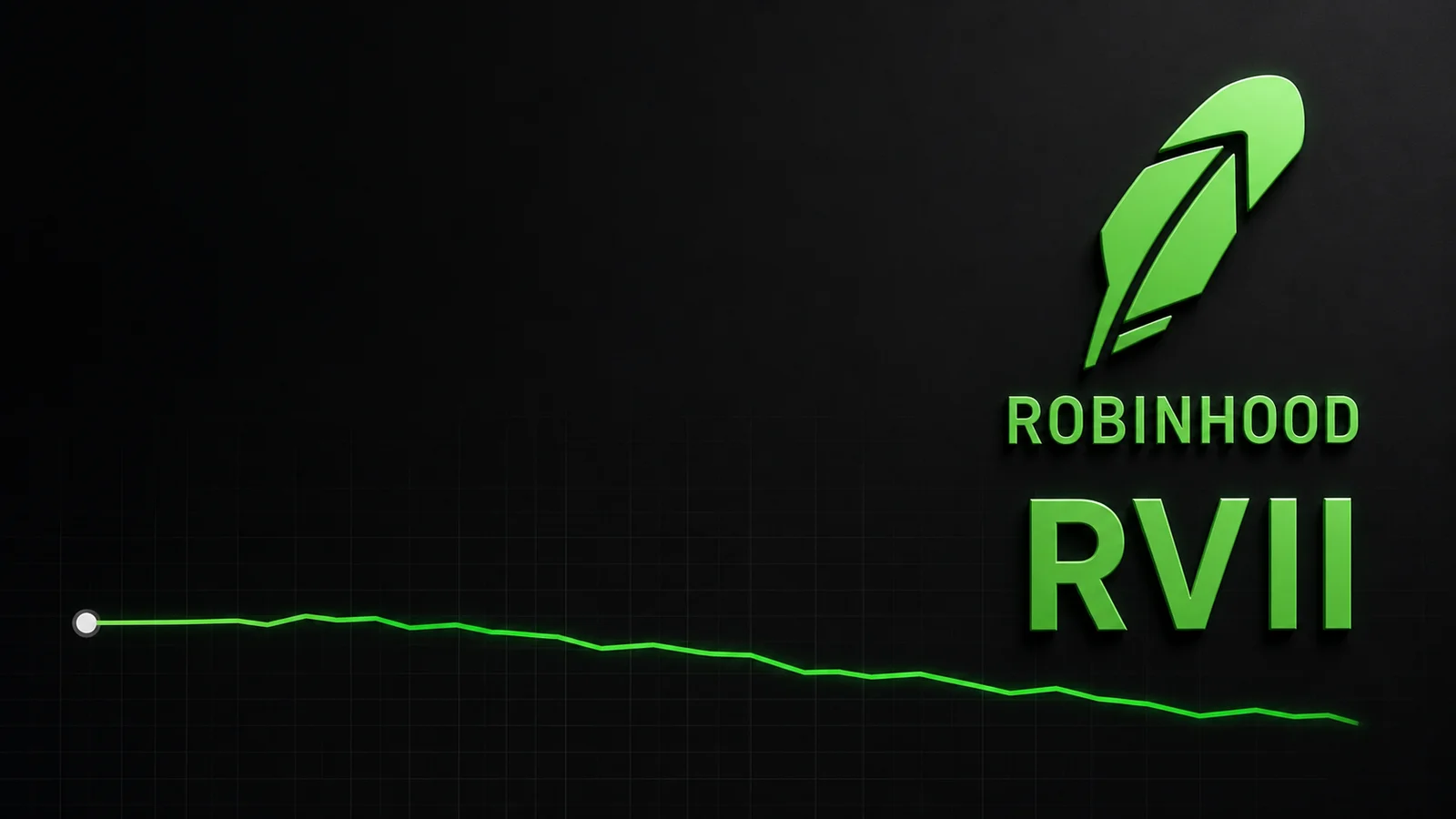
- Robinhood Ventures Fund II (RVII) listed on the NYSE on Aug. 13 at $25 per share. By Aug. 17, it traded near $23.85.
- The fund holds about 80 early-stage Y Combinator startups, most bought through $250,000 SAFEs. Robinhood put in $12.5 million of its own money.
- RVII charges a 2% base fee plus 20% of gains, with total annual expenses of 4.08% and a 4.5% sales load off the top.
- The offering generated approximately $225 million, although the prospectus allows as long as 36 months to deploy the proceeds.
Robinhood Markets (HOOD) listed its second venture fund on the New York Stock Exchange on Aug. 13. The fund, Robinhood Ventures Fund II (RVII), priced at $25 a share. After closing its first full session at $24.45 on Aug. 14, it changed hands near $23.85 on Aug. 17.
The vehicle is a business development company organized as a closed-end fund. Unlike an ETF or mutual fund, it does not redeem an investor's shares. Anyone seeking to exit must find a buyer on the exchange. There is no investment minimum or accredited-investor restriction, allowing any Robinhood customer to participate.
About 80 startups, mostly $250,000 each
RVII targets early-stage private businesses associated with startup accelerator Y Combinator. Its prospectus identifies about 80 portfolio companies. Nearly every holding takes the form of a SAFE, or simple agreement for future equity, which converts into shares later. Most commitments are $250,000. Two total $100,000 each, and another two total $1 million each.
The list leans hard toward artificial intelligence. Many of the companies describe an AI agent built for one job.
| Company | What it does | Check |
|---|---|---|
| Apollo Atomics | Ultra-compact nuclear reactors | $250,000 |
| Asimov Robotics | Robotic pit stops for self-driving cars | $250,000 |
| Oxus AI | Robotic birds for surveillance | $250,000 |
| Replicas Group | Phone numbers for AI agents | $250,000 |
| Known Quantity Labs | Liability insurance for AI agents | $250,000 |
| Rudus | AI agents that build personal injury cases | $250,000 |
The pattern repeats down the page. Replicas Group sells phone numbers for AI agents. Known Quantity Labs sells liability insurance for AI agents. Rudus builds AI agents that assemble personal injury cases. Robinhood says it will add more companies over time.
What it costs
RVII is expensive compared with most retail funds. It charges an annual management fee equal to 2% of net assets. Its adviser also receives 20% of realized capital gains, a compensation model associated with hedge funds. The prospectus projects total yearly expenses of 4.08%. IPO investors paid an additional 4.5% sales load, which the document says "will immediately reduce the net asset value of each Share purchased in this offering."
The fund is run by Robinhood Ventures DE, LLC, a unit of Robinhood Markets. Rich Aberman, a Y Combinator alumnus, is the portfolio manager. Sarah Pinto is president of the fund. Goldman Sachs led the underwriting.
The initial sale covered 8 million shares at $25, raising $200 million. Underwriters received an option to purchase another 1.2 million shares, and reports placed the eventual proceeds near $225 million. Robinhood held 500,000 shares before the IPO, representing a $12.5 million investment.
Most of that money is not invested yet. The audited balance sheet dated March 31, 2026 showed $8.85 million in SAFEs against $12.1 million in net assets. The prospectus says the fund expects to invest the proceeds "within 36 months." Until it does, buyers pay the 2% management fee on a large pile of cash.
How it compares to Fund I
Robinhood launched its first venture fund, Robinhood Ventures Fund I (RVI), in March. The two are different bets. Fund I is concentrated in large, late-stage private companies, with widely reported stakes in SpaceX and OpenAI. Fund II is spread across dozens of small, early-stage startups. Fund I charges no performance fee; Fund II takes 20% of gains. On Aug. 17, RVI traded near $28.75, above its own $25 IPO price, while RVII traded below.
Big investors have crowded into a handful of late-stage private names, and Saudi Arabia's wealth fund alone holds about $26 billion of SpaceX. Higher up the risk curve, appetite has been uneven. SpaceX itself briefly fell below its IPO price in July.
Closed-end funds that hold private companies can trade far from the value of what they own. Destiny Tech100 (DXYZ), a similar exchange-listed fund, has traded at large premiums to its net asset value, and changed hands near $34.02 on Aug. 17. RVII has gone the other way in its first days, trading at a discount.
Robinhood tells buyers plainly what they are getting. The prospectus warns that an active trading market may not develop, and that investors "may not have access to the funds they invest ... for an indefinite period."
Robinhood has been buying as well as listing. It added Crypto.com prediction markets and a stake in the exchange behind them.