Key points
- The S&P 500's top five stocks now match the bottom 434, Michael Batnick says
- Our own count came out at 431
- Batnick's count was 282 in 2018 and 350 in 2020
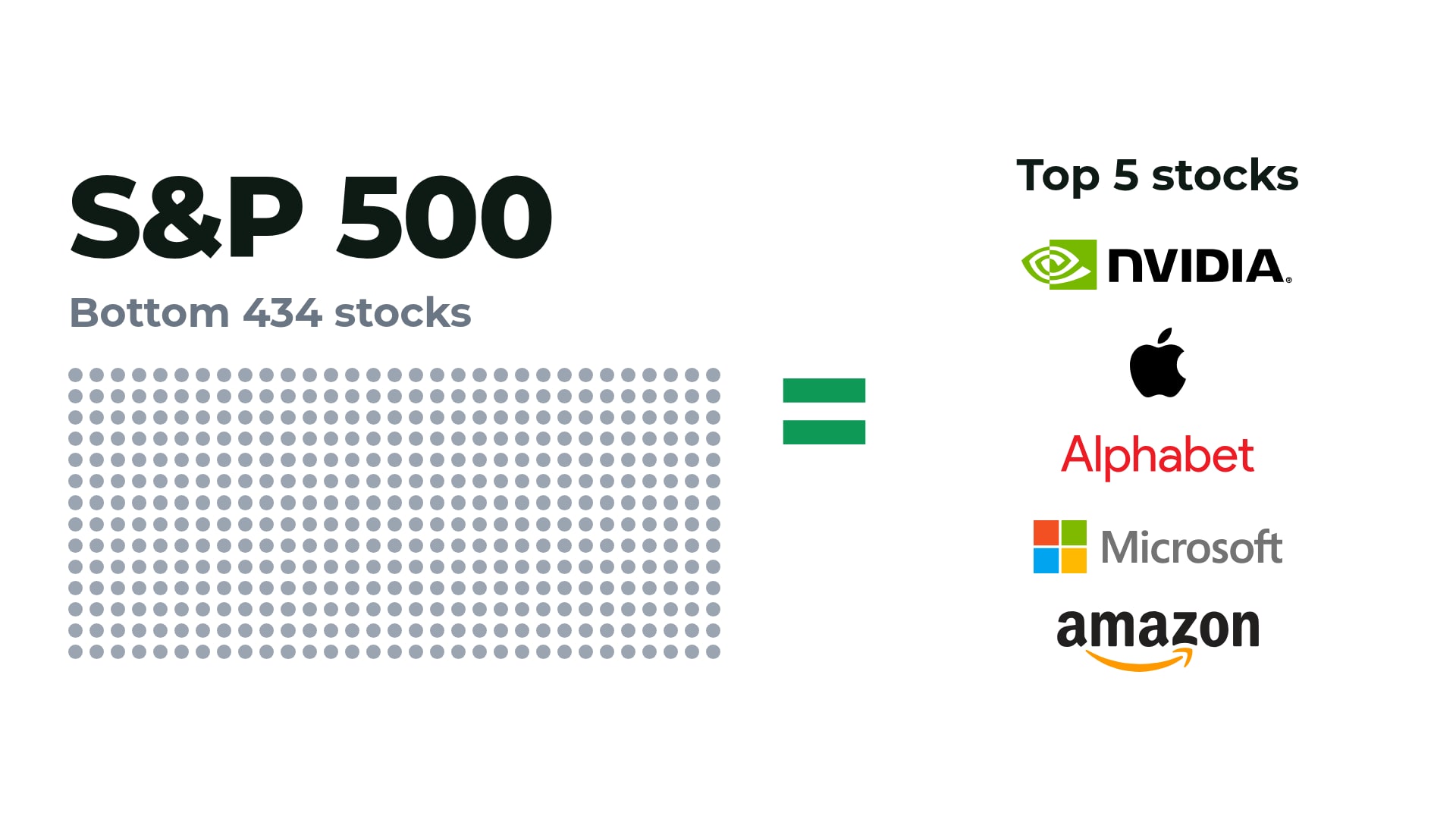
The five biggest stocks in the S&P 500 are now worth as much as the bottom 434 combined, Michael Batnick of Ritholtz Wealth Management posted on X on Oct. 8. "One of the main reasons so many breadth indicators are off the charts is because the concentration in the index is like nothing we've ever experienced," he wrote.
Batnick has been running this comparison for years, which is why I like it. There's a trail. In July 2018 he posted that the top five were worth "$4,095,058,706,432" and the bottom 282 were worth "$4,092,769,755,136." In April 2020 he put the number at 350, measured by index weight. Now it's 434.
Our own count came out at 431
We ran the numbers ourselves using Yahoo Finance market values at the Oct. 8 close, counting Alphabet's two share classes as one company. The top five are Nvidia (NVDA) at $5.57 trillion, Apple (AAPL) at $4.97 trillion, Alphabet (GOOGL) at $4.26 trillion, Microsoft (MSFT) at $3.88 trillion, and Amazon (AMZN) at $2.74 trillion.
That's $21.4 trillion, or about 30% of the $71.0 trillion combined market value of all 500 companies. Adding up from the smallest company, the bottom 431 came to $21.3 trillion, roughly matching the top five. Our company-level market-value calculation produced a result similar to Batnick's, though it isn't necessarily calculated on the same basis as his.
The median S&P 500 company is worth about $45 billion. Microsoft, fourth on the list, is worth more than 85 times that. At the very bottom sits Mosaic, the fertilizer company, at $6.3 billion. Nvidia is worth nearly 900 Mosaics, and they're both in your index fund.
Five companies can keep the index near a record
On Sept. 21, the S&P 500 closed just 0.4% below its record while 30 of its stocks hit 52-week lows and only seven hit new highs. Concentration helps explain how those two things can happen together: gains in a few heavily weighted companies can offset weakness across many smaller ones.
Since then, the index has gone almost nowhere on net. It closed at 7,764.70 on Sept. 21 and 7,765.36 on Oct. 8, even after setting a record close of 7,818.93 on Oct. 6.
What surprised me was how close the equal-weight version has stayed this year. The Invesco S&P 500 Equal Weight ETF (RSP), which resets each company to an equal weight every quarter, returned 11.9% through Oct. 8, including dividends. The SPDR S&P 500 ETF Trust (SPY) returned 14.4% over the same period. Equal weighting trailed by 2.5 percentage points, but it still delivered a double-digit gain.
Five companies account for $31 of every $100 in SPY
On Oct. 5, I wrote about big pension funds trimming US stocks over AI concentration. An S&P 500 fund follows the index's weights. As of Oct. 8, that put about $31 of every $100 in SPY into these five companies, according to State Street's daily holdings file.
I don't read 434 as a signal to sell. The S&P 500 closed at 2,815.62 on the day of Batnick's 2018 post and 2,736.56 on the day of his 2020 post. Selling over concentration then and staying out would have meant missing the subsequent rally.
But the number does tell investors something about what they own. Holding 500 companies spreads exposure across many businesses; it doesn't spread the money evenly. Equal weighting reduces the influence of the largest companies, though it has delivered a lower return this year.
The five companies report earnings over the next several weeks. For an investor holding SPY, nearly a third of the fund will be reporting with them.
I am not a financial advisor, and nothing here is investment advice.