Key points
- SK Hynix's quarterly revenue passes a new milestone
- How SK Hynix adds up its shareholder return total
- SK Hynix shares Kioxia gains with shareholders
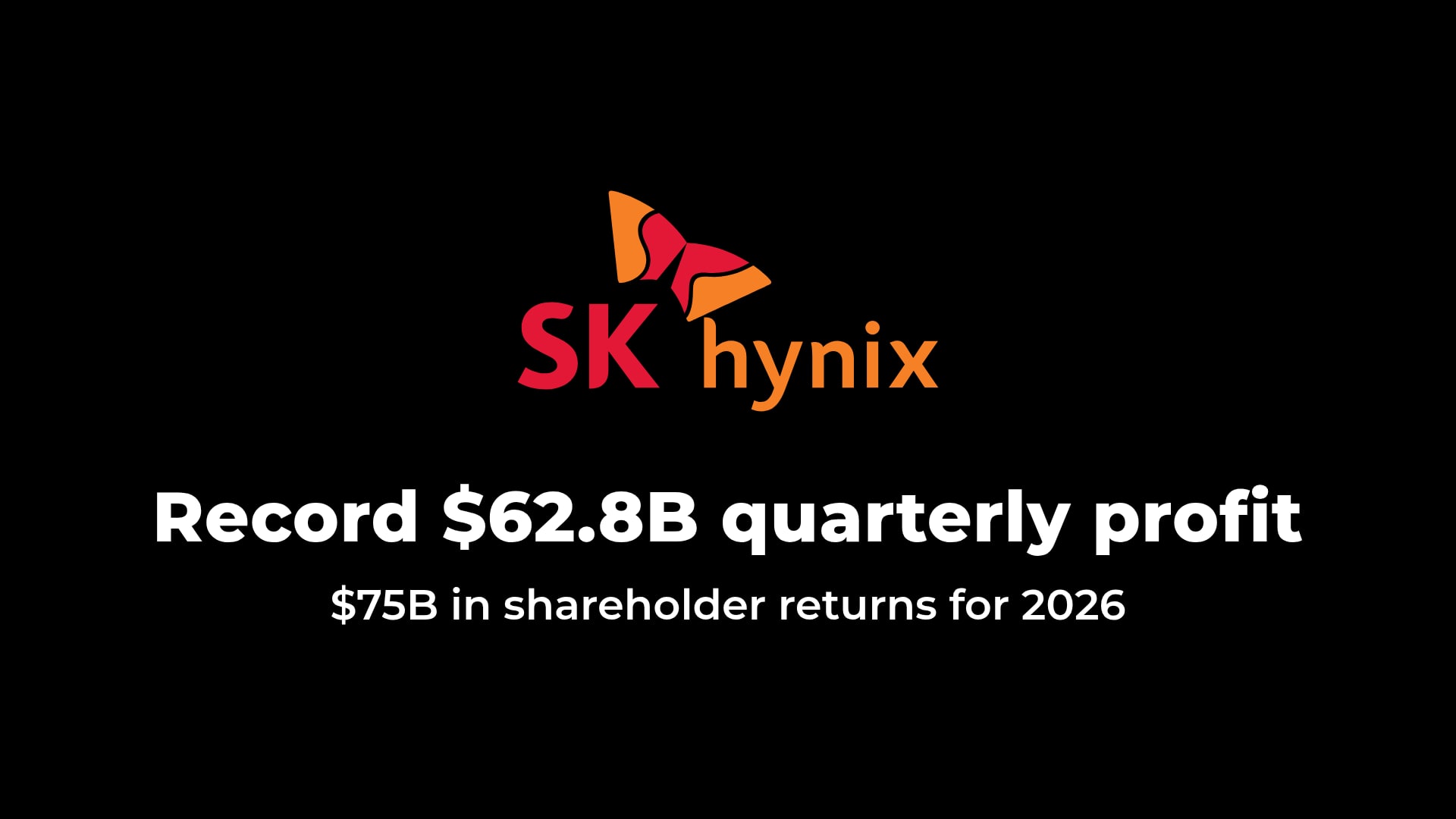
SK Hynix (000660) reported record third-quarter results on October 28 and said it plans about 100 trillion won ($75.3B) in shareholder returns for the full year.
Revenue reached 104.6 trillion won ($78.8B), the first time it has passed 100 trillion won in a single quarter. Operating profit was 83.3 trillion won ($62.8B), more than seven times the 11.4 trillion won ($8.6B) it earned a year earlier. Its operating margin, the share of revenue left as operating profit, was 80%.
Both figures beat analyst forecasts. The FnGuide average reported by Etoday (이투데이) called for 98.23 trillion won ($74.0B) in revenue and 76.96 trillion won ($58.0B) in operating profit. By our calculations, SK Hynix beat the revenue estimate by 6.5% and the profit estimate by 8.3%.
August's buyback is part of the 100 trillion won
SK Hynix put the total at about 100 trillion won and named two parts, at least 30 trillion won ($22.6B) in cash dividends and at least 60 trillion won ($45.2B) for buying back its own shares and canceling them. Both are minimums, and together they come to at least 90 trillion won ($67.8B). The company didn't say how the rest of the 100 trillion won would be split. Canceled shares are gone for good, so each share that's left owns a slightly bigger piece of the company.
SK Hynix ended September with 98.7 trillion won ($74.3B) in net cash, which is cash minus borrowings. Its shareholder return plan covers all of 2026.
The 60 trillion won includes the 40 trillion won ($30.1B) buyback SK Hynix approved in August. The company said that buyback was finished last week, and those shares will be canceled soon.
On October 28, the board approved a new 20 trillion won ($15.1B) buyback. Only half of it counts toward the shareholder total. SK Hynix will cancel 10 trillion won ($7.5B) of the shares and use the other 10 trillion won for employee compensation, which isn't part of the 100 trillion won.
According to Newspim (뉴스핌), SK Hynix's policy is to return at least half of its free cash flow to shareholders. Free cash flow is the cash a company has left after running the business and paying for factories and equipment.
SK Hynix shares Kioxia gains through a special dividend
The board also approved a third-quarter dividend of 20,000 won ($15) a share, about 14 trillion won ($10.5B) in total. Half of it, 10,000 won ($7.53), is a special dividend. SK Hynix said the special dividend shares the gains from its investment in Kioxia, the Japanese flash memory maker, and that most of the Kioxia gains realized this year will go to shareholders.
"Going forward, we will keep producing stable results based on solid growth in memory demand and our technology competitiveness, and we will keep sharing them with shareholders," SK Hynix said.
Net profit, what's left after all costs and taxes, was 39.8 trillion won ($30.0B), less than half of operating profit. The release didn't explain the difference.
SK Hynix expects demand to stay above supply through 2030
SK Hynix said it expects memory demand to stay above supply through 2030. The company has signed long-term supply agreements, or LTAs, with 14 major customers, and the volume under those contracts is more than half of its total production capacity for 2027 and 2028. A contract usually runs five years, and SK Hynix said it's also discussing ways to make that term longer.
HBM4 is the newest kind of high-bandwidth memory, the stacked memory that sits next to AI processors. SK Hynix expects HBM4 to pass the older HBM3E in both shipments and revenue in the fourth quarter. To make more HBM4, the company will raise its M15X plant to maximum capacity by the end of the year. SK Hynix also expects its investment to rise significantly next year, when the first plant at Yongin goes into full operation.
On its earnings call, SK Hynix said customers are asking for more than twice the HBM it can supply, according to iNews24 (아이뉴스24). Some customers are lowering the number of memory layers in each HBM stack from 12 to 8. SK Hynix said they're doing this to get more stacks out of a limited supply, so they can build more AI accelerators.
"Moves by some customers to adjust their HBM specifications are a clear example of demand overwhelming supply," the company said. It added that its medium- to long-term outlook for HBM demand hasn't changed.
SK Hynix shares rise after the results
SK Hynix shares were up 6.94% at 1,434,000 won ($1,080) as of 10:20 a.m. in Seoul on October 28. Samsung Electronics (005930) was up 7.43% at 238,500 won ($180), and the Kospi was up 5.26% at 5,934.87.
The Korea Exchange triggered a buy-side sidecar at 9:54 a.m., the second day in a row. A sidecar holds computer-driven program buying for five minutes after Kospi 200 futures stay 5% or more above the previous close for one minute. Foreign investors and institutions were net buyers early in the session, while individual investors were net sellers.
The gain follows a hard week for SK Hynix. Its shares fell 24.3% from October 8 to October 16, the biggest weekly drop since the 2008 financial crisis. That week included a 7.57% fall in the Kospi on October 15.
Meanwhile, Samsung Electronics releases its detailed third-quarter results on October 29.
The company statement is translated from Korean. Won figures are converted at 1,328 won to the dollar, the Naver Finance rate on October 27, 2026.