Key points
- SK Hynix HBM share falls to 50% in Q2
- Samsung more than doubles to 33% in a year
- Micron (MU) falls from 21% to 18%
- Most HBM revenue is still HBM3E, not HBM4
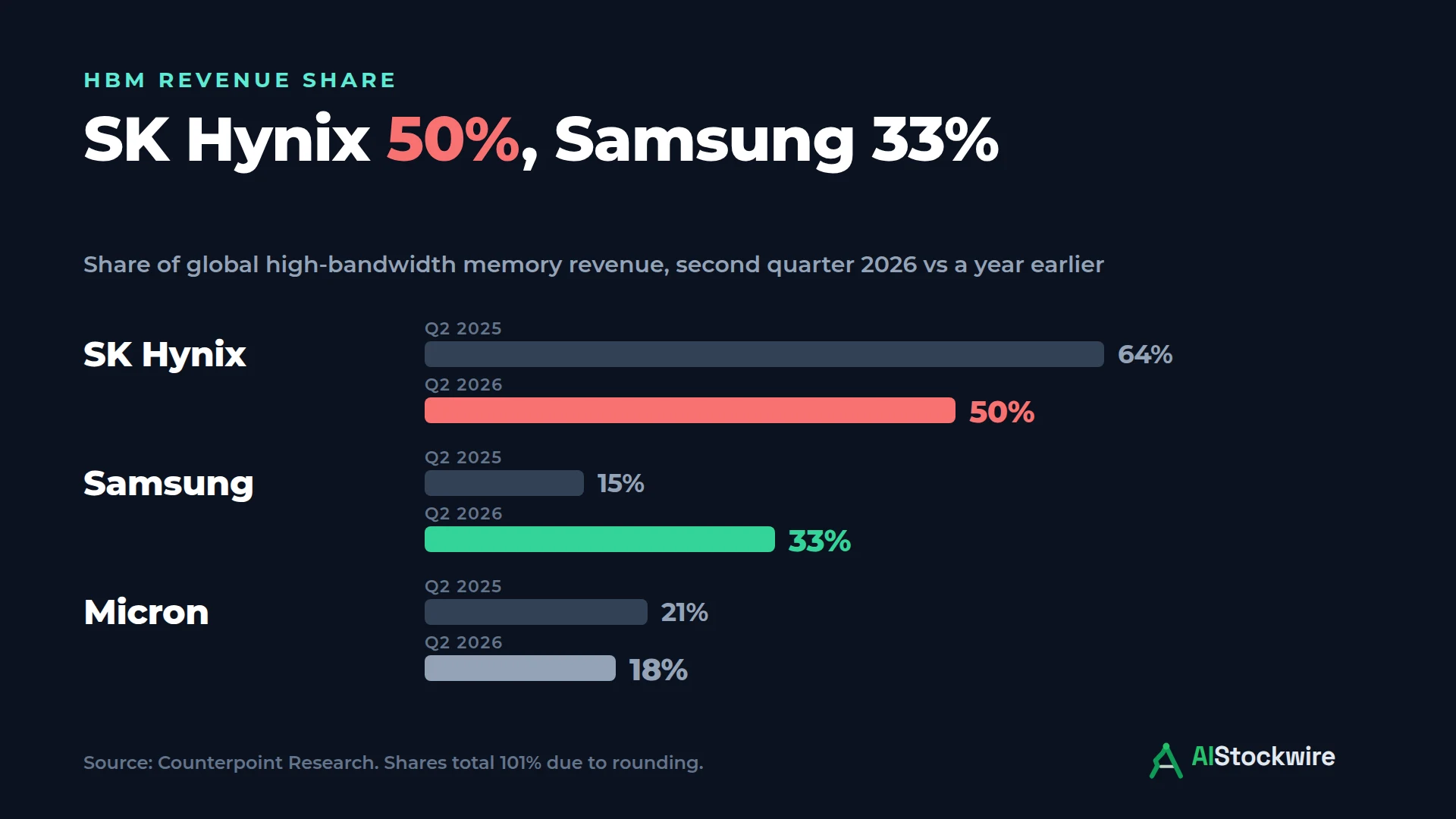
On September 3, the Korean press picked up a Counterpoint Research report on which companies earned the most from high-bandwidth memory in the second quarter. SK Hynix (SKHY) is still first, with 50 percent of HBM revenue. A year ago it had 64 percent. Samsung Electronics is second with 33 percent, up from 15 percent a year ago. Micron (MU) is third with 18 percent, according to eToday (Korean language). The three add up to 101 percent, which Counterpoint says is rounding.
Our HBM memory stocks page sorts the names into makers, packaging, equipment and interface silicon.
The short version is that Samsung took most of what SK Hynix lost. A year ago SK Hynix was 49 points ahead of Samsung. Now it's 17 points ahead.
The same thing happened inside the latest quarter, only faster. From the first quarter to the second, SK Hynix went from 58 percent to 50, Samsung went from 21 percent to 33, and Micron slipped from 21 percent to 18. Samsung was the only one of the three that gained. In share terms its year-over-year rise is a 120 percent increase, by our arithmetic.
Samsung has been at least tied for second since the third quarter of 2025. The second quarter is the first time it's clearly ahead of Micron. A year earlier it was behind Micron.
Samsung narrowed the gap before HBM4 became a major driver
The product mix will matter over the next few quarters. Counterpoint wrote that "most of the HBM revenue comes from HBM3E, and shipments of HBM4 are expected to become visible in the second half of the year," and that Samsung is "expected to gradually increase its market share with the shipment of HBM4," in its quarterly share tracker. Those quotes are in the original English.
So the share Samsung took in the second quarter came mostly from the older generation, HBM3E, which it was late to. HBM4 is in the numbers too, just not yet large enough to drive most of the industry's revenue. Samsung started shipping HBM4 in volume on February 12, and Financial News reported in June (Korean language), citing industry sources and the company, that HBM4 sales had passed $1 billion in about four months. That figure hasn't been confirmed in a Samsung filing.
We wrote in August about the forecasts that have Samsung's HBM4 yields catching SK Hynix by 2027. The Counterpoint numbers show Samsung sharply narrowing the difference while HBM4 was still too small to drive the totals.
A smaller share of a much bigger market
Share isn't the same as sales. The same Counterpoint report says total DRAM revenue, of which HBM is one part, rose 57 percent from the first quarter and 385 percent from a year earlier. Counterpoint doesn't publish HBM revenue growth or HBM revenue by company, so the shares say who got the bigger piece of the market, not how much any one company sold.
Tight supply is also visible in the HBM spot market. Buyers who didn't sign long-term contracts have been paying up to five times the contract price on the spot market, which we covered on August 31. If you want the basics of what HBM is and why these are the only three companies supplying it at scale, our explainer covers it.
In Seoul on September 3, SK Hynix closed down 1.05 percent and Samsung closed down 0.20 percent, on a day the Kospi ended up 0.26 percent after falling almost 2 percent in the early afternoon. Korean coverage of the report described the same thing from the other side, that Samsung pulled clearly into second place by increasing supply of its latest HBM to the big global technology companies.
Meanwhile, Micron's share went the same direction as SK Hynix's, from 21 percent to 18. It's the only one of the three listed directly on a US exchange, and its fiscal fourth-quarter report is the next checkpoint for investors. The things to look for there are its HBM revenue for the quarter, whether HBM4 has started shipping to customers in volume, and how much of next year's HBM supply it says is already sold.
There is a share-price question sitting alongside the business one. At $1,248 a share in Korea, SK Hynix faces the split decision Samsung already made.