Key points
- The New York Fed sold Euros to buy Yen for the US Treasury on July 31, the first US action to support the Yen since 2011.
- Japan intervened two days running, with Bank of Japan data implying as much as $58.97 billion sold on July 30 alone.
- The Dollar ended the week at 157.40 Yen after reaching 163.98 on July 22. The Nikkei rose 4.03% on July 31.
The Federal Reserve Bank of New York sold Euros to buy Yen on Friday, July 31, on behalf of the U.S. Treasury, the Financial Times reported and Reuters relayed the same day. It was the first time the United States acted directly to support the Japanese currency since March 2011, when the G7 intervened together after Japan's earthquake and tsunami and the New York Fed bought $1 billion against the Yen, split between the Treasury's stabilization fund and the Federal Reserve's own portfolio. Before that, the United States bought $833 million of Yen on June 17, 1998.
The orders went through Goldman Sachs and Morgan Stanley. A Reuters photograph of Treasury Secretary Scott Bessent's notepad showed the line "Buy Japanese Yen (JPY) $5-10 bil." Treasury has not confirmed a size.
Japan moved first. Its authorities sold Dollars during New York hours on Thursday, July 30. The Dollar closed that session at 160.18 Yen, down 1.91% from 163.30 the day before, and Reuters reported an intraday move to as strong as 157.8. Bank of Japan account data implies Japan may have sold as much as $58.97 billion that day. The Ministry of Finance does not publish confirmed totals until the end of the month.
South Korea sold Dollars in the same window to support the Won. The Dollar bought about 1,475 Won on July 22 and about 1,440 at the end of July 31.
Atsushi Mimura, Japan's vice finance minister for international affairs, described the American role on July 31. "We are receiving support from the United States that goes beyond psychological support, and I'm constantly in contact with relevant authorities," he said.
The week in Dollar/Yen
The Dollar reached its 2026 high against the Yen on July 22, a week before the Fed held rates on a 9 to 3 vote.
| Date | Dollar/Yen | Note |
|---|---|---|
| July 22 | 163.98 | Session high, the Yen's weakest level of the year |
| July 29 | 163.30 | Close, the day of the Fed decision |
| July 30 | 160.18 | Close, after Japan and South Korea sold Dollars |
| July 31 | 157.40 | Close, after the US bought Yen |
The Euro leg showed up in the cross rate. Euro/Yen closed July 31 at 181.49, down from 184.58 on July 30, a fall of 1.67%.
Why did the US sell Euros instead of Dollars?
The Treasury pays for currency intervention out of the Exchange Stabilization Fund. That fund's foreign currency holdings are only Yen and Euro denominated, so buying Yen draws down the Euro side of the portfolio.
How big was the intervention?
No official figure exists yet for any of the three countries. Japan's Ministry of Finance publishes its monthly intervention total at the end of August. The $58.97 billion figure is an estimate drawn from Bank of Japan account projections rather than a confirmed report, and the $5-10 billion on Bessent's notepad is a photographed line rather than a Treasury statement.
Was this actually coordinated?
Accounts differ, and none of the three governments has issued a joint statement. Korean outlets including KED Global described it as the first simultaneous intervention by the three countries under mutual coordination. Analysts quoted by Reuters called it tacit support rather than the explicit coordinated intervention of 2011, which the G7 announced in a joint statement beforehand.
What the Bank of Japan did
The BOJ held its short-term rate at 1% on July 31. Governor Kazuo Ueda said the year on year rise in the consumer price index is likely to accelerate to a level "clearly above" 2% from the second half of fiscal 2026, and that the bank expects to keep raising rates. Reuters reported that most analysts expect a move to 1.25% by year end.
Stocks
The Nikkei 225 rose 4.03% on July 31 to 64,362.02. South Korea's Kospi rose 17.91% to 6,595.45, three sessions after a 10.84% single day fall that halted trading, and on a day when leveraged funds returned 60%. The S&P 500 rose 0.70% and the Nasdaq Composite rose 1.00%.
Eric Theoret, FX strategist at Scotiabank, said the prospect of further action is now part of the trade.
"Even the mere kind of possibility that this could happen is definitely something that markets are going to respond to in a very sensitive way," he said.
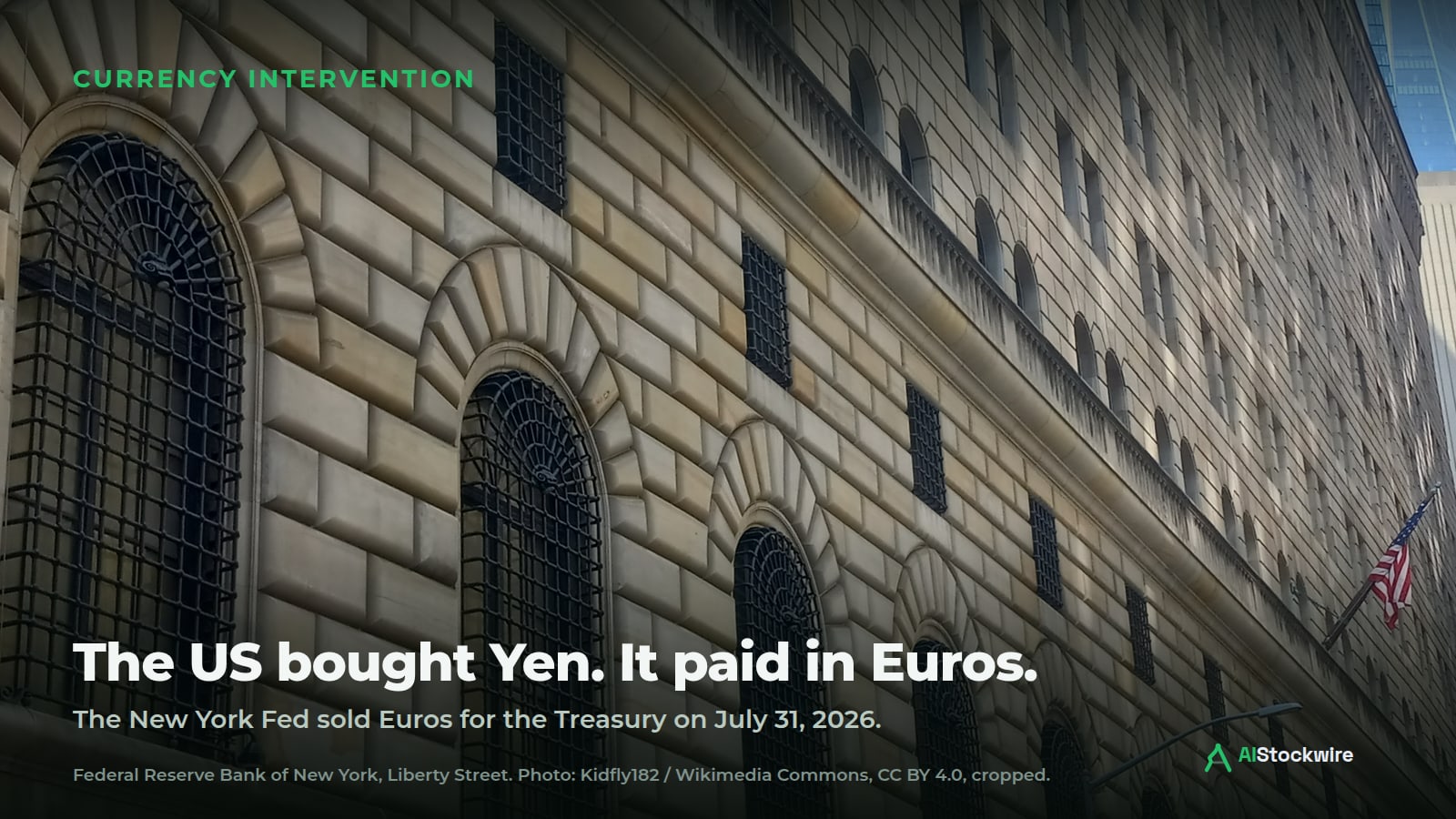
Cover photo: Federal Reserve Bank of New York, Liberty Street. Kidfly182 / Wikimedia Commons, CC BY 4.0, cropped.
Exchange rate and index levels are July 31, 2026 closes. This article is for informational purposes only and is not investment advice.