Key points
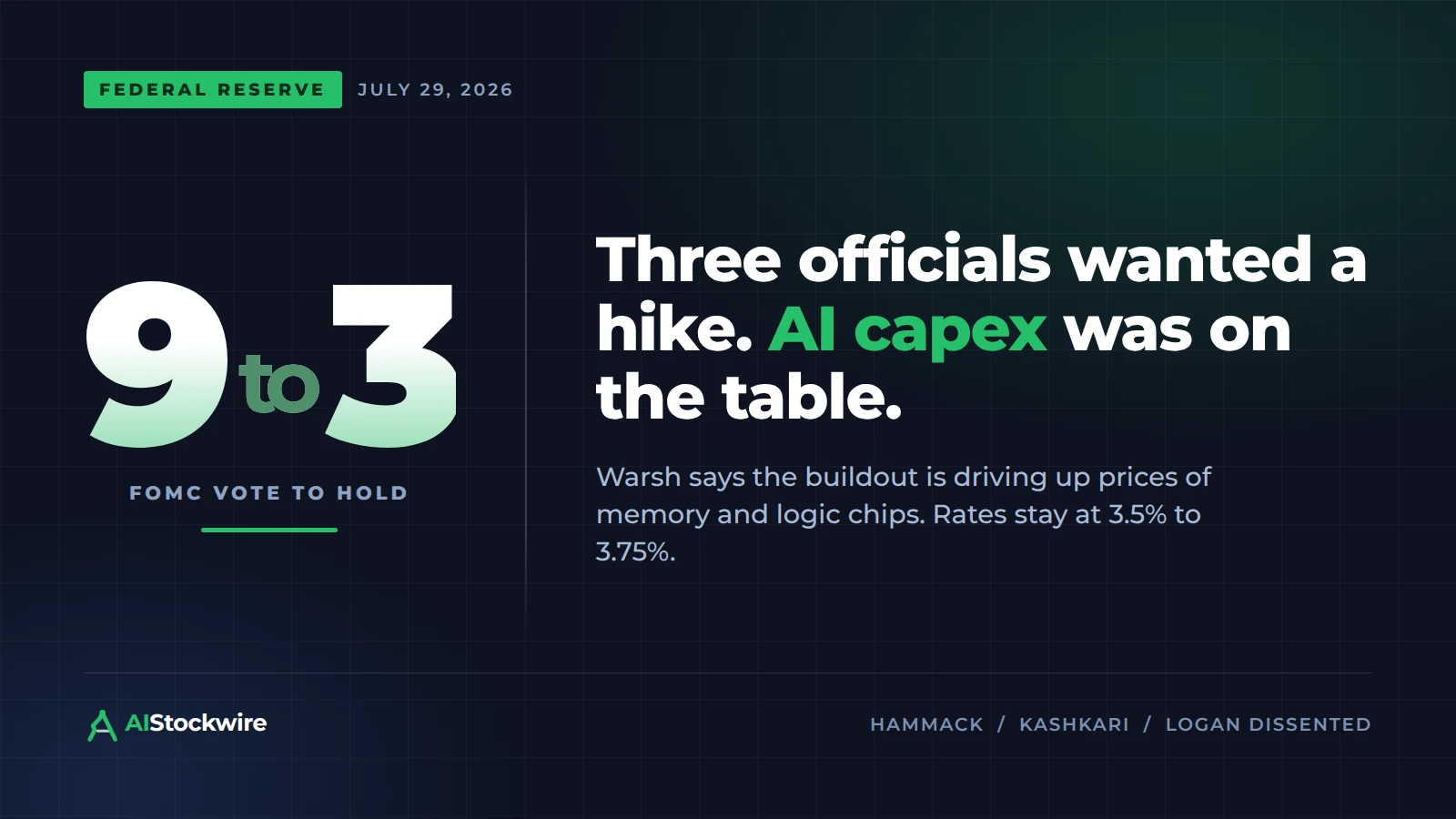
- The Fed held the federal funds target range at 3.5% to 3.75% on July 29 in a 9 to 3 vote, with Beth Hammack, Neel Kashkari and Lorie Logan dissenting in favor of a quarter-point increase.
- Chairman Kevin Warsh listed the AI capex boom as one of four questions the committee debated, and said it is driving up prices of memory and logic chips.
- Four-quarter growth in AI-related high-tech equipment and software is near 20%, per Warsh.
- Treasury yields rose sharply between meetings, a move Warsh ranked in the top decile of the last two decades.
- Micron (MU) fell 8.3% Wednesday afternoon, with Nvidia (NVDA), Taiwan Semiconductor (TSM) and the power names all lower.
The Federal Reserve left its benchmark interest rate unchanged on Wednesday. The vote was 9 to 3.
Beth M. Hammack, Neel Kashkari and Lorie K. Logan each dissented, a vote against the decision that is recorded by name in the policy statement. Each preferred to raise rates by a quarter percentage point. The target range for the federal funds rate stays at 3.5% to 3.75%.
It was the second meeting chaired by Kevin Warsh. In his prepared opening statement he called the discussions "collegial and constructive." At the news conference afterward he described them another way, telling reporters, "I asked for a good family fight, and I got one."
Why did three officials vote against holding?
Inflation is still running above the Fed's goal. "Inflation remains elevated relative to the Committee's 2 percent goal," Warsh said in his opening statement.
He spent part of that statement on the target itself. Five years of high inflation have left "a mistaken impression that is hard to shake: that the Fed's implicit inflation target was somehow above 2 percent," Warsh said. "There is only a target, and it is 2 percent."
Five-plus years of inflation above target "cannot be cured in nine weeks," he said, or by a single month of modest price decreases.
What does AI have to do with an interest rate decision?
Warsh said the committee's discussion centered on four questions. The third was about prices, and he used AI as the example.
"The business capex boom, for example, is driving up prices of memory and logic chips and associated A.I. infrastructure," Warsh said. "Do those changes indicate a broader inflationary dynamic, or do we just focus on them just because they are under the bright streetlight?"
Capex is short for capital expenditure, which here means data centers and the chips inside them.
His second question put AI spending on a list with the pandemic supply chains, military conflicts, energy-supply disruptions and higher tariff rates. Warsh included it as "and yes, the surge in A.I.-related investment."
In the AI-related category of high-tech equipment and software, "the most recent data shows four-quarter growth rates of nearly 20 percent," Warsh said. That is helping sustain manufacturing output, and capex "is preparing the ground for future growth."
He did not say when. The "precise timing and magnitude of effects on the supply side remain hard to predict," Warsh said, and the capex surge "does not necessarily make the Fed's role any easier."
Does the rest of the committee agree with him?
Warsh has argued publicly that AI spending will lower prices over time by raising productivity. Minutes of the June 16 and 17 meeting, released July 8, put him in the smaller camp.
Many participants said "ongoing strong demand for AI infrastructure would likely sustain upward pressure on prices for technology products and electricity." Some participants said "productivity gains associated with AI adoption would eventually reduce production costs." In the Fed's language, many is a larger group than some.
Most participants said strength in business investment "remained concentrated in AI-related expenditures."
What happened to interest rates between meetings?
Nominal and real yields across the Treasury curve are "materially higher" than they were 42 days ago, Warsh said. Some of the increases between the two meetings "are among the most significant in the last two decades, ranking around the top decile or so."
The policy rate did not move over that stretch. Market attention centered on incoming data, Warsh said, and the reduction in forward guidance "may have been a factor." Market participants are "learning to play the ball, not the referee," he said, and called that a change for the better.
Hike odds ran from 10.7% to 38% in the nine days before this meeting. Citadel said the Fed would raise. All 104 economists Reuters surveyed said it would not.
What did AI and power stocks do?
Micron (MU) traded at $752.77 late Wednesday afternoon, down 8.3%. Taiwan Semiconductor (TSM) fell 3.3% to $379.35. Nvidia (NVDA) was down 2.7% at $191.61. SK Hynix (SKHY) fell 0.8%.
Vistra (VST) was down 3.9% at $142.81. Talen Energy (TLN) fell 2.2% to $318.91. Constellation Energy (CEG) was down 0.4% at $258.77.
T1 Energy raised the budget for its Austin solar factory by 20% this week. It named competition from Texas data centers for labor and equipment.
Minutes from this week's meeting are due August 19.
Quotes are from the preliminary transcript of Chairman Warsh's press conference opening statement, July 29, 2026, the FOMC policy statement of the same date, and the minutes of the June 16 and 17, 2026 FOMC meeting released July 8, 2026. The "family fight" remark is from the news conference question period as reported by Yahoo Finance. Stock prices are intraday as of 3:38 p.m. ET, July 29, 2026. This is general market commentary and not investment advice.