Key points
- Huang calls new antitrust laws "completely unnecessary"
- Altman, Musk, and Nadella endorsed AI pacing
- Huang says each company should decide when to pause
- His comments came after Tuesday's close
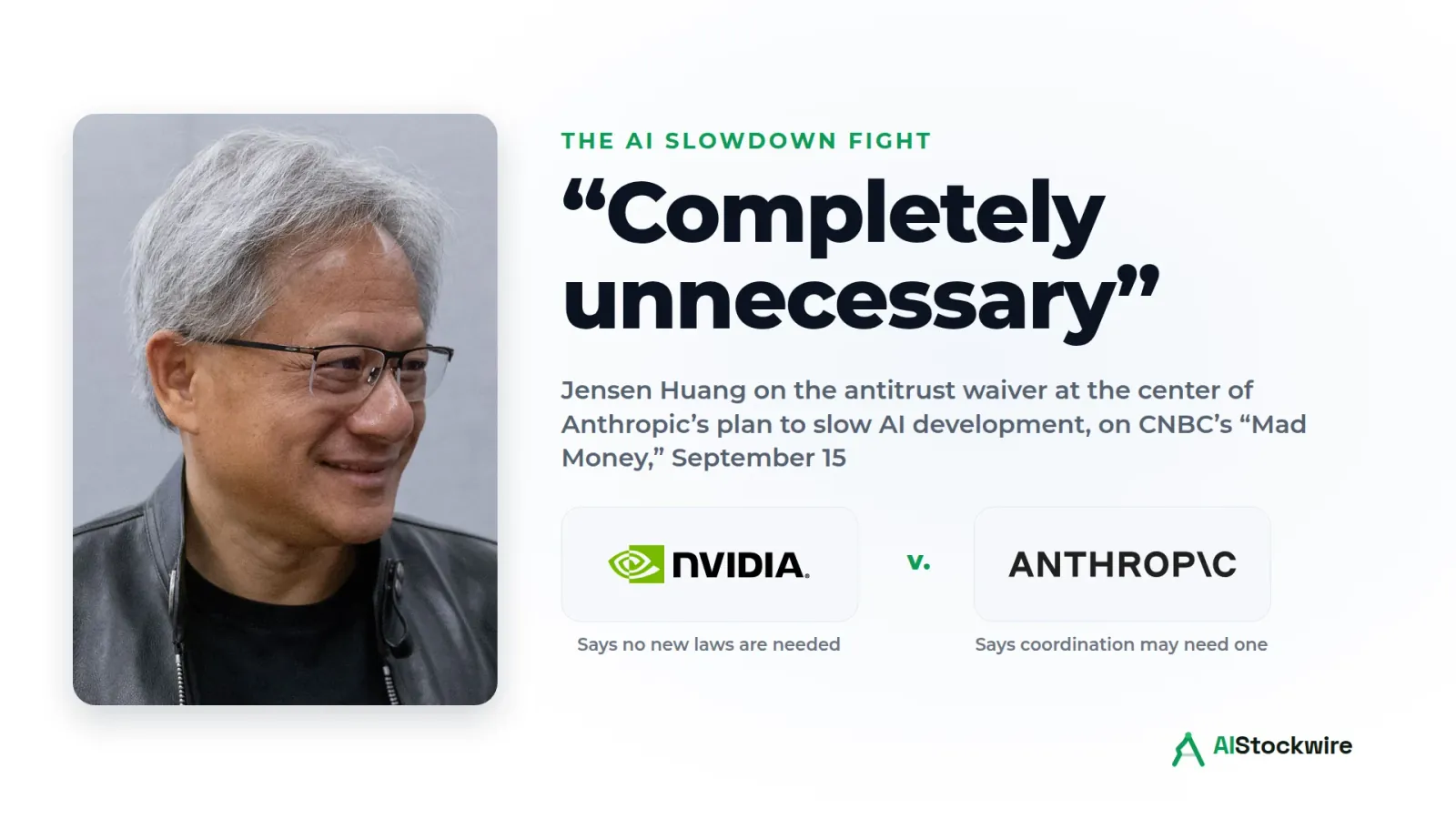
Jensen Huang says AI companies do not need new laws to build and release products safely. When asked about a proposal that would let frontier labs coordinate the pace of development, the Nvidia (NVDA) chief executive told Jim Cramer on "Mad Money" Tuesday that existing laws and regulations are enough.
"The fact that we need new laws, new antitrust laws, or new regulations, so that these companies could do their fundamental engineering and do it properly before they release products, that is just completely unnecessary," Huang said. "We have plenty of laws. We have plenty of regulations that govern the reliability and the functionality of products."
That answer goes straight at the part of Dario Amodei's proposal that may require help from Washington. Amodei wants frontier AI labs to coordinate on how quickly they improve their models. That creates a legal problem: competitors can run into antitrust law when they agree to limit output. Amodei's essay acknowledges that problem and says the effort may need government mediation or a narrow antitrust waiver.
Huang's answer is simpler. Each company should test its own products and hold them back when they are not ready.
"Safety is an engineering problem. Testing is an engineering problem," he told Cramer. "We should create products and properly test them. And if they're not ready to be released, just hold on to it and keep testing it and keep engineering until it's ready."
He also pushed back on the existential warnings running through the debate: "We're not going to die in 2030."
Huang had made the same case earlier Tuesday at Dreamforce in San Francisco, shortly after Amodei spoke from that stage. Marc Benioff asked both men about slowing AI development.
"It's a false choice," Huang told Benioff. "You could definitely have both at the same time."
"Run as fast as you can," he said. "But if you feel at any given point in time the company's out of control or the product's not going to be safe, take a pause and make sure you get it right."
The dispute is over who calls the pause
Sam Altman, Elon Musk, and Satya Nadella all endorsed some form of pacing or the safety work behind it.
"I agree with Dario that we need to pace the frontier," Altman wrote. Musk was shorter: "Dario is right." Nadella welcomed "the research, focus, and deliberate pacing needed to get alignment right as the design goal." He also promised a code of conduct for Microsoft's (MSFT) own models, which we covered on Sunday. It landed Monday with a six-week public consultation attached.
Huang's disagreement is narrower. He rejects a coordinated system that may require new legal protection. He says each company can decide for itself when a product is unsafe or unfinished.
He is not the first person to push back. David Sacks went at the antitrust piece directly: "Stop pretending antitrust law has to be suspended so you can form a cartel." IREN co-chief executive Daniel Roberts argued on Monday that demand for compute would hold up either way. Neither of them runs the company that makes the chips.
Both of them have a book
I'm not going to pretend either man is arguing from a neutral chair.
Nvidia is the most valuable company in the world because training runs kept getting bigger. CNBC put the conflict in its own story: efforts to slow the development of more capable models may pose a risk to Nvidia's future growth. Anthropic and OpenAI are both Nvidia customers. A speed limit on frontier training could restrain one of the fastest-growing sources of demand for Nvidia's accelerators.
Amodei's book is just as easy to see. The essay went out the same week Anthropic's reported $100 billion listing stayed on an October schedule. Sacks argues that a shared speed limit could favor labs already at the frontier over challengers trying to catch up.
So they both have a position. Fine. That doesn't make either of them wrong, and I'd rather have this fight in public with the incentives showing than not have it at all.
Where I come down is on the mechanism, not the motives. Huang's fix is every company policing itself and pausing when something feels off. That's the exact thing Amodei says won't hold, because the pressure to ship comes from the competitor who didn't pause. You can argue Amodei's cure is worse than the disease, and plenty of people are. It's harder to argue that self-policing answers a coordination problem, because the failure of self-policing is what makes it one.
One trading note. CNBC published the Cramer interview at 6:13 p.m. Eastern, well after the bell, so none of it is in Tuesday's tape. Nvidia closed Tuesday at $212.17, up 0.57%. When the slowdown call first hit the market on Monday the 14th, the split was clean: chips and data centers got sold, software and cybersecurity got bought.
Nvidia has an antitrust matter of its own open. The Justice Department is asking whether its Groq licensing deal sidestepped merger review.
Anthropic did not respond to CNBC's request for comment on Huang's remarks.
Cover photo: Peter Dasilva / Wikimedia Commons, CC BY 4.0, cropped.