Key points
- Hunterbrook finds newer AMD firmware in a blacklisted Chinese company's server updates
- What Hunterbrook says it couldn't establish about AMD, licenses, and export law
- How AMD and Nvidia report revenue linked to China
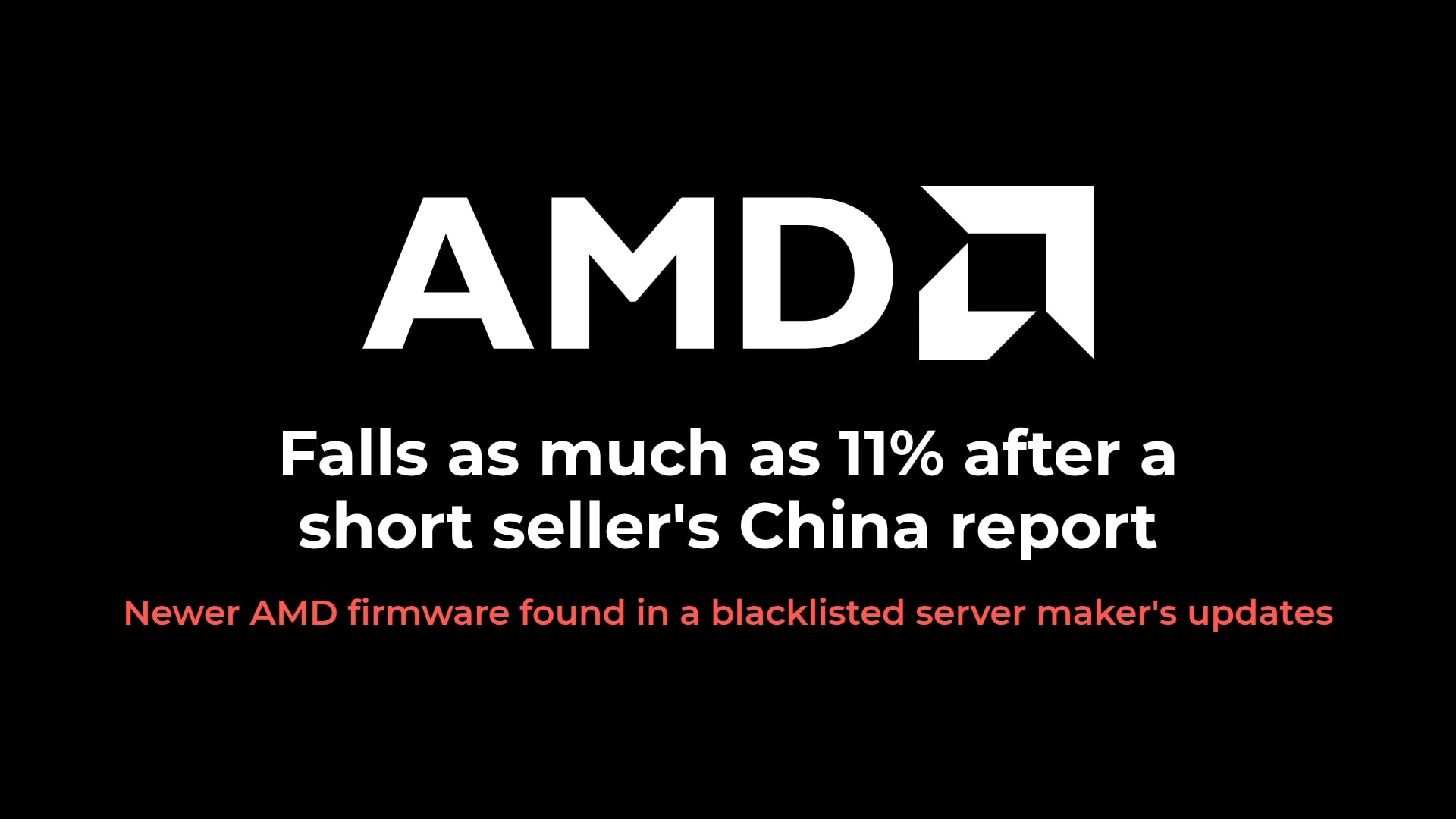
AMD (AMD) shares fell as much as 11.2% on Nov. 19 after Hunterbrook Media reported that a blacklisted Chinese server maker posted updates containing AMD firmware versions released after the server maker was added to the US export blacklist.
Hunterbrook said it couldn't determine how the server maker obtained the code or whether AMD or anyone else had a license to supply it. The publication said its findings don't establish that AMD violated export controls. Its affiliated fund, Hunterbrook Capital, said it is short AMD. AMD didn't answer Hunterbrook's questions.
The stock fell as low as $470.56 and was down 7.0% at $493.16 as of 11:21 a.m. ET, compared with its Nov. 18 close of $530.14. It was trading near $530 when the report was published at 10:27 a.m. ET, and most of the drop came in the following half hour.
Hunterbrook found newer AMD code in a blacklisted company's server updates
The US put IEIT Systems, a server maker controlled by China's Inspur Group, on its Entity List in March 2025. Hunterbrook said IEIT has since built at least six newer versions of AMD's startup firmware into updates for three of its AMD server models. IEIT posted the latest of those updates on Oct. 19, 2026, according to its download page.
Hunterbrook said the same firmware appears on the websites of three server sellers that aren't blacklisted: Maginfra in China, Kaytus Systems in Singapore, and Aivres Systems in Fremont, California. Their firmware files were 99.94% identical to IEIT's, Hunterbrook said. Kaytus's 2025 audited accounts name IEIT as its ultimate holding company, and IEIT's 2022 annual report listed Aivres, then called Inspur Systems, as a subsidiary.
AMD's website lists Aivres among the makers of servers built on its Instinct AI chips. An Aivres manager in Fremont told a Hunterbrook reporter, "we ship a lot to China and neighboring countries."
Hunterbrook says it can't show AMD broke export law
Finding newer AMD code in IEIT's updates doesn't show that AMD supplied it after the listing. Hunterbrook said one possible route is through the three affiliated sellers, which aren't blacklisted. The Commerce Department doesn't make export licenses public, and AMD didn't say whether it holds licenses to sell to any of the companies named. AMD asked for more time to answer Hunterbrook's questions and didn't reply, according to the report.
Software can count as an export under US rules. In an Oct. 2 settlement with Lambda Research, a Massachusetts software company, Commerce's Bureau of Industry and Security said that each automatic update Lambda sent to Huawei's Japan unit, a company on the Entity List, "constitutes an export" that needed a license. The settlement also covered updates Lambda sent to SiCarrier, a Chinese company added to the list in December 2024.
How AMD and Nvidia report revenue linked to China
The report lands a week after Jensen Huang resigned as Nvidia's CEO. AMD shares rallied after his resignation, and Hunterbrook says some investors treated AMD as a less risky way to own AI chips than Nvidia (NVDA). Hunterbrook argues AMD faces similar China risks.
The two companies don't measure China revenue the same way, so their figures aren't directly comparable. AMD reports revenue by where customers are billed. Nvidia reports it by where customers are headquartered. A Chinese company billed through a Singapore unit would count toward Singapore at AMD, while a US company's purchases for use in China would count toward the US at Nvidia.
| Measure | AMD | Nvidia |
|---|---|---|
| China and Hong Kong share of revenue | 22.4% ($7.75 billion), by billing location, fiscal 2025 | 9.1%, by customer headquarters, fiscal 2026 |
| Singapore share of revenue | 12.4% ($4.28 billion), by billing location, fiscal 2025 | Not in the report |
| Chip assembly, testing, and packaging | Mostly two ventures 85% owned by China's Tongfu Microelectronics | Mostly Taiwanese and South Korean suppliers |
Source: Hunterbrook Media, citing AMD's fiscal 2025 annual report and Nvidia's fiscal 2026 annual report.
Hunterbrook also traced $67 million of 2025 licensing income at AMD to two Chinese chip ventures with Hygon that the US blacklisted in 2019. It said those payments could be royalties for technology licensed before the listing, and that the Entity List restricts exports to listed companies, not payments from them.
Two US rules could reach AMD's customers in Asia
Singapore matters because of a rule that took effect the same day. It requires a license to export or reexport advanced computing items, including data-center AI chips, to Singapore, Malaysia, Indonesia, Thailand, and Brazil, or to transfer them within those countries. Chips going to companies headquartered in the US, or whose ultimate parent is, don't need the new license if the exporter files the required reports, as we explain in our guide to the US remote-access rule.
A second rule would extend Entity List restrictions to foreign companies owned 50% or more, directly or indirectly, by listed companies. Commerce has suspended it through Jan. 10, 2027, under a Nov. 9 extension, and hasn't said whether it will take effect then. Hunterbrook says the rule could reach Kaytus. Kaytus's 2025 audited accounts name IEIT as its ultimate holding company, and IEIT's 2023 interim report listed Kaytus as wholly owned. We couldn't confirm Kaytus's ownership as of Nov. 19.
The Bear Cave, a publication affiliated with Hunterbrook, published a separate report on AMD's finances the same day. It said AMD's purchase commitments rose from $12.2 billion at the end of 2025 to $48.8 billion in September, against $15.8 billion of cash and short-term investments.