Key points
- Alibaba's cloud revenue rose 53%
- Alibaba's adjusted profit fell short of forecasts
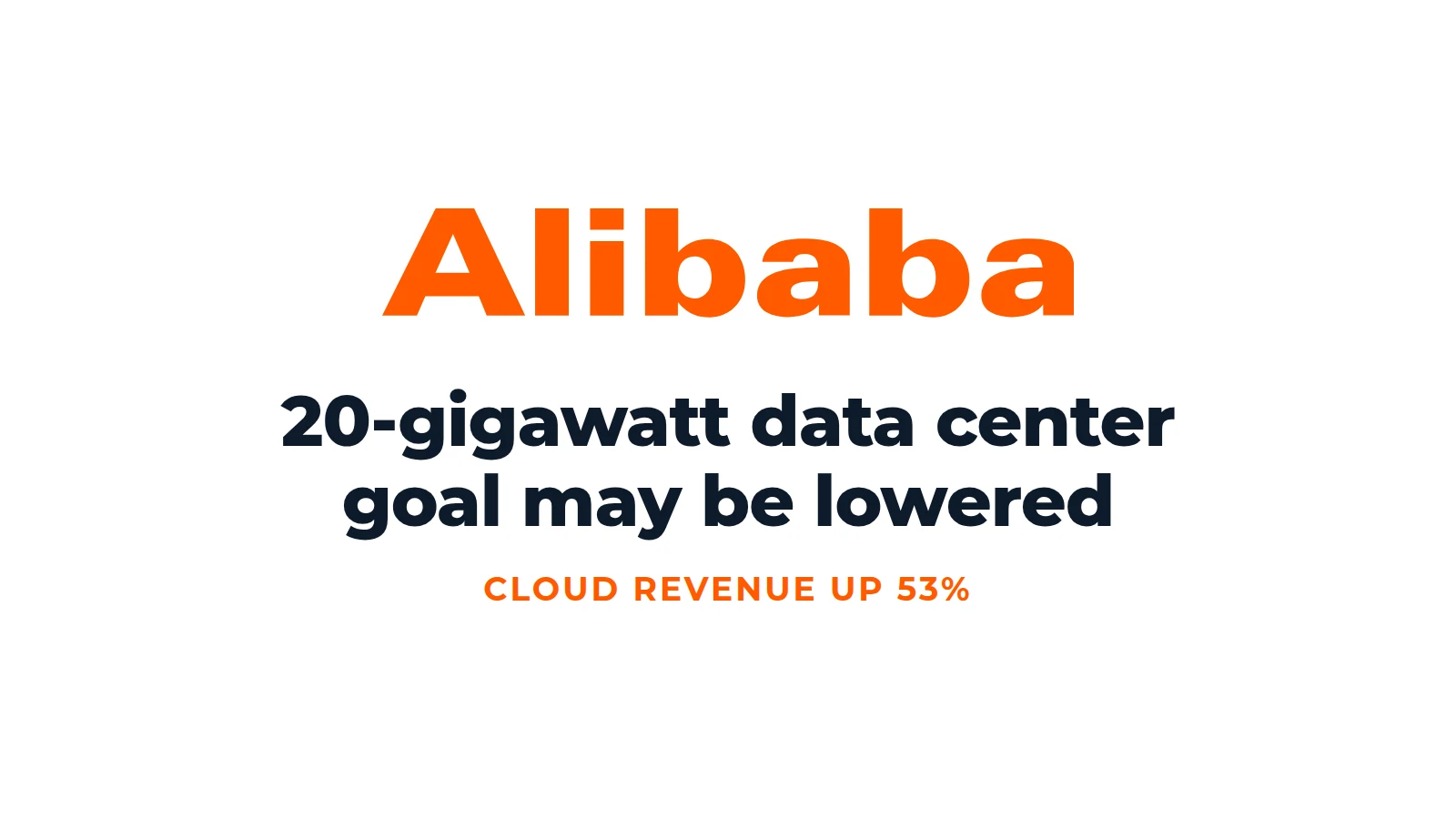
- Alibaba may lower its 20-gigawatt data center goal
Alibaba (BABA) reported 53% revenue growth in its AI cloud business for the September quarter, while adjusted profit for the company fell short of analysts' forecasts.
On the earnings call, Chief Executive Eddie Wu said new US export rules on computing power may lead Alibaba to lower its long-term goal of 20 gigawatts of data center capacity.
Total revenue rose 10% from a year earlier to 271.5 billion yuan ($40.5B). Alibaba's US-listed shares were up 3.7% at $87.50 as of 10:19 a.m. ET on Nov. 19.
Cloud revenue grew 53%
Revenue from AI Cloud and Compute Services, the segment that combines Alibaba Cloud with the T-Head chip unit, rose 53% to 60.97 billion yuan ($9.1B), according to Alibaba's results release. Revenue from outside customers grew 64%.
AI-related products brought in 17.9 billion yuan, marking their 13th straight quarter of triple-digit growth. The segment's adjusted EBITA, a measure of operating profit, rose 121% to 8.84 billion yuan.
Adjusted profit missed estimates
Alibaba's total revenue topped the Bloomberg consensus of 270.53 billion yuan, Yahoo Finance reported. Adjusted earnings were 8.10 yuan per American depositary share, up 86% from a year earlier but below the 10.75 yuan analysts expected. Adjusted net income was 19.9 billion yuan, short of the 26.61 billion yuan forecast.
Net income more than tripled to 64.4 billion yuan ($9.6B), which Alibaba attributed mainly to higher net investment income and income from operations. Alibaba removes investment gains, share-based pay, and impairment charges from its adjusted profit figure.
Capital spending was 50.5 billion yuan ($7.5B) in the quarter, up 60% from a year earlier and down from 67.7 billion yuan in the June quarter, Chief Financial Officer Toby Xu said on the call. Free cash flow was an outflow of 34.5 billion yuan, compared with an outflow of 21.8 billion yuan a year earlier, mainly because of cloud infrastructure spending.
What did Wu say about the 20-gigawatt goal?
Alibaba set the target in September, when it unveiled the Zhenwu V900 chip and said it wanted more than 20 gigawatts of data center capacity by 2032. On the call, a UBS analyst asked how tighter US restrictions on access to advanced GPUs and overseas computing would affect Alibaba's spending toward that target.
"Based on our current preliminary assessment, it may lead to a downward revision of that long-term 20-gigawatt target," Wu said, according to a transcript of the call. He added that there would be "a certain impact on our overall capex plan." He didn't say how much the target could fall.
The US Commerce Department rule on AI chips and computing access took effect on Nov. 19. Wu didn't say which parts of the new rules he meant. He said they will affect next year's products and services, and that Alibaba's operating plan and targets for next year may be affected to some extent while the company is still evaluating them. He said Alibaba has obtained and used computing power in compliance with applicable laws and regulations.
Taking those factors into account, Wu said Alibaba might expect its cloud revenue growth target for next year to be in a range of 30% to 45%. He expects growth to rebound to 50% or higher in 2028, as Alibaba's supply of domestic chips grows. Its 2030 goals are unchanged: $100 billion in external cloud revenue, with a margin above 20%.
Wu said Alibaba will invest most heavily in 2027 and 2028 as it ramps up production of its own chips. Asked whether Alibaba could turn free cash flow positive sooner, Wu said that by his preliminary assessment, Alibaba should reach positive cash flow overall in the second half of 2028. The interpreted answer didn't say which cash flow measure he meant. Operating cash flow is already positive: it rose 55% to 15.7 billion yuan in the September quarter.
Is Alibaba training its AI models on its own chips?
It's started. Qwen is Alibaba's family of AI models. "Qwen is already training its next-generation model on T-head's domestic chips," Wu said. He also said Model Studio, Alibaba's platform for building with AI models, already runs inference on domestic chips. Inference is the work of running a model after it has been trained. Wu didn't name the model in training or say which T-Head chip it uses, beyond calling them "this year's chips."
After 2027, most of the AI chip capacity Alibaba adds will be domestic chips, including its own, Wu said. Alibaba will also buy chips from other Chinese suppliers, mostly for inference. Its own flagship chips will go first to training its own models, then to close partners and important customers.
The V900 is the chip that is supposed to make that possible. Wu said mass production will begin in the first quarter of 2027, and that V900 supernode clusters, which link large numbers of the chips together, will launch at commercial scale in the second quarter of 2027. He said the V900 has three times the computing performance of the current Zhenwu M890. A third chip, the J900, is planned for large-scale production in 2028.
Investors won't get T-Head's own numbers yet. T-Head has filed confidentially for a Hong Kong listing, and Xu said listing rules prevent Alibaba from disclosing its financial information. He did say domestic chips make up a growing share of Alibaba Cloud's computing capacity.
What Alibaba hasn't said yet is how far the 20-gigawatt goal might fall, or which parts of the US rules it expects to affect next year's plan. Wu called his view on the target a preliminary assessment.
Dollar figures use the conversion rate in Alibaba's results release. Quotes from the call are from an English transcript published by The Singju Post. Answers given in Chinese were translated by an interpreter on the call, and Alibaba said its statements in the original language prevail.