Key points
- A weekly AI/tech watchlist: five names, each with a specific catalyst and risk. It is a watchlist, not a buy list.
- Week of July 6: CleanSpark (CLSK), Nokia (NOK), Teradyne (TER), Ondas (ONDS), and AeroVironment (AVAV).
- We're still bullish on last week's four names too, but a Bullish Watch only earns its name if it stays fresh, so this week is a new batch, not a repeat.
- Four of the five had a rough stretch for their own specific reasons this week, AI-capex fear (Teradyne, Nokia), a bitcoin pullback and insider selling (CleanSpark), a five-week slide (Ondas). The fifth, AeroVironment, already proved its own bounce case on a beat-and-raise plus a fresh Army contract.
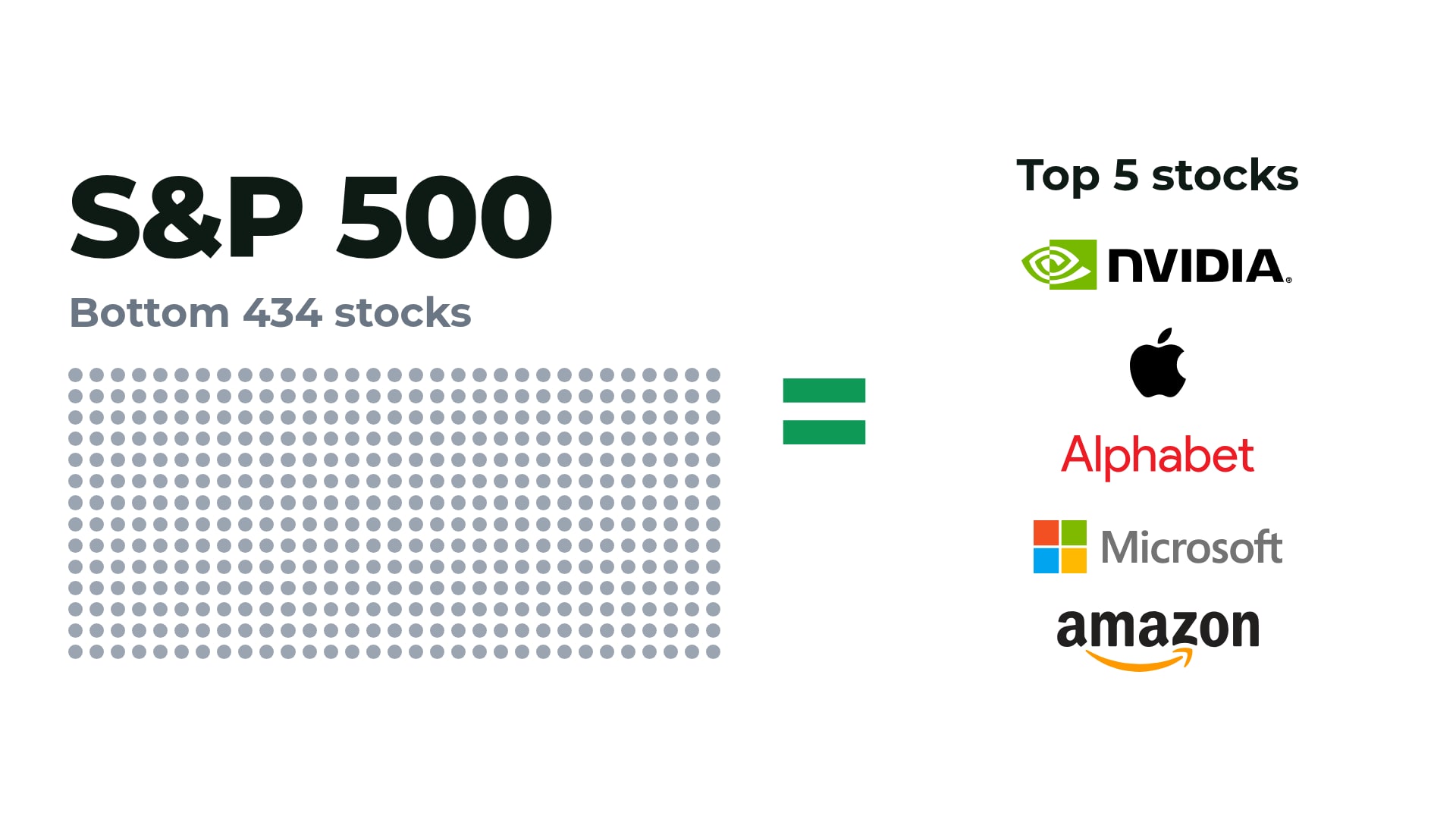
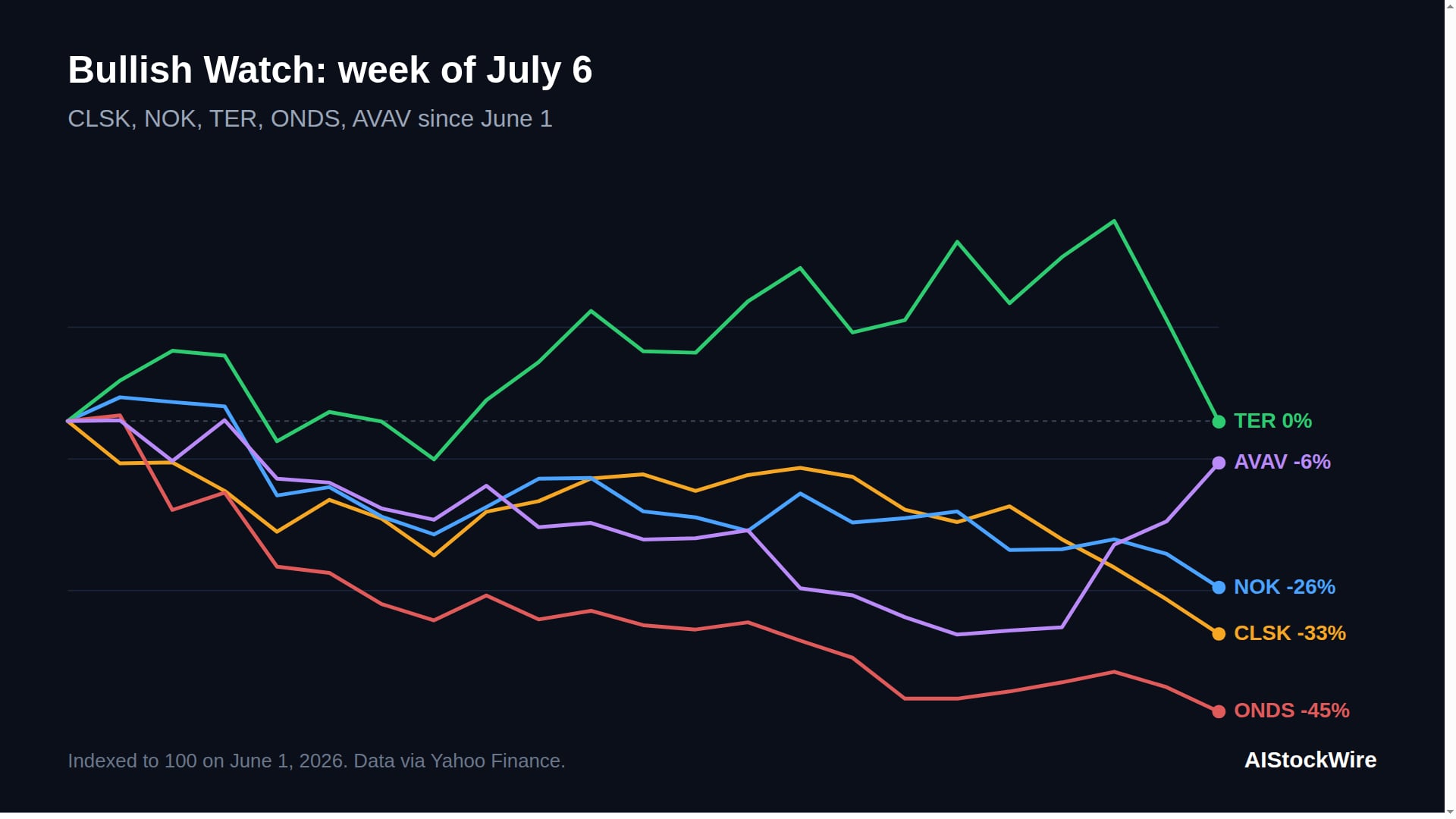
- Final, Friday, July 10 close: none of the five finished green. Nokia and Ondas both faded Friday to end flat and down 2.6%, CleanSpark finished down 1.2%, Teradyne down 7.0%, and AeroVironment down 23.9%. The megacaps went the other way all week, Nvidia gained about 8.5%, so the miss here was the speculative end of AI, not the sector.
This week's scoreboard
Final scoreboard: the full week, from Monday's open through Friday, July 10's close. "Close (Thu, Jul 2)" is the last official close before this list ran, since markets were closed Friday, July 3 for the holiday. "Open" is Monday's 9:30 a.m. Eastern open, our entry reference for the week; each close column after that is that day's official 4:00 p.m. close. "Week to date" tracks the move from the Monday open, our stated entry point; "Since Thursday's close" tracks the move from the last price before this list ran, for anyone measuring from when they first read it. We refresh both each trading day.
| Stock | Close (Thu, Jul 2) | Open (Mon, Jul 6) | Close (Mon, Jul 6) | Close (Tue, Jul 7) | Close (Wed, Jul 8) | Close (Thu, Jul 9) | Close (Fri, Jul 10) | Week to date | Since Thursday's close |
|---|---|---|---|---|---|---|---|---|---|
| CleanSpark (CLSK) | $12.62 | $13.01 | $13.49 | $12.48 | $12.40 | $12.87 | $12.85 | -1.2% | +1.8% |
| Nokia (NOK) | $12.07 | $12.44 | $12.52 | $11.85 | $11.95 | $12.91 | $12.44 | 0.0% | +3.1% |
| Teradyne (TER) | $369.09 | $386.58 | $379.66 | $343.11 | $351.57 | $362.87 | $359.60 | -7.0% | -2.6% |
| Ondas (ONDS) | $7.41 | $7.45 | $7.81 | $7.35 | $7.52 | $7.66 | $7.26 | -2.6% | -2.0% |
| AeroVironment (AVAV) | $190.89 | $190.00 | $176.83 | $162.53 | $157.78 | $148.33 | $144.58 | -23.9% | -24.3% |
Final grade (Friday, July 10 close). A losing week, and an honest scoreboard says so: none of the five finished green from Monday's open. Nokia (NOK), up 3.8% as late as Thursday, gave all of it back Friday to finish dead flat. Ondas (ONDS) faded the same way, from +2.8% to -2.6%. CleanSpark (CLSK) finished down 1.2%, Teradyne (TER) down 7.0%, and AeroVironment (AVAV) down 23.9%, the week's clear loser. The context matters, though: this was not the whole AI trade falling apart. The Nasdaq 100 (QQQ) finished the week up about 0.8% and the VanEck Semiconductor ETF (SMH) up about 0.7%, and Nvidia (NVDA) gained roughly 8.5% on the week. Money crowded into the biggest AI names and sold almost everything speculative, quantum, drones, small-cap power, robotics, and oversold lists like this one. Next week's edition digs into that split.
Back with the second edition of the Bullish Watch, our weekly look at AI-related names we're following into the week ahead. Last week's batch did not go well, three of four names finished red as money rotated out of chips, but we're still bullish on all four (AAOI, Micron (MU), Qualcomm (QCOM), and Arista (ANET)) heading into this week too. Nothing in the actual case for any of them broke last week, the selling was rotation, not a verdict. A Bullish Watch only earns its name if it stays current, though, so this week brings five new names rather than a repeat.
This week's batch has its own theme: four of the five names had a rough week, whether from the wave of fear over AI capital spending that we've been tracking all week, a pullback in bitcoin, or their own specific overhang, and the question for each is whether the selling went too far. The fifth, AeroVironment, already answered that question for itself with real news of its own.
A quick calendar note. Markets were closed Friday, July 3, for the Independence Day holiday, so this list originally ran with Thursday's closes. Update, Monday, July 6 close: prices below now reflect the first trading day of the week. All five names moved, and Ondas got real news of its own along the way.
Here are the five names.
1. CleanSpark (CLSK), the bitcoin-stabilizing pick
Price: $12.62, down about 33% from its June 1 high of $18.81. The catalyst: bitcoin has stopped falling and looks like it's putting in a bottom, up from about $58,500 on June 30 to nearly $62,000 by July 3.
CleanSpark is still fundamentally a bitcoin miner, it mined hundreds of coins in May alone, but it's spent 2026 pivoting into AI and HPC hosting, building a Texas campus that could scale to 600 megawatts and reportedly in talks with Meta about hosting space in Georgia, though that deal is not confirmed. The slide has two real drivers, not one: a fiscal second quarter, reported May 11, that missed badly on both revenue and the bottom line (a $1.52-per-share loss), and a sharp drop on June 5 that coincided with insider Rule 144 share-sale filings and a broader pullback in bitcoin that dragged crypto-linked stocks down with it. We've seen this pattern before: the miners fall together when bitcoin slides, and they tend to bounce together too. If bitcoin's stabilization holds, CleanSpark is the highest-beta way to play it, with analyst targets in the high teens and low $20s.
The risk: the fiscal Q2 miss was real, not just sentiment, and the Meta hosting talks are still just talks. If bitcoin resumes falling, or the AI pivot stalls out, there's no floor here beyond the crypto trade CleanSpark was originally built on.
2. Nokia (NOK), the re-rating pick
Price: $12.07, down about 28% from its June 2 high of $16.85. The catalyst: JPMorgan more than doubled its price target to $21 from $14 on June 12, pointing to roughly 1 billion euros in new AI and cloud optical orders and Nokia's own indium phosphide fab capacity.
The bull case hasn't changed since Nokia's AI-networking pivot first caught our attention, we wrote about the old phone brands becoming AI stocks back when this rally started. Since then, Nokia has launched a new suite of optical networking gear built for AI-era data centers, announced a $4 billion US R&D and chip-packaging investment, and struck an autonomous-network partnership with Google Cloud. The stock has given back a chunk of its spring rally, which is what tends to happen after a fast run, not necessarily a sign the story broke. David's own take on riding out the rough week covers the case for staying put.
The risk: Nokia doesn't report earnings until July 23, so this trade has to work on sentiment alone until then. It's also a "show me" story: the AI order book is growing, but Nokia's core networking business is still slow-growing and low-margin, so any multiple expansion depends on that execution actually showing up in the numbers.
3. Teradyne (TER), the sector-fear pick
Price: $369.09, down about 24% in just two trading days from its June 30 high of $483.84, and essentially back to where it started the month. The catalyst: a blowout first quarter, revenue up 87% to $1.28 billion with about 70% of sales now tied to AI, and three separate analysts raising price targets to $525 to $550 within days of each other.
Teradyne makes the equipment that tests AI chips and, through its Teradyne Robotics unit (Universal Robots, Mobile Industrial Robots), builds the collaborative robots increasingly used on factory floors. It just showed off new physical-AI applications at the Automate trade show. None of that changed this week. What changed is that the whole semiconductor sector got hit by fear that AI computing capacity is outrunning demand, the same worry that dragged the Philadelphia Semiconductor Index down more than 7 percent and rattled the Korean chipmakers we covered earlier this week. Cantor Fitzgerald, Bank of America, and Susquehanna all raised their targets to $525 or $550 just days before the drop, and the broader Street consensus, still sitting near $400, hasn't caught up either way.
The risk: if the AI-capex fear is right and cloud giants really do slow spending, semiconductor-test demand is directly exposed, and Teradyne just proved how fast this stock can move in a straight line, in both directions. It doesn't report again until July 28.
4. Ondas (ONDS), the turnaround pick
Price: $7.41, down for five straight weeks and about 45% since its June 2 high of $13.58. The catalyst: more than $40 million in new defense and counter-drone orders in June alone, on top of a freshly announced $125 million acquisition of Cyberhawk, an infrastructure-inspection company with a $95 million backlog.
The Cyberhawk deal, expected to close in the third quarter, is Ondas's sixth acquisition of the year, adding a business with 95 percent recurring revenue and customers in 40 countries. Combined with Q2 orders above $150 million and momentum out of the Eurosatory defense show, there's a real growth story underneath the chart. The problem is the chart itself: five consecutive red weeks, and Wall Street's average target, near $19, implies the Street thinks this is overdone.
Update, Monday, July 6: Ondas announced an $875.8 million deal to acquire DZYNE Technologies, an autonomous ISR and counter-drone maker, for $200 million in cash plus roughly 85 million new Ondas shares. The deal came with a raised 2026 revenue target of at least $525 million, up from $390 million. It is a much bigger addition than Cyberhawk, and the stock closed the day at $7.81, up about 5% from Thursday's $7.41.
The risk: Ondas's CEO did sell about $32 million of stock on June 1, right near the top of the run, and it's worth being precise about what that actually was. It was a sell-to-cover: 4.5 million RSUs vested that day, and the shares were sold automatically to cover the tax withholding on the vesting, not a discretionary bet against his own company. He still holds roughly 4.7 million shares directly and indirectly afterward. The bigger risk is the setup itself. About a third of the float, roughly 33 percent as of early July, is sold short, one of the most heavily shorted stocks on the market, and the company has registered more shares for sale on top of that. A business funded by serial, dilutive acquisitions can grow revenue fast while still leaving shareholders with a smaller slice each time, and a stock this crowded on the short side can move hard and fast in either direction on any headline. The order growth is real. So is the dilution. So is the crowded short.
5. AeroVironment (AVAV), the beat-and-raise pick
Price: $190.89, up sharply from a June 25 low of $136.68 but still below its own May 28 high of $214.39. The catalyst: a record fiscal fourth quarter reported June 29, revenue of $641.6 million against $559.1 million expected and EPS of $1.84 against $1.47 expected, followed three days later by a fresh $500 million US Army counter-drone contract that alone drove a 10.7 percent pop on July 2.
Unlike the other four names on this list, AeroVironment already proved its bounce case rather than waiting for one. What's kept it from reclaiming its full high is its own fiscal 2027 guidance, which came in below consensus on earnings, and a wave of price-target cuts that followed even the beat: UBS to $166, RBC to $210, Stifel to $220, and Jefferies to $229, among others. The reasons cited were heavy GAAP amortization tied to the BlueHalo and Empirical acquisitions, a conservative view on the timing of contract awards from a possible $350 billion defense reconciliation bill, and the loss of the SCAR program. Most of those firms kept Buy or Outperform ratings anyway. Even after the cuts, the targets cluster between $200 and $230, meaningfully above where the stock sits now.
The risk: the earnings-quality concern is real, not just Wall Street nitpicking. Acquisition-related amortization will keep weighing on GAAP earnings for years, and if the defense reconciliation bill slips further, the contract-timing assumptions behind the guidance get worse, not better. This is a name where the headline numbers are already strong and the debate is entirely about the fine print.
Update, Monday, July 6: AVAV closed at $176.83, down about 7% from Thursday's $190.89, giving back some of its post-earnings run. We could not find any fresh negative news behind the move, more a normal cooling off after a fast run into a July 8 investor day.
Update, Thursday, July 9: The slide kept going. AVAV closed at $148.33, now down about 22% from Monday's open and roughly back to its pre-earnings range, essentially giving back the entire beat-and-raise, Army-contract pop. We still can't point to fresh company-specific bad news behind it, which makes this look more like a broad unwind of a crowded trade than a change in the underlying story, but four straight down days is enough to take seriously either way.
Also on the radar
A few names we're watching but didn't put on the official list: Intuitive Surgical (ISRG), which popped nearly 6 percent on July 2 even though it's still down for the year, on no fresh news we could pin down, worth watching for a real catalyst to show up; Serve Robotics (SERV), which just launched an autonomous laundry-delivery pilot and debuted new work at Cannes Lions, its first push beyond food delivery; and Agility Robotics, which isn't tradeable yet but just signed a $2.5 billion SPAC merger agreement with Churchill Capital Corp XI (ticker CCXI) that would make it the first pure-play humanoid-robot public listing, backed by a Foxconn-led investment. None of these were fresh or clean enough to make the top five this week.
How to read this
This is a watchlist, not a buy list. Every name here got cheaper the prior week for a real reason (except AeroVironment, which already got more expensive for a real reason), and every name has a real bull case for why the market's read on it might be wrong. The full week is now on the scoreboard, and it was a losing one: none of the five finished green from Monday's open, even though two of them held gains as late as Thursday. That's evidence the market hasn't bought the bull case yet, not proof the case is wrong, the selling hit nearly everything speculative in AI this week while the megacaps rallied. We graded last week just as honestly, when three of four names lost money. Winners and losers both go on the scoreboard.
Sources
- CleanSpark, Second fiscal quarter 2026 results (reported May 11, 2026)
- Intellectia.AI, JPMorgan doubles Nokia price target to $21
- Teradyne, First quarter 2026 results
- GuruFocus, Cantor Fitzgerald raises Teradyne target to $550
- Ondas, Ondas to acquire Cyberhawk
- Ondas, DZYNE Technologies acquisition and raised 2026 revenue target, covered in our July 6, 2026 report
- StockTitan, Ondas CEO exercises 4.5M RSUs, shares sold for taxes
- GuruFocus, AeroVironment secures $500M Army contract, shares surge 10.7%
- MarketBeat, Ondas (ONDS) short interest
This is general market commentary and opinion, not investment advice. Scoreboard prices are official closing prices, updated through Friday, July 10, 2026, the final update for this list. The watchlist writeups below reflect Thursday, July 2, 2026's close, the original reference price for this list, with dated update notes added where something changed. Markets can go down as well as up, and you can lose money. Always do your own research and consider speaking with a licensed financial professional before making any investment decision.