Key points
- Magnificent Seven correlation falls to a 13-year low
- Apple's correlation with the group remains low
- Alphabet and Amazon still move in step
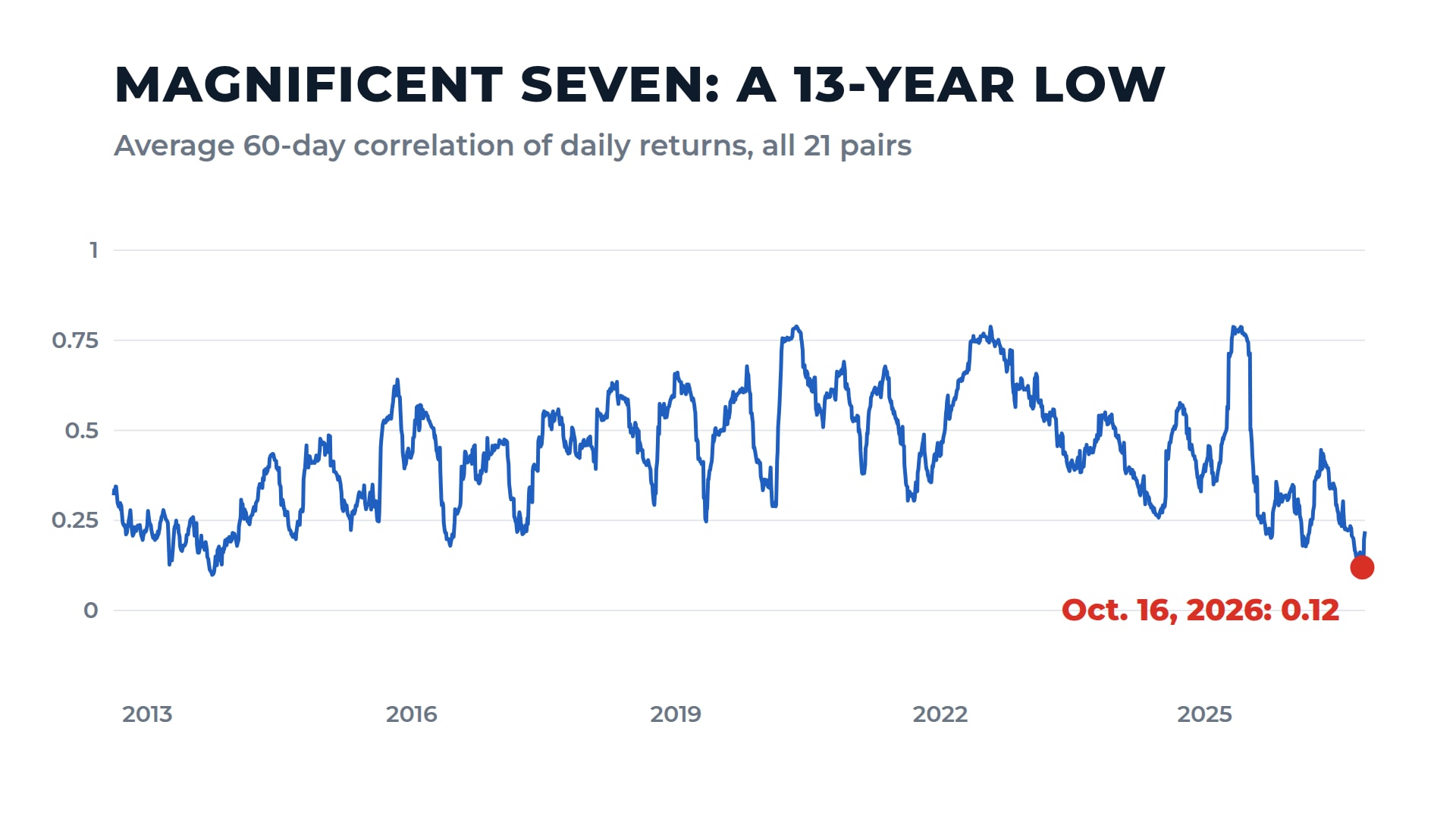
The Magnificent Seven tech stocks are moving less in step. Their average 60-day correlation fell to 0.12 on Oct. 16, its lowest level since October 2013, by our calculations.
We compared the daily returns of every pair in the group, 21 combinations in all. The average had recovered to 0.22 by Tuesday's close, but that was still half its average of 0.44 since 2012. It peaked at 0.79 on July 27, 2022.
CNBC used the same 21-pair approach and reported Wednesday that the average had fallen to its lowest level in more than a decade.
A correlation of 1 means two stocks' returns move perfectly in the same direction. A reading near 0 means they had little linear relationship over the period measured; a negative number means they tended to move in opposite directions.
Apple and Nvidia have drifted furthest from the group
At the Oct. 16 low, seven of the 21 pairs had negative correlations, including all six that involve Apple (AAPL). Apple and Amazon (AMZN) were the furthest apart, at minus 0.46.
Apple is still the odd one out. Through Tuesday, its average correlation with the other six was 0.08, and Nvidia (NVDA) was close behind at 0.09. Apple and Nvidia had the lowest reading of any pair, at minus 0.12. Apple and Meta Platforms (META) were also below zero, and Alphabet and Nvidia sat just under it.
Apple accounts for much of the drop. The 21-pair average weights every pair equally, and Apple is in six of them. Without Apple, the other six stocks averaged 0.24 on Oct. 16 and 0.28 on Tuesday, by our calculations. Their low for 2026 was 0.20, on Feb. 23, so October wasn't a 13-year low for those six.
Apple also leads the group this year. Its shares are up 27.7% in 2026 through Tuesday's close, followed by Nvidia at 16.9%. Meta is down 6.0% and Tesla (TSLA) is down 9.4%. D.A. Davidson analyst Gil Luria called Apple "the place to hide from the AI trade."
The companies "all have different exposures to AI," Luria said. "This requires a much more granular approach to which of the largest mega-caps an investor wants to own as opposed to just owning them wholesale."
The cloud companies still move together
The three cloud providers are the exception. Alphabet (GOOGL) and Amazon had the highest correlation of any pair through Tuesday, at 0.62. Microsoft (MSFT) and Amazon came in at 0.51, and Microsoft and Alphabet at 0.49.
All three report this week. Microsoft and Alphabet post third-quarter results after the bell on Wednesday, and Amazon reports Thursday. In the second quarter, Google Cloud revenue grew 82% from a year earlier, Microsoft's Azure grew 43%, and Amazon Web Services grew 37%. Amazon and Alphabet also spent more on data centers and equipment than their operations generated in that quarter. Our earnings preview on Google's TPU push covers what's riding on Alphabet's report.
Outside the cloud group, Nvidia and Tesla had the highest correlation, at 0.39.
How we calculated it: We used daily adjusted closes from Yahoo Finance from May 18, 2012, Meta's first trading day, through Oct. 27, 2026. For each trading day, we took the correlation of the past 60 daily returns for each of the 21 pairs and averaged them. Year-to-date changes use official closes from Dec. 31, 2025, through Oct. 27, 2026.