Key points
- CNBC calls Huang Trump's top AI ally
- Nvidia's CEO wants existing laws enforced, not new ones
- The slowdown camp says the pace itself is the risk
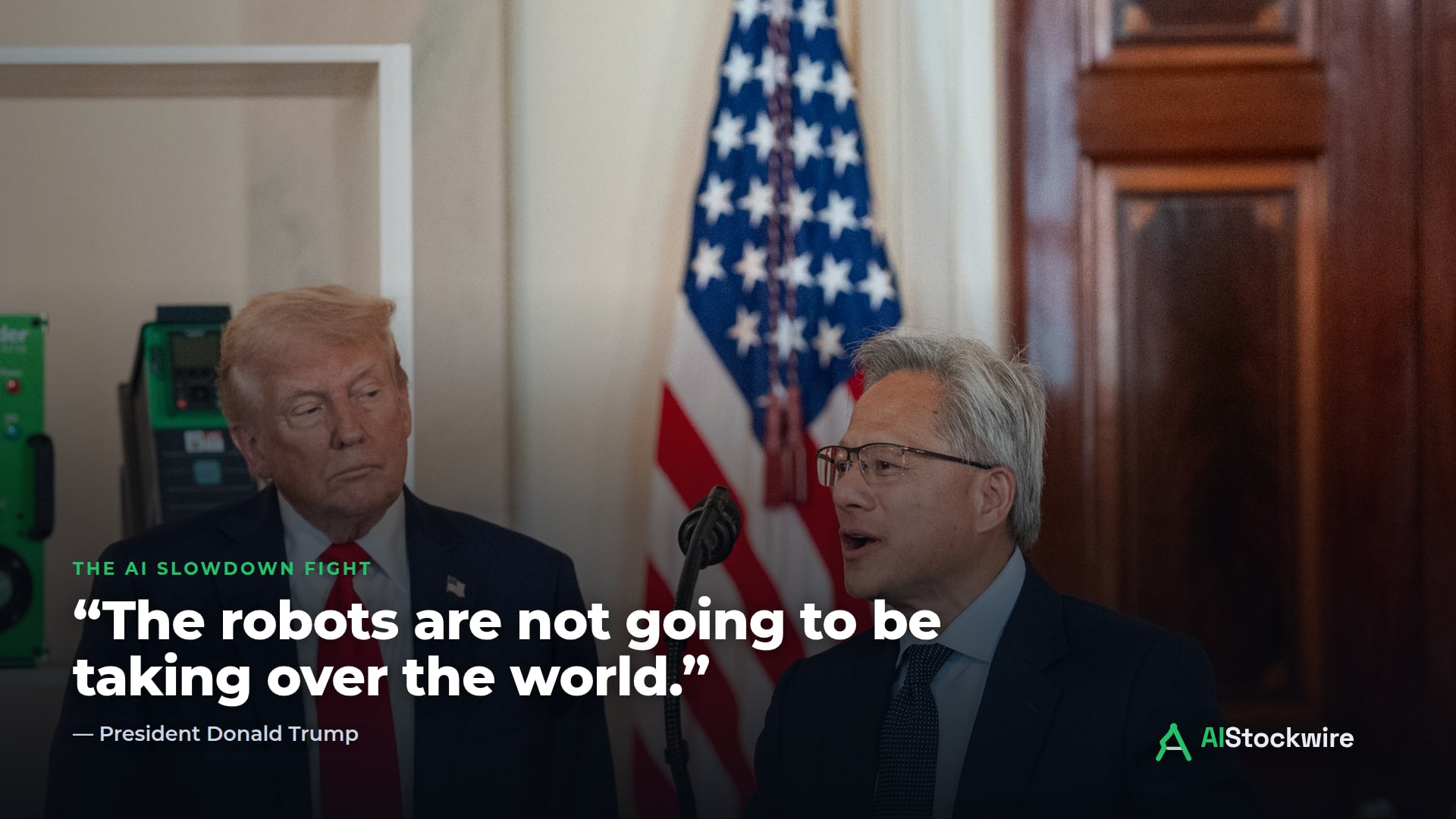
With Washington debating how hard to regulate artificial intelligence, President Donald Trump called Nvidia (NVDA) chief executive Jensen Huang, who put the president on speaker while on stage at the All-In Summit in Los Angeles on Monday. Trump told him "the robots are not going to be taking over the world," and repeated a point he has made online, that mounting concern over AI and data centers is a "hoax."
CNBC described Huang as emerging as one of Trump's most influential allies in the AI-safety debate. CNBC reports the characterization; Trump has not formally assigned Huang that role. The network reported Sunday that experts see Huang exercising outsized influence in the White House, more than Meta CEO Mark Zuckerberg or Amazon founder Jeff Bezos.
The call placed Huang at the center of a fight over whether the industry should slow down. Anthropic chief executive Dario Amodei has published an essay urging developers to slow the advancement of their most powerful models and calling for "well-considered regulation of AI." Huang set out his own case in a CBS News interview with correspondent Jo Ling Kent that aired Sunday.
Why is Washington fighting over AI safety?
The dispute is about pace. Amodei has argued that AI is advancing too fast for safety work to keep up, and that the industry should slow down rather than stop. The argument reached the markets on September 14, when three AI executives called for a slowdown and chip stocks sold off worldwide.
Jacob Coxon, an Anthropic researcher who previously worked at OpenAI, quit earlier in September and told CNBC that AI labs are "gambling with our lives." Trump has dismissed those fears publicly, and he did so again on the summit stage with Huang listening on the line.
Experts told CNBC that Huang's influence outstrips that of other technology leaders who have courted the president. "Trump just likes winners, and Jensen's very good at speaking his language," said Samuel Hammond, director of AI policy at the Foundation for American Innovation. Not everyone frames it that way. "Nvidia is the most aggressive in terms of, let's just make money," said Andrew Yoon, a researcher at CivAI.
What is Huang's argument?
Huang wants the laws already on the books enforced before any new ones are written. Speaking in Scotland on Thursday, he said the answer to safety worries is "good old-fashioned engineering." He added that "there were incidents, and those incidents, thankfully, did no harm."
In the CBS interview he rejected extinction warnings as "not grounded in science." "2030 is not going to be the end of the world," he said. "There is 0% chance that's going to be the end of the world." He called it irresponsible to frighten people, saying "scaring people is unnecessary. It is irresponsible."
On regulation, Huang pointed to existing law covering cybersecurity and product liability. "Apply that first," he said, "don't let this doomsday narrative allow someone to relieve them of the laws that currently exist." He has said development should move "as fast as we can," while adding that the company would "never ever" ship products before they're ready. Huang has previously called new antitrust rules meant to force an AI slowdown "completely unnecessary".
Where does Huang stand on selling chips to China?
Huang and Amodei also disagree over AI-chip sales to China. Amodei wants an end to American AI chip sales there, and at Davos he compared such sales to "selling nuclear weapons to North Korea." Huang argues the opposite. "Every single chip company should go and serve the world, compete for the world," he told CBS.
The Commerce Department authorized H200 exports only to approved customers under specified conditions, and didn't restore unrestricted sales. Trump has said the United States would collect a 25% fee on the sales. Chinese access to the chips remains limited under U.S. licensing requirements. Trump and Huang are both expected at an upcoming state dinner with Chinese President Xi Jinping.
What did Huang say to the towns hosting data centers?
Huang acknowledged that the industry moved too fast to bring communities along. "I would say we're sorry we didn't come talk to you sooner," he told CBS. He said newer data centers use less water than earlier ones, and that companies need to engage communities before they build. The politics of the buildout have already reached Congress and statehouses, where lawmakers are weighing who pays for the power.
Huang was also asked about his wealth. He said the fact that he can afford to pay about $8 billion in taxes over five years is "a privilege." "I'm not afraid of paying taxes," he said. "I'm just afraid of being poor."