Key points
- What Intel's new inference card can do
- Why it doesn't need liquid cooling
- How it stacks up against AMD's card
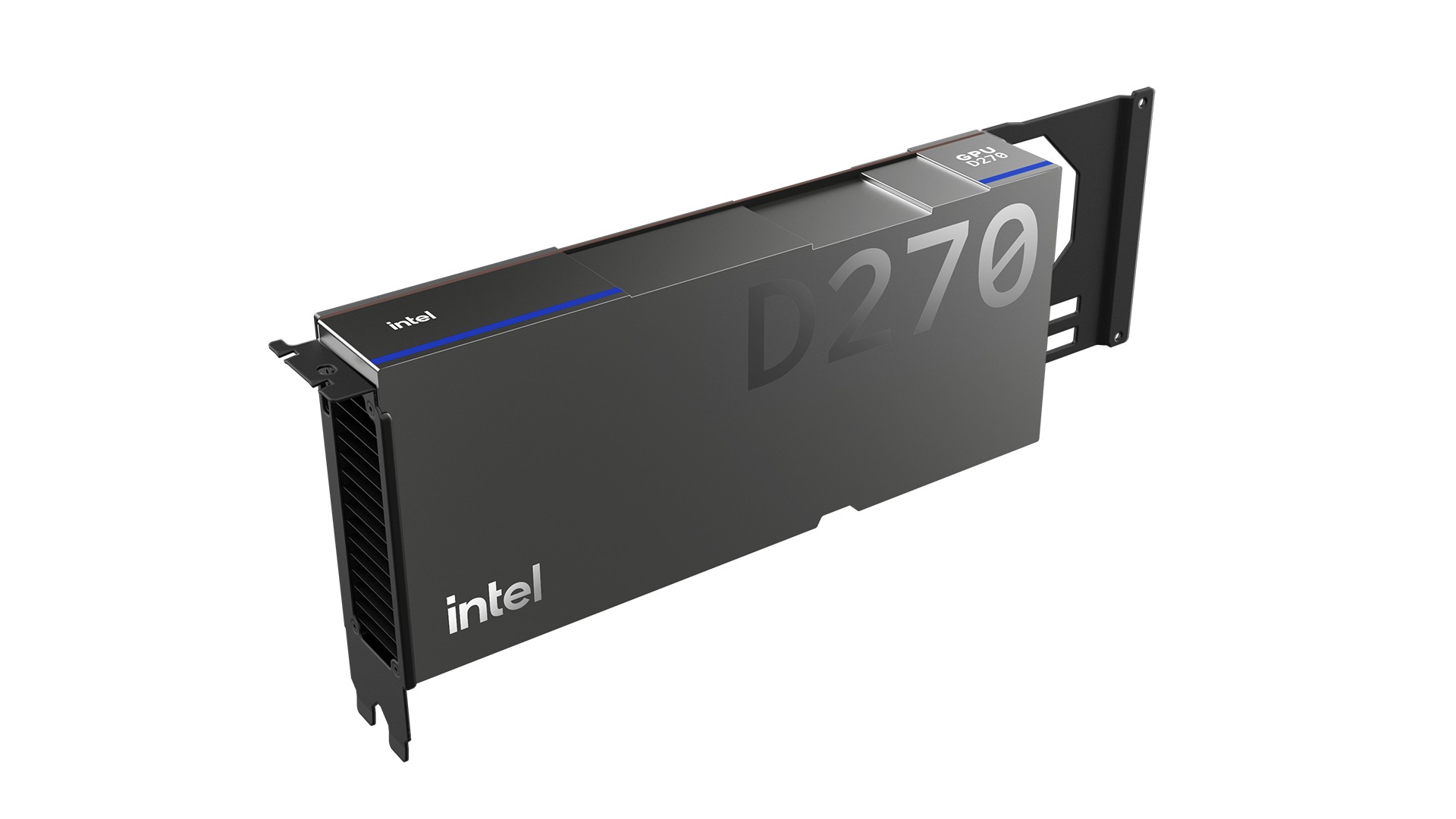
Intel (INTC) released final specifications Monday for its Crescent Island AI chip and gave it a product name, the Intel GPU D-Series. The card is designed to run AI inference, the work of using a trained model, in existing data centers without specialized racks or liquid cooling, according to Intel.
Intel announced the specifications at the Open Compute Project Global Summit and said customer sampling is underway. It disclosed neither pricing nor a shipping date. Intel shares closed down 3.2% at $101.35.
Built for standard slots and air cooling
The D-Series plugs into a standard PCIe slot and operates within a 350-watt power limit. Built on Intel's Xe3P graphics architecture, it delivers a stated peak of 1.3 petaflops of FP8 compute, with memory bandwidth of 1.5 terabytes per second.
Intel's card has 160GB of LPDDR5X memory, while partners can build versions with up to 480GB. LPDDR5X is also used in laptops and phones. It offers less bandwidth than the high-bandwidth memory, or HBM, used in flagship AI chips from Nvidia (NVDA) and AMD (AMD).
Intel says one card can support models with up to 300 billion parameters, and an eight-card system more than 1 trillion. Those limits depend on the numerical precision used to store the model and the amount of text it processes at once.
It isn't built to match Nvidia's top chips
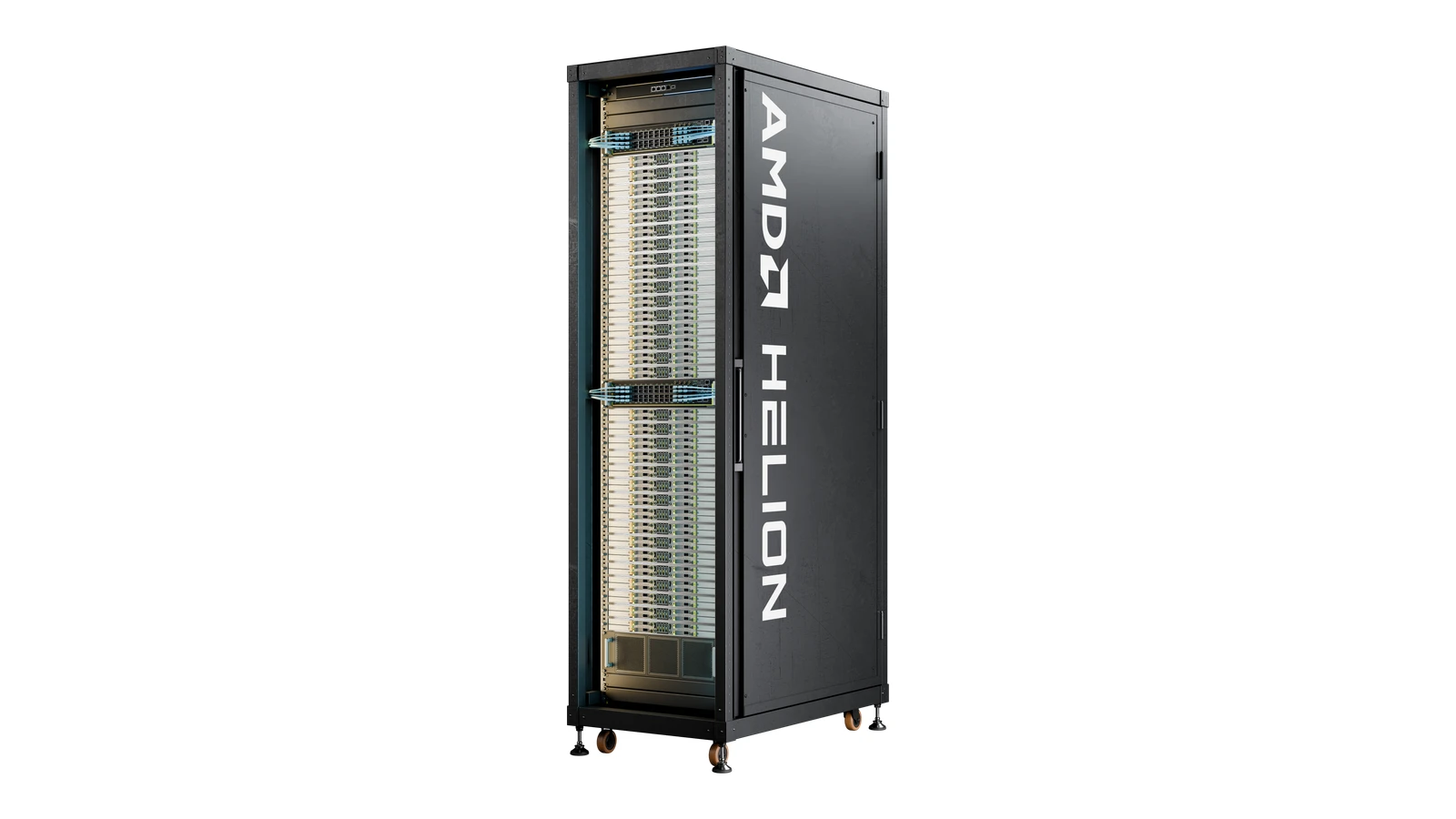
The D-Series targets existing data centers rather than the performance level of flagship AI accelerators such as Nvidia's Blackwell Ultra or AMD's MI455X, according to ServeTheHome. AMD's similar PCIe card, the MI350P, has a theoretical peak of 2.3 petaflops of dense FP8 compute. Intel's 1.3 petaflops is also a theoretical peak, about 40% lower on that measure, which doesn't show how the two cards perform on real workloads. AMD's top MI350P configuration uses 600 watts.
The D-Series is Intel's new data center GPU designed for AI inference. Its previous data center GPU line, Ponte Vecchio, went on sale as the Data Center GPU Max Series in January 2023. Intel canceled the planned successor, Rialto Bridge, in March 2023 and decided in January 2025 to keep Falcon Shores as an internal test chip. When Intel went to the AI Infra Summit in September, its Crescent Island questions were still unanswered.
"Inference is becoming the defining AI workload, and enterprises need infrastructure that delivers the right performance at the right cost," said Anil Nanduri, vice president of AI products and go-to-market in Intel's Data Center Group.
Intel data center executive Nicolas Dubé is scheduled to give a keynote at the summit on October 13 at 10:30 a.m. PT.
Cover image courtesy of Intel Corporation.