Key points
- Three Karman (KRMN) directors bought stock the same day
- Every purchase was a code P open-market buy
- The buying came near a 52-week low
- One director accounts for almost all of it
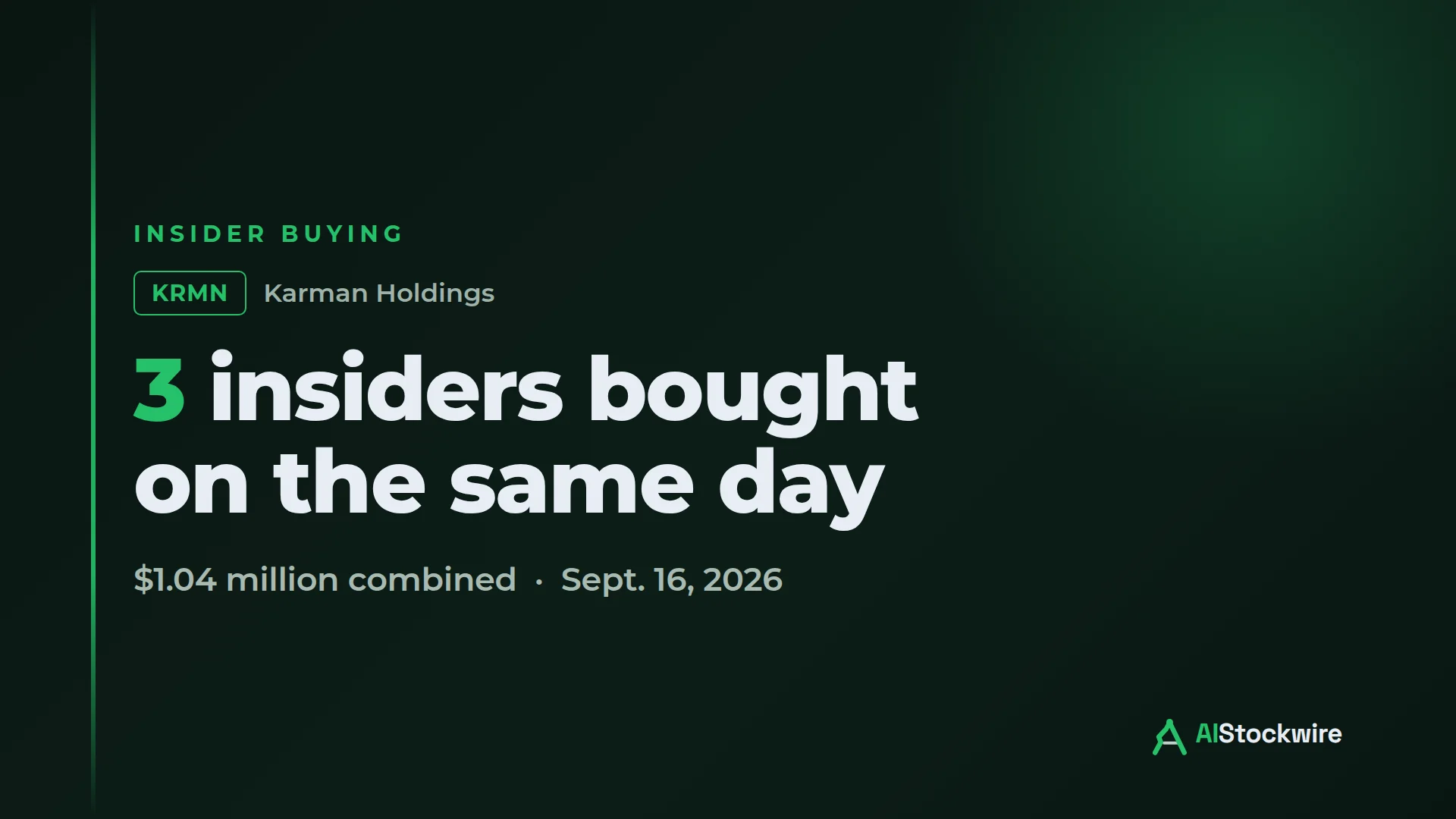
Something turned up on our insider-buying tracker this week that I wanted a second look at. Three directors of Karman Holdings (KRMN) all bought stock on the same Wednesday, Sept. 16, and their Form 4s reached the SEC two days later. Together they put in about $1.04 million.
That headline number is real, but it hides how lopsided the buying was. One person did almost all of it.
Who bought what
The big buyer was David Stinnett, Karman's chairman, who bought about $1.01 million of stock. The other two are independent directors, and their purchases were small. Mary Petryszyn bought about $18,700, and Stephen Twitty bought about $10,100. So the million-dollar figure is really one director's buy with two modest additions on the same day.
What the three share is the part I find more interesting than the total. Every purchase carries transaction code P, and none of them was made under a trading plan.
Why code P and the blank plan box matter
Code P is what an insider uses for an ordinary open-market purchase. It means real money went in to buy shares, as opposed to the coded entries you see when an executive picks up a grant or hands stock back to cover taxes. The other field worth checking is the Rule 10b5-1 box. When that box is checked, the purchase came out of a schedule the insider set up months earlier, so the timing reflects that earlier decision. The filings do not indicate that these purchases were made under Rule 10b5-1 plans.
Three insiders buying on the same day is exactly what the tracker is built to surface. It doesn't tell you the stock is cheap. It tells you that three of the company's directors put their own money in at Wednesday's price. How much to make of that is a separate question, and I went through the research on it in a separate piece.
Where the stock was trading
Some context helps. Karman is based in Huntington Beach, California. The company designs and builds systems for missiles, defense and space programs: payload protection, interstage structures and propulsion. Karman went public on the New York Stock Exchange (NYSE) in February 2025 at $22 a share, backed by the private equity firm Trive Capital. The stock ran hard after that, touched $118.38 in late January, and then slid for most of the year.
The slide's been the strange part, because the business has held up. Karman beat estimates in August and raised its full-year revenue guidance. The stock kept falling through all of it.
By last week it was near the bottom of that move. Karman set a 52-week low of $33.99 on Sept. 11, five days before the directors bought. On Sept. 15, Guggenheim started coverage with a buy rating and a $63 price target, and the shares jumped about 10% that day. The directors bought the next morning, at a weighted-average price of $37.32. A footnote on the chairman's filing says his shares "were purchased in multiple transactions at prices ranging from $36.99 to $37.52 per share." The stock closed Thursday at $35.25, a little below what the directors paid two days earlier.
The chairman and the two independent directors
Stinnett is a partner at Trive Capital, and he'd been Karman's largest insider holder well before Wednesday. His filing reports 3,530,395 shares held directly after the buy, so his $1.01 million is a small addition to a stake he already had.
The two independent directors are a different case. Petryszyn joined the board in 2025, after running the defense systems business at Northrop Grumman. Twitty joined the same year; he's a retired Army lieutenant general who finished his career as deputy commander of U.S. European Command. Both owned only small amounts of Karman stock before this, so their buys, small as the dollars are, are personal money going into a company they help oversee.
What the filings don't tell you
A Form 4 gives you the date, the size, the price and whether a plan was involved. It doesn't give a reason. None of the three filings says why they bought, or whether any of them intends to buy more. The buying lines up with a fresh analyst call and a knocked-down price, but the forms leave that connection unstated, and I'd leave it there too.
Every Karman filing lands on its stock page as it arrives, and this same-day cluster sits on our insider-buying tracker, where I came across it. This is general information, not investment advice.