Key points
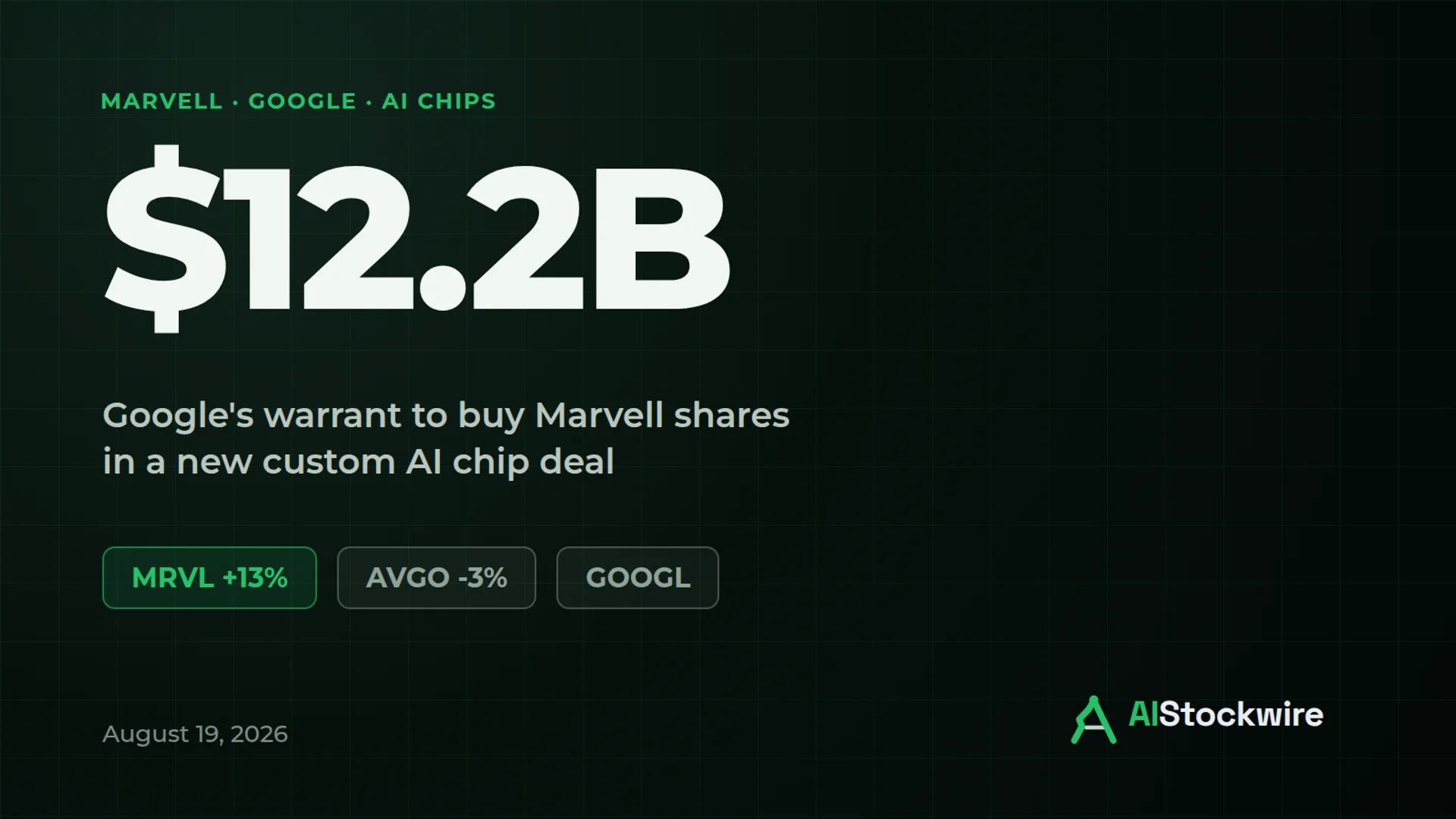
- Marvell (MRVL) jumped as much as 13% to $243.66 in early trading on August 19, after giving Google a warrant worth up to $12.2 billion.
- Google can buy up to 58.97 million Marvell shares at $206.58 each, but most of that only vests as Google spends on Marvell's custom AI chips through fiscal 2033.
- Broadcom (AVGO) fell as much as 4%, and fellow AI suppliers Astera Labs (ALAB) and Credo (CRDO) turned negative too as the session wore on.
Marvell Technology and Google signed a commercial agreement on July 29, 2026, covering a range of custom chips for Google's Tensor Processing Unit ecosystem. On August 18, Marvell followed that agreement by issuing Google a warrant for up to 58.97 million shares at $206.58 apiece. Fully exercised, the warrant would be worth about $12.2 billion.
Investors reacted the next morning. Marvell shares climbed as much as 13% in early trading, while Broadcom, the incumbent chip partner in Google's TPU program, fell as much as 4%, and the selling spread to other AI chip suppliers as the day went on. The important detail is that most of Google's warrant does not vest on a preset timetable. It vests as Google spends money on Marvell's custom chips.
What Marvell is building for Google
In an SEC filing dated August 19, Marvell Technology (MRVL) disclosed that it had signed the commercial agreement with Google LLC on July 29. The work covers several types of custom silicon connected to Google's TPU ecosystem: AI inference accelerators, storage controllers, network interface controllers, memory interface controllers and near-memory compute.
Marvell has designed custom chips for hyperscale cloud providers for years. We looked more closely at the industry's shift from training AI systems to running AI models, called inference, in more detail here.
How the warrant works
The warrant issued on August 18 covers exactly 58,970,907 Marvell shares. Google can exercise it at $206.58 a share until it expires on August 18, 2033.
Only a small portion vests with time. Google receives 1,360,867 shares in equal quarterly installments during the first year. The other 57.6 million shares are divided into 240 equal tranches. One tranche vests for each $500 million in custom-chip revenue that Google generates for Marvell, beginning in Marvell's third quarter of fiscal 2027 and continuing through the end of fiscal 2033.
For every tranche to vest, Google's purchases would have to produce as much as $120 billion in custom-products revenue for Marvell over that period. The figure is a ceiling, not a sales commitment.
Marvell chief executive Matt Murphy had already pointed to rapidly growing AI demand. During the company's May 27 first-quarter earnings call, he told investors, "We are seeing exceptional AI-related bookings, and as a result, we are significantly raising Marvell's revenue outlook for both fiscal 2027 and fiscal 2028." The warrant connects a substantial part of that opportunity to purchases by one customer rather than leaving it entirely as a forecast.
Where the stock traded
| Ticker | Move | Price | 2026 so far |
|---|---|---|---|
| Marvell (MRVL) | +9% | $236.43 | +178% |
| Broadcom (AVGO) | -4% | $364.50 | +5% |
| Alphabet (GOOGL) | +0.5% | $345.86 | +10% |
| Astera Labs (ALAB) | -6% | $286.39 | +72% |
| Credo Technology (CRDO) | -5% | $234.43 | +63% |
Even after Wednesday's jump, Marvell traded about 28% below its 52-week high of $329.88. The move also landed a week ahead of the company's next earnings report, scheduled for August 27, with options pricing in a swing of about 14% either way that day.
The selling was not limited to Broadcom. By midday, Astera Labs and Credo Technology, two smaller suppliers that also sell into the AI networking and optics buildout, had both turned negative, down 6% and 5% respectively, even though each remains up more than 60% for the year. The move reads as investors pricing in more competition across the whole group of Google's chip suppliers, not just a one-for-one swap between Marvell and Broadcom.
What analysts were already saying
The Google news landed while Wall Street was already leaning bullish into that August 27 report. Stifel holds a Buy rating and a $350 price target, and has said it expects Marvell's fiscal second-quarter revenue to come in above its own $2.70 billion forecast, pointing to strength in the data center segment, 76% of April-quarter revenue, and continued ramp in Marvell's custom silicon program. UBS also carries a Buy rating on the stock. TD Cowen raised its price target to $225 from $200 on August 17, citing Marvell's market share in optical digital signal processors, part of the same networking and optics buildout we track alongside Astera Labs and Credo here.
What the deal does, and does not, signal
Broadcom is not out of Google's supply chain. The company signed its own multi-year extension with Google in April 2026 covering custom AI chips and rack hardware through 2031, and that agreement stays in place. What changed is that Google now has a second qualified vendor for a broad set of TPU-adjacent silicon, not just the accelerator chip itself, and Wednesday's stock reaction (Marvell up, Broadcom down) reads as the market pricing in more competition for that business rather than Broadcom losing it outright. It is the same rotation-between-suppliers dynamic we've been tracking across the AI chip trade, just with a specific dollar figure attached this time.
The revenue is not guaranteed. Every dollar of the $120 billion ceiling depends on Google actually buying chips from Marvell at a pace Google alone controls, and Marvell still has to design, build and ship products Google wants at a price Google is willing to pay, every quarter, for seven years.
A month later, Marvell took its first 2nm optical chip demos to ECOC 2026.
Sources: Marvell Technology 8-K filed with the SEC on August 19, 2026; Reuters; Bloomberg; 24/7 Wall St.; Tradingpedia; Marvell's May 27, 2026 first-quarter fiscal 2027 earnings call; live quotes. Prices and moves are updated as of midday Wednesday, August 19, 2026, and are subject to change before the close.