Key points
- Training a frontier model means tens of thousands of GPUs trading data constantly. The network that connects them is one of the fastest-growing line items in every AI buildout.
- There are two layers: scale-up inside the rack, which Nvidia's NVLink handles, and scale-out across the data center, where Ethernet is winning a long fight with InfiniBand.
- The public names split three ways: switching (Arista, Broadcom), connectivity and custom silicon (Marvell, Astera Labs, Credo), and optics (Coherent, Lumentum, Fabrinet, Applied Optoelectronics, Ciena).
- For the chips these networks connect, see our AI hardware stack piece.
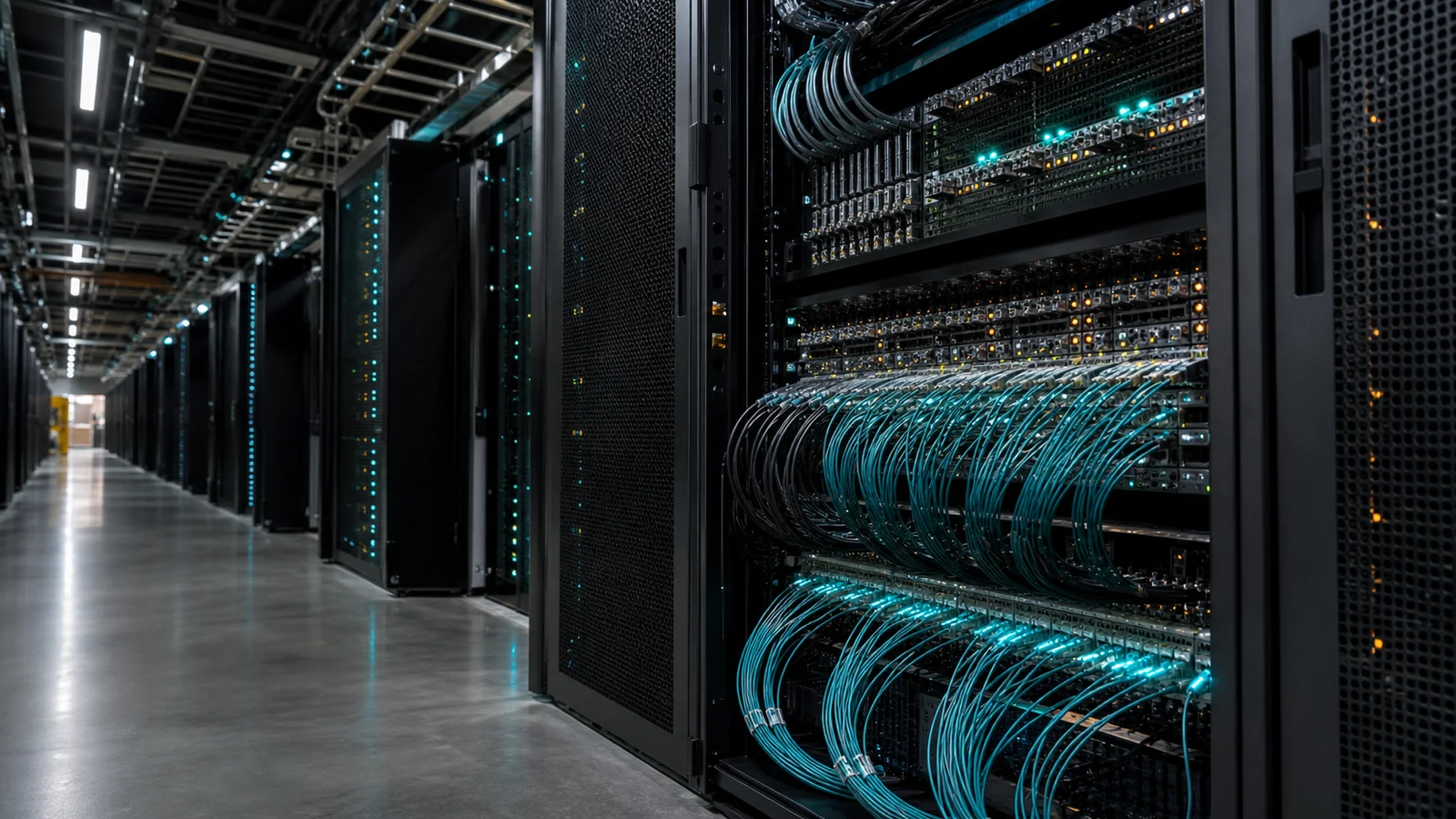
A single GPU can't handle large-scale AI by itself. Today's models use clusters containing tens of thousands of chips and, in some cases, more than 100,000. Every processor must behave as part of the same machine. That requires enough bandwidth to move data without leaving costly silicon idle. Estimates generally put networking at 10% to 15% of a GPU cluster's hardware bill, with the proportion increasing as clusters expand.
Those connections are built in two tiers. Within the rack, GPUs communicate through an extremely fast, short-distance link. Nvidia (NVDA) calls its version NVLink. Its current Blackwell chips move 1.8 terabytes per second per GPU, and the next generation doubles that to 3.6. Traffic traveling across the larger data center uses one of two rival standards. Nvidia owns InfiniBand, while the broader industry supports the open Ethernet standard. Momentum is moving toward Ethernet. AMD, Arista, Broadcom, Meta and Microsoft, among others, formed the Ultra Ethernet Consortium in 2023 to establish Ethernet as the standard choice for AI. Ethernet already accounts for about two-thirds of back-end AI switch sales, per Dell'Oro Group.
Nvidia noticed. Its own networking revenue hit a record $14.8 billion in the quarter ending April 2026, up 199% from a year earlier, and its Spectrum-X Ethernet line now runs above a $10 billion annual pace. The quarter ended July 26 took total data center revenue to $89.0 billion, up 117%. So the biggest chip company is also one of the biggest networking companies, which is the backdrop for every name below. There is a second-order effect too: SemiAnalysis estimates that when Nvidia halved the memory on Rubin Ultra to get memory down from 41% of a rack's cost, the money it freed moves to scale-up networking.
What each company does
| Company | Role in the network | Signal (fiscal quarter noted) |
|---|---|---|
| Arista Networks (ANET) | Data-center Ethernet switches | Q2 2026 revenue $3.01B, up 38%, its first $3B quarter; full-year 2026 guide raised to $12.6B, the third raise this year; joins the S&P 100 on September 21 |
| Broadcom (AVGO) | Switch silicon plus custom AI chips and optics | AI revenue $16.7B, up 221% (Q3 FY2026, reported September 2); guided to $21.7B in Q4, about $115B in FY2027 and $230B in FY2028 |
| Marvell (MRVL) | Custom silicon and optical DSPs | Q2 FY2027 revenue $2.74B, up 37%, data center 79% of it; outlook about $12B for FY2027 and $18B for FY2028, including a new Google custom-chip deal |
| Coherent (COHR) | Optical transceivers and lasers | Datacenter and comms revenue up 59%, 79% of revenue (Q4 FY2026) |
| Lumentum (LITE) | Optical components | Fiscal Q4 2026 revenue about $1.01B, its first $1B quarter |
| Fabrinet (FN) | Optical contract manufacturing | Fiscal Q4 2026 revenue $1.32B, up 45% |
| Astera Labs (ALAB) | Retimers and scale-up connectivity fabric | Q2 2026 revenue $392M, up 104% |
| Credo Technology (CRDO) | Active electrical cables and SerDes | Q1 FY2027 revenue $479M, up 115%, seventh straight quarter of triple-digit growth; Q2 guide $525M to $535M |
| Applied Optoelectronics (AAOI) | Optical transceivers | Q2 2026 revenue $191.9M, up 86%; a third $600M at-the-market stock program opened in August after $1.1B of shares sold since March |
| Ciena (CIEN) | Data-center interconnect | Fiscal Q3 2026 revenue $1.67B, up 37%; full-year guide $6.42B and backlog expected above $10B |
Fiscal years differ across these companies, so the quarter labels matter more than the calendar. Treat each figure as the last one that company reported, not a live number. The table was last brought current on September 20, 2026.
Two forces behind the growth
One driver is the migration to Ethernet. Spending that shifts from InfiniBand to Ethernet flows through Arista and Broadcom rather than Nvidia's proprietary system. Broadcom chief executive Hock Tan put a number on it in June: "Q2 semiconductor revenue from AI of $10.8 billion grew 143% year-over-year, above our forecast, driven by increasing demand for custom AI accelerators and AI networking." Three months later Broadcom reported $16.7 billion and said supply is secured through fiscal 2028. That shift explains why Arista raised its full-year guidance three times in 2026. Marvell showed the other side of custom silicon: it gave Google a warrant worth up to $12.2 billion to win a chip deal, and its stock fell 10% on the lower gross margin that comes with more custom work. The other driver is the optical upgrade cycle. Data-center links are progressing from 400 gigabits to 800 gigabits and, more recently, 1.6 terabits. Every jump creates additional demand for transceivers from Coherent, Lumentum, Fabrinet, and Applied Optoelectronics. Copper remains practical across the shortest distances, the territory served by Credo and Astera Labs. Longer connections move to light.
Where the thesis can break
Optical networking has always been cyclical. Applied Optoelectronics has swung sharply for years, while dependence on a small number of hyperscalers makes orders uneven. Losing a single program can wreck a quarter. Nvidia is no longer merely a supplier to customers; it now competes directly in networking. Co-packaged optics, an approaching technology change, could also rearrange the winners in transceivers.
That doesn't make this group an automatic buy or sell. It maps the spending that follows once customers purchase GPUs and need to connect them. Our stock score tool can grade the filings for each company in about ten seconds.
Sources
- Related coverage: Inside the AI hardware stack, layer by layer
- Related coverage: The AI power equipment stocks
- Nvidia, first-quarter fiscal 2027 results (networking revenue) and second-quarter fiscal 2027 results
- Company results: Arista Q2 2026, Credo Q1 FY2027, Ciena Q3 FY2026
- Ultra Ethernet Consortium (formation and membership)
- Company revenue figures from each firm's most recent quarterly report, via SEC EDGAR
This is general market commentary and opinion, not investment advice. Markets can go down as well as up, and you can lose money. Always do your own research and consider speaking with a licensed financial professional before making any investment decision.