Key points
- Michael Burry disclosed a new short on Micron (MU) in his July 2 Trading Post, reported near $1,052.
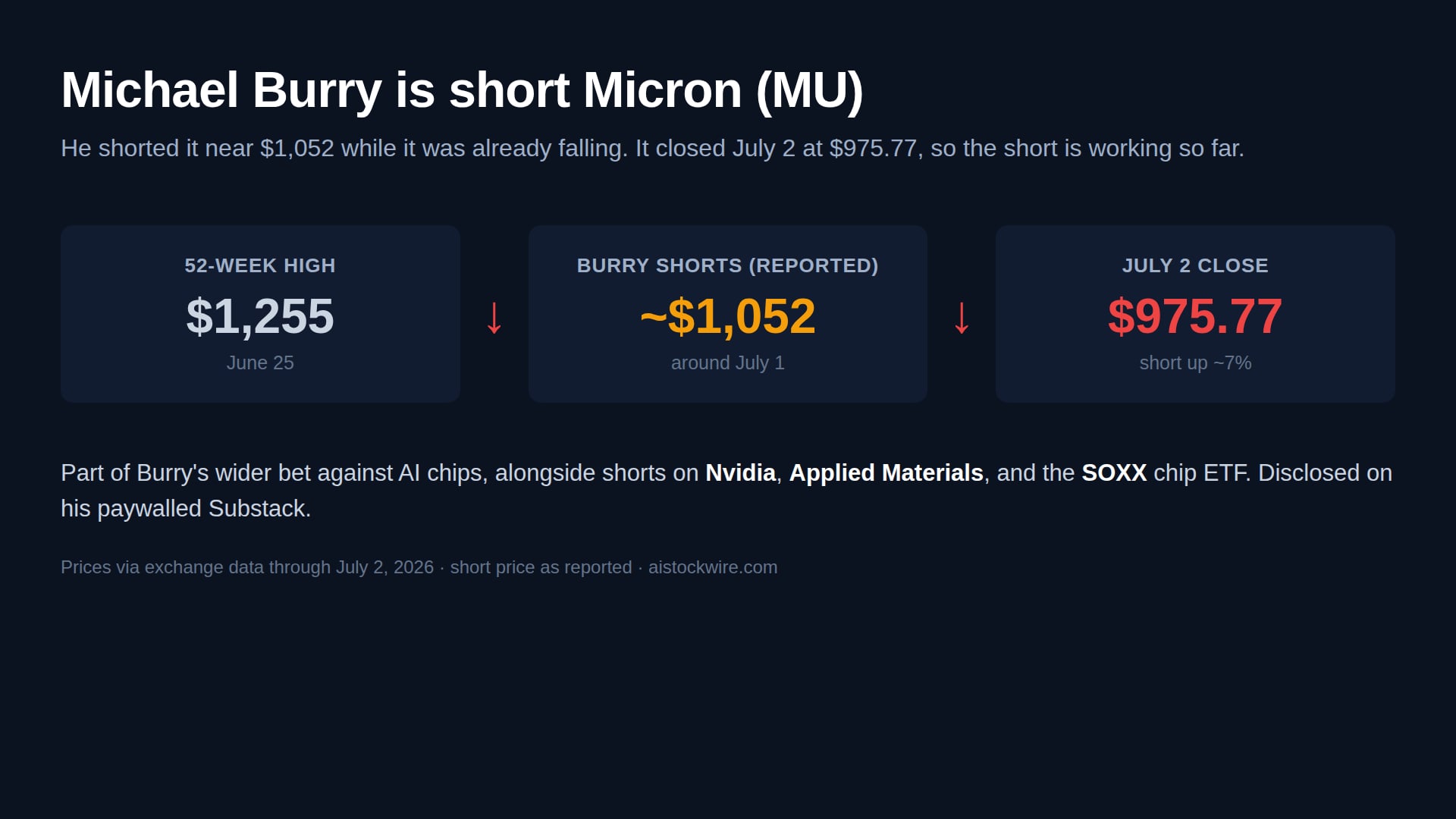
- He shorted it after it had already fallen hard, from a $1,255 high on June 25. Micron then dropped to $975.77 by July 2, so the short is working.
- In the same post he added to four or five of his long positions, so he is not betting against everything.
- His trades now come from a paywalled Substack, not regulatory filings, since he closed his fund in late 2025.
Update, July 26, 2026: Micron closed at $920.95 on Friday, July 24, which puts this short about 12% ahead of Burry's stated $1,051.87 entry. He has since also disclosed bets against Nvidia (NVDA), AMD and Applied Materials. We compared Micron against SK Hynix, Nvidia and AMD here.
I will admit it. I love a good look inside someone else's portfolio, and Michael Burry keeps handing us one. On July 2 he posted another trade update, and the move everyone noticed was a fresh short on Micron (MU), a chip stock that had already been through the wringer.
Here is what we actually know. In his July 2 Trading Post, Burry said he opened a new short position. Traders who follow his disclosures pegged the entry near $1,052. That number comes with a caveat. His full post is behind a paywall, so $1,052 is what got passed around, not something he published in the open. What is confirmed, straight from the post, is the shape of it: one new short, plus additions to a handful of his long positions.
Why the timing matters
First, the basics, because shorting trips people up. A short is a bet that a stock falls. You borrow the shares, sell them today, and plan to buy them back later for less, keeping the difference. If the stock rises instead, the losses can keep growing on you.
Now, the timing. Micron was not riding high when Burry shorted it. It had already dropped from about $1,255 in late June to roughly $1,050 by the start of July. Shorting something that is already this cut up is a real statement. It says he does not think the bleeding is done.
For now, he looks right. Micron kept sliding and closed at $975.77 on July 2, its first finish under $1,000 in a while. From a reported entry near $1,052, that short is already up around 7 percent. If you own Micron, I know that is not a fun thing to read. It does help to remember this is one person's bet, not a verdict. The broader chip sell-off that pulled Micron down is here if you want the full picture.
He is not short everything
This is the part the scary headlines tend to skip. Micron is not the only name Burry is leaning against. His recent disclosures include shorts on Nvidia, Applied Materials, and the big semiconductor ETF, so Micron fits a pattern more than it stands alone.
But in that same post, he also added to four or five of his long positions. He is not sitting there betting the whole market goes to zero. He recently bought call options on Microsoft, which is basically a bet that a stock goes up, and Microsoft is the software name that held up while the chips fell. So the honest read is not "Burry is short everything." It is someone leaning hard on one side while quietly building the other.
Read it with a little care
Two things are worth holding onto. Burry closed his firm, Scion, in late 2025, so he no longer files the quarterly 13F reports that used to make his positions official. What we get now is his own account on a subscription Substack, plus secondhand notes on the exact prices. And a famous investor shorting a stock is not a green light for you to do the same. Shorting is genuinely risky, a quick price jump can hurt you, and by the time a trade reaches the news it has often already moved. Watching what someone like Burry does is one thing. Acting on it is another.
Sources
- Michael Burry, Trading Post July 2, 2026 (subtitle: "A new short and five additions to long positions"; full post is paywalled).
- Micron (MU) prices and 52-week range from exchange data through July 2, 2026.
- Reported $1,052 short entry via market-watch accounts tracking Burry's disclosures; not confirmed by a regulatory filing.
This is general market commentary and opinion, not investment advice. The reported $1,052 Micron short price comes from Burry's paywalled disclosure as circulated by others and is not independently confirmed by a regulatory filing. Prices are as of July 2, 2026 and will move. Short selling carries open-ended risk. Always do your own research.