My position: I own SKHY. I sold near $190 when it spiked on July 14 and bought back at $154 on the memory selloff, a round trip I wrote up at the time. It closed Friday at $154.57, essentially where I bought it, and I'm holding into Wednesday's earnings. Nothing below is investment advice.
Key points
- Nvidia and SK Group signed a $500B AI infrastructure letter of intent after Friday's close in both New York and Seoul, so no market has priced it.
- Given $1,000 for one of the four, I'd put it in SK Hynix (SKHY), at 5.6x forward earnings even after the ADR premium against 6.4x for Micron.
- Leopold Aschenbrenner's fund holds puts against NVDA, AMD and MU, and still backed SK Hynix's US listing.
- SKHY closed 28% above the Seoul price, a spread to watch, though it stays cheapest of the four on forward earnings.
- SK Hynix reports Wednesday, July 29, with consensus at a record 64.1T won ($43.9B USD) operating profit in one quarter.
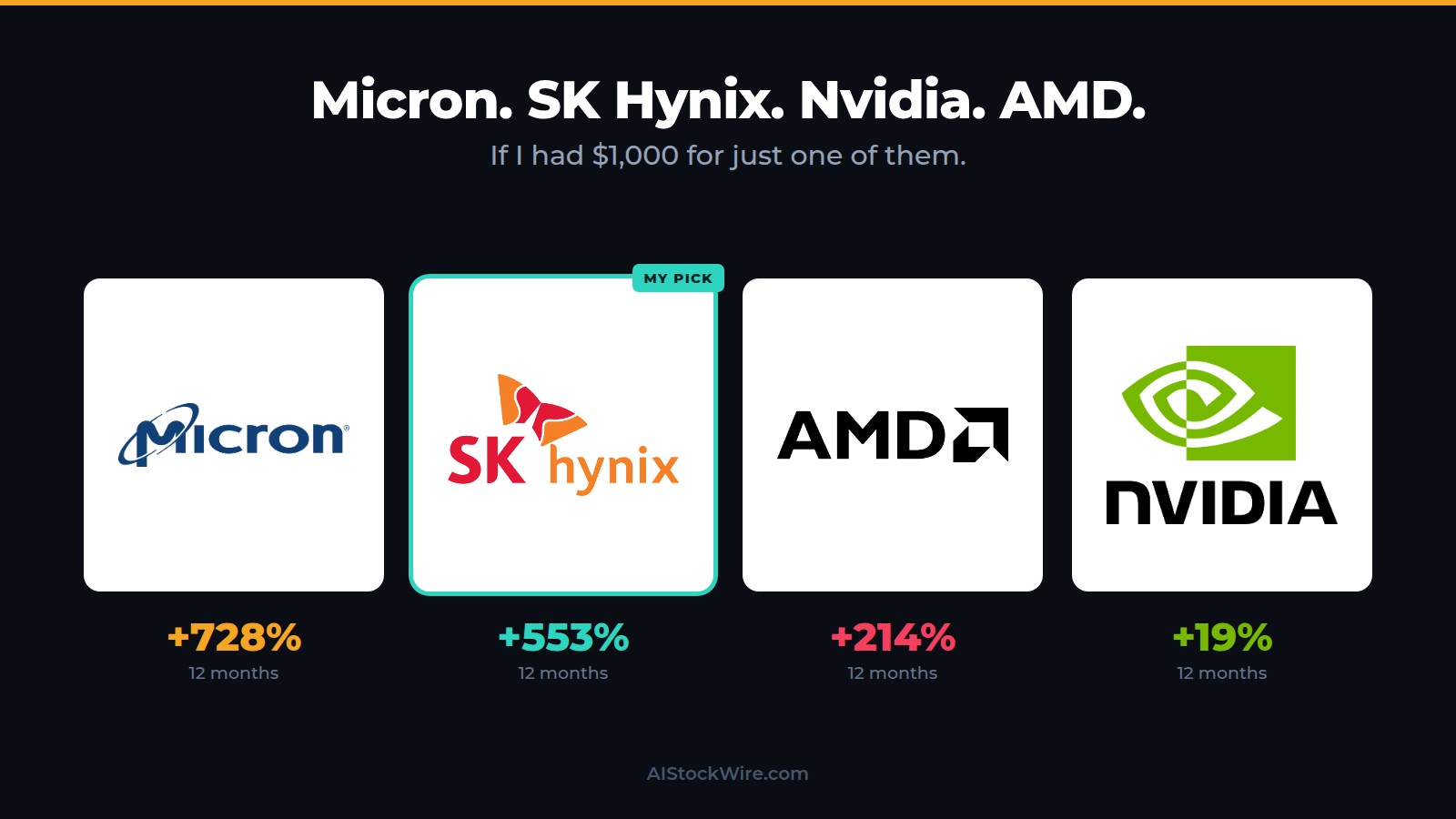
Four companies make most of the money in AI hardware right now. If I had $1,000 to put into exactly one of them today, it would go into SK Hynix, and Friday handed me a better reason than I had a week ago.
The live figure sits on our ADR premium tracker, alongside every other major AI listing that trades in two places.
Nvidia and SK Group signed a letter of intent Friday night covering more than $500 billion of AI infrastructure, announced at an AI summit in San Francisco in front of Korea's president Lee Jae Myung. SK Telecom is building a 2-gigawatt Vera Rubin DSX AI factory out of it. Nvidia and SK Hynix are setting up a long-term partnership to secure and co-develop next-generation AI memory, HBM included.
"South Korea has all the ingredients to become a global AI powerhouse," Jensen Huang said in the announcement, citing the country's networks, data centers and chip technology. SK chairman Chey Tae-won framed it around "how much intelligence we can produce," and said SK would use SK Hynix memory and SK Telecom infrastructure to "build a world-class AI factory."
No market has priced this yet. The announcement crossed the wire at 1:10 a.m. Eastern on Saturday, nine hours after New York closed and nearly a full day after Seoul finished for the week. It was already Saturday afternoon in Korea when it landed. SK Hynix ended Friday in Seoul down 8.34%, at 1,759,000 won, and the $154.57 on the Nasdaq is a pre-deal price too. Monday, July 27 is the first session either line can respond to it.
One note on the ticker. The 000660 line in Seoul is the company. SKHY on the Nasdaq started trading July 14, so it has no real history yet. Everything below is the Seoul listing unless I say otherwise.
The four side by side
| Micron (MU) | SK Hynix (Seoul) | Nvidia (NVDA) | AMD | |
|---|---|---|---|---|
| Price, July 24 | $920.95 | 1,759,000 won | $206.84 | $521.95 |
| Market value | $1.04T | 1,282T won ($878B USD) | $5.01T | $851B |
| Past 12 months | +728% | +553% | +19% | +214% |
| Below 2026 closing high | 24% | 40% | 12% | 10% |
| Trailing P/E | 20.8 | 16.7 | 31.7 | 174 |
| Forward P/E | 6.4 | 4.4 | 22 | 58.5 |
| Revenue, last 12 months | $90.3B | 132.1T won ($90.5B USD) | $253.5B | $37.5B |
| Net income, last 12 months | $50.5B | 75.1T won ($51.5B USD) | $159.6B | $5.0B |
Why I like SK Hynix here
The knock on memory is always the same. It's a commodity, the profits are peak-cycle, don't pay up for them. That argument has been right plenty of times. It describes a spot market, and close to half of SK Hynix revenue now sits under long-term agreements instead, according to TrendForce.
The company has already committed all of its 2026 production capacity to orders it's holding. HBM4 mass production starts this quarter.
Chief executive Kwak Noh-jung told reporters on July 10 that he can't build fast enough. "Our customer demand continues to go up, while our capacity has limitations," he said. He expects 2027 to bring the worst memory shortage the industry has had.
Friday's partnership stacks a named multi-year buyer on top of that book, with the first phase of the SK Telecom factory due in 2027. Contracted volume at agreed prices behaves differently from spot DRAM. At 4.4 times forward earnings, that's the cheapest forward multiple of the four.
And the demand behind SKHY isn't a forecast at this point, it's turning up on other companies' earnings calls. Elon Musk thanked Micron by name on Tesla's July 22 call for a "very significant allocation" of memory, and called chip pricing "pretty insane." The next day Intel's Lip-Bu Tan told his own call that "memory has become the biggest supply constraint challenge" his company faces, ahead of logic, wafers and substrates. Those are two buyers, not two suppliers talking their own book.
And they report this Wednesday, July 29. Consensus wants 64.1 trillion won ($43.9B USD) of operating profit on 84 trillion won ($57.6B USD) of revenue, in three months. That would be the biggest quarter in the company's history, and it would out-earn all but a handful of companies on the planet. We ran the full preview last week.
Leopold Aschenbrenner is short Nvidia, AMD and Micron
Leopold Aschenbrenner runs Situational Awareness, a $13.7 billion fund. Put his first-quarter 13F next to my table and it gets a little funny. He's holding puts against Nvidia worth $1.57 billion notional. Puts against AMD worth $969 million. Puts against Micron worth $584 million.
That's every other name in the comparison. His chip puts total $8.46 billion notional, about 62% of the fund's reported value, and they cover Broadcom, TSMC, ASML, Intel and the VanEck Semiconductor ETF on top of those three.
Then he backed SK Hynix's Nasdaq listing. He and Baillie Gifford and Coatue together signaled they'd take up to $7 billion of that offering.
So a guy who's short the AI chip complex with both hands made exactly one exception, and the exception is the name I'm making the case for. He doesn't have to be right for me to notice which side of the boat he got on.
Micron's Apple problem
Micron and SK Hynix earn almost exactly the same money. Look at the table again. Same revenue, same net income, same product, same customers.
The difference is who they're fighting. Apple (AAPL) has been lobbying Washington to let it buy memory from China's CXMT. Micron has been lobbying the Trump administration to block it, warning that letting Chinese suppliers in could wreck the domestic industry the way US steel went. Apple's response is that Micron's gross margins above 80% are price gouging.
Micron's May quarter came in at 84.6% gross margin. Apple's number is right.
Apple started testing CXMT parts on July 8 and has already raised MacBook and iPad prices as much as 25% on memory costs. I don't want to own the company whose biggest customer is lobbying the government against it and qualifying a replacement at the same time. We covered CXMT's $8.6 billion IPO here.
Nvidia and AMD, quickly
Nvidia is the safest of the four and it's been the worst stock, up 19% in a year. Custom chips from Alphabet, Amazon, Microsoft and Meta went from 20.9% of the AI chip market in 2025 to a forecast 27.8% this year. At 22 times forward earnings I still like it. I just like SK Hynix more. And notice who the buyer is in Friday's deal.
AMD trades at 174 times trailing earnings and 58.5 times forward, on the OpenAI and Meta commitments of 6 gigawatts each. It needs years of clean execution to grow into that price.
Yes, SKHY trades at a premium. It's still the cheapest of the four.
Here's the objection I keep hearing, and the number behind it is real. Ten SKHY shares equal one Seoul share. Friday's Seoul close works out to $120.53 per American share at 1,459 won to the dollar. SKHY closed at $154.57. You're paying 28% over the Korean price.
On trailing earnings that premium does eat the discount. It puts SKHY at 21.4 times against Micron's 20.8. Fine.
Now run it the way I've argued this whole piece, on forward earnings, because that's what a sold-out 2026 order book and an HBM4 ramp actually show up in. SK Hynix is 4.4 times forward in Seoul. Pay the full 28% and you land at 5.6. Micron is 6.4. Nvidia is 22. AMD is 58.5. Even after handing over the premium, SKHY is the cheapest stock in the group on the only multiple that reflects what these companies are about to earn.
It matters for a practical reason too. Most US brokerage accounts can't touch the Seoul listing, so SKHY is the realistic way in for almost everyone reading this. Telling you the value lives in Korea isn't much use if you can't get there.
The premium is a risk to track, not a reason to pass. It hit 51% on July 14 before coming in, and it can compress quickly once more ADR supply reaches the market. I went into why the company listed in New York at all on July 10. If that spread closes while Seoul goes sideways, it comes out of your return. I'd still rather own the cheapest forward multiple in AI and watch the spread than pay 22 times for Nvidia or 58 for AMD.
So the $1,000 goes to SKHY, all of it. It's the cheapest forward multiple of the four, it earns what Micron earns, and on Friday it added a named multi-year buyer to a book that was already committed through 2026.
I've traded this one around rather than sat still. I sold the spike in the middle of July, bought it back on the selloff, and I'm holding through Wednesday's print.
None of this is a promise. A letter of intent isn't a purchase order, Wednesday's numbers are still consensus, and Michael Burry is betting against two of these four. He shorted Micron on July 2 at $1,051.87, saying put options "seemed expensive," and with the stock at $920.95 that's working for him so far.
Sources
- Nvidia and SK Group $500 billion AI infrastructure letter of intent, announced July 24, 2026 in San Francisco, including the SK Telecom 2-gigawatt data center and SK Hynix HBM supply partnership
- Closing prices and valuation multiples for MU, NVDA, AMD and 000660.KS as of July 24, 2026, with won converted at 1,459 to the dollar
- Situational Awareness LP first-quarter 2026 Form 13F, and reporting on the fund's participation in SK Hynix's Nasdaq ADR offering alongside Baillie Gifford and Coatue
- Reporting on Apple's CXMT lobbying and Micron's opposition before the Trump administration; TrendForce on SK Hynix long-term agreements; Kwak Noh-jung's July 10, 2026 remarks; Michael Burry's July 2, 2026 Substack post
- Related coverage: SK Group's $1.44T USD commitment and how circular AI financing works. Filing histories: MU, NVDA and AMD.
None of this is investment advice. Every price here is a snapshot of one Friday close, taken before the market could react to Friday's announcement.