Key points
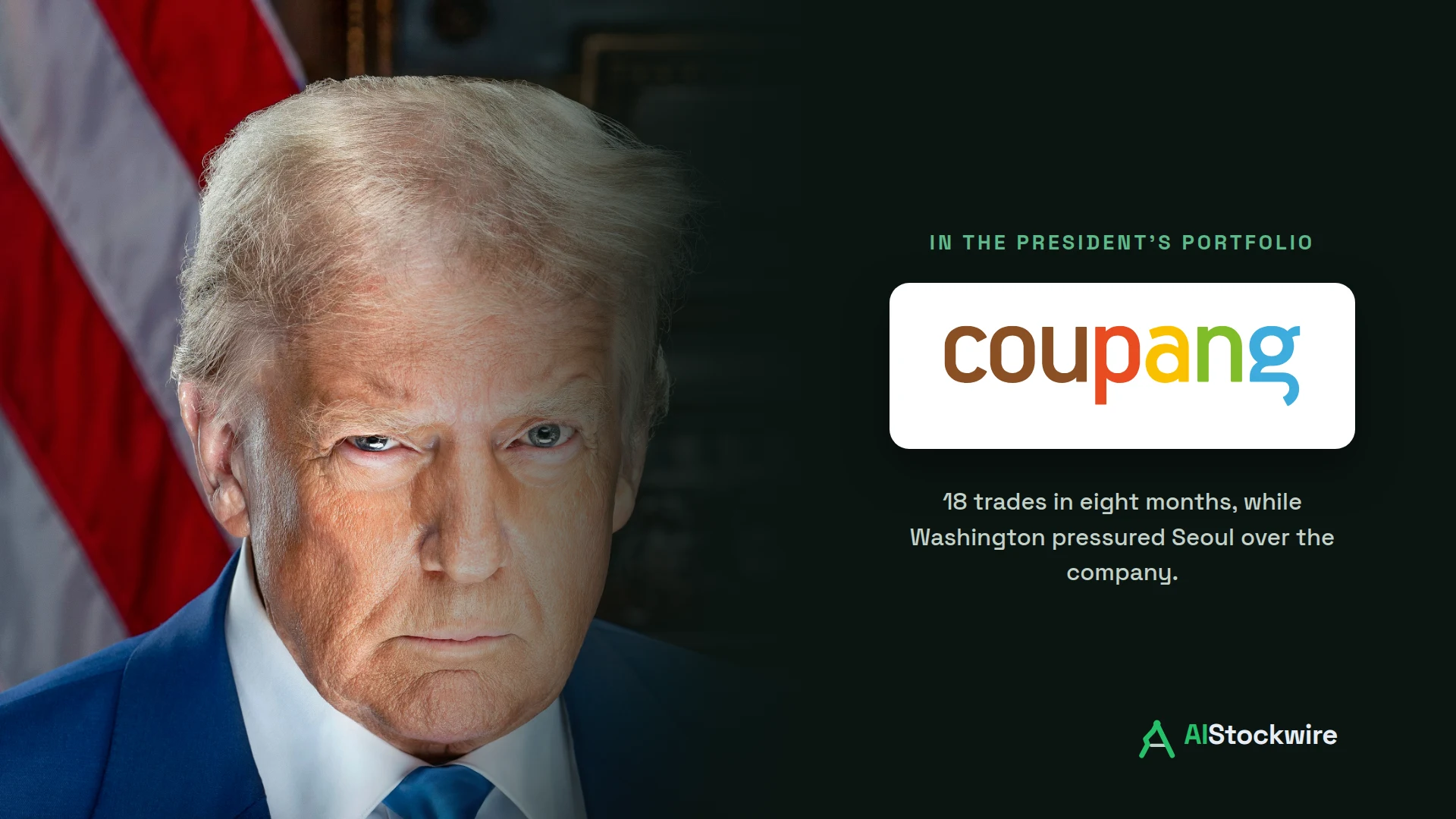
- President Trump's disclosures show 18 Coupang (CPNG) trades across two accounts from October 2025 to May 2026.
- They ran while his administration pressed Seoul over Coupang, which drew a 625 billion won ($403 million) fine in June and a House Judiciary report in July.
- US Trade Representative Jamieson Greer took a $10,000 honorarium from Coupang in 2024, before taking office.
Most of what sits in President Donald Trump's stock disclosures is what most people would expect from a large managed portfolio: Nvidia, Microsoft, Boeing, and hundreds of individual bond positions. One name is harder to overlook. Coupang (CPNG), the Korean e-commerce business listed in New York, appears 18 times in eight months, a period when Trump's administration was publicly clashing with Seoul over the same company. That made the underlying filings worth examining.
The activity spans October 9, 2025 through May 22, 2026. It covers two investment accounts and appears in three reports filed with the Office of Government Ethics. Because federal disclosure rules require value ranges rather than exact figures, each transaction is reported as a band. The smallest begins at $1,001; the largest reaches $250,000.
What the transactions show
The pattern begins on October 9th, when the account placed two purchases simultaneously. One fell between $1,001 and $15,000; the other was valued at $50,001 to $100,000. Coupang finished that session at $32.47. One week later, the account bought and sold the stock on the same day. Two more sales followed in November while the price was declining. It then made two purchases in December and two sales in January. The largest Coupang buy in the entire sequence came on February 12th: $100,001 to $250,000, when the shares traded at $17.13.
So the account entered near the high, sold during the slide, and committed its largest sum after the share price had fallen to about half its October level. The remaining two lots were sold on May 18th and May 22nd at $15.70 and $16.12, respectively. On August 13th, Coupang closed at $16.29.
Measured from those first October purchases, the holding is down about 50 percent. Measured from February, it's close to flat.
The fight those trades were sitting inside
Those eight months were turbulent for Coupang. A former employee retained access to company systems through November 8, 2025, and South Korea's government said 37.55 million people were affected. Korean authorities began investigations and threatened company executives with criminal charges. In June, regulators imposed a 625 billion won penalty, equivalent to about $403 million.
Washington viewed the Korean response as discriminatory treatment of an American company. US investors sued South Korea in January. Then, in July, the House Judiciary Committee released a 35-page interim report called "Closed for Competition: South Korea's Discriminatory Attacks on American-owned Businesses." It accused Seoul of violating a trade agreement Trump had negotiated the previous year. According to the report, the former employee actually retained data from about 3,000 accounts, compared with the 37.55 million figure cited by Seoul. South Korea's foreign ministry responded that the committee's account reflected "only Coupang's unilateral claims."
Where the conflict question comes in
The Trump Organization's position is that outside managers run the accounts and that the president learns of trades only afterward, and the Coupang pattern fits that. Buying a name, selling it and buying it back over eight months is model behavior, the same question we walked through on his Snowflake trades, where the account sold nine days before the news that sent the stock up 37 percent in a session.
The part the model explanation leaves alone is the rest of the administration. US Trade Representative Jamieson Greer took a $10,000 honorarium from Coupang on May 17, 2024, while he was at a law firm, before he took office. Under Secretary of State Allison Hooker did paid consulting work for the company. Greer's office is the one that negotiated the trade agreement the House report says Seoul violated.
Political science professor Shin Yul told the Korea Times that from Korea's side, the fact that Trump held Coupang shares at all "could be seen" as a problem.
The other odd names
Coupang isn't the only holding that raises this shape of question. The account bought Oracle early in 2026 while the administration was helping the company keep TikTok running in the US. It bought between $500,001 and $1,000,000 of Nvidia on January 6, 2026, and the following week the administration loosened export controls on Nvidia's AI chips. It added to Intel after the US government took its own stake in the company. Every one of those is a bigger dollar figure than the Coupang line. Coupang is the one where the other party is a foreign government.
A disclosure hands you dates and bands. It stays quiet on who picked the stock. It won't tell you whether anyone in the White House ever saw the ticker, or why February looked like the moment to buy the most. What it does show is that the president's money was in a company his own government was going to bat for, and that the public only got the record months after the fact. We've written on how to track trades by Congress and the president, and on whether copying these trades actually works. This is general market commentary and not investment advice.
Sources
- US Office of Government Ethics periodic transaction reports for Donald J. Trump, as reported transaction-by-transaction by Korea JoongAng Daily and The Korea Herald, July 2026: 18 Coupang Inc. (CPNG) trades dated Oct. 9, 2025 through May 22, 2026, including purchases of $1,001 to $15,000 and $50,001 to $100,000 on Oct. 9, 2025, and $100,001 to $250,000 plus $1,001 to $15,000 on Feb. 12, 2026
- House Judiciary Committee, "Closed for Competition: South Korea's Discriminatory Attacks on American-owned Businesses," interim staff report, July 1, 2026
- The Korea Times, "Trump's Coupang stock trades raise conflict-of-interest questions amid diplomatic dispute," July 5, 2026, for the Greer honorarium and the Shin Yul comment
- CPNG daily closing prices: $32.47 (Oct. 9, 2025), $17.13 (Feb. 12, 2026), $15.70 (May 18, 2026), $16.12 (May 22, 2026), $16.29 (Aug. 13, 2026)