Key points
- When Huang would cut off a customer
- His zero-incident goal for AI security
- The selloff preceded the reports
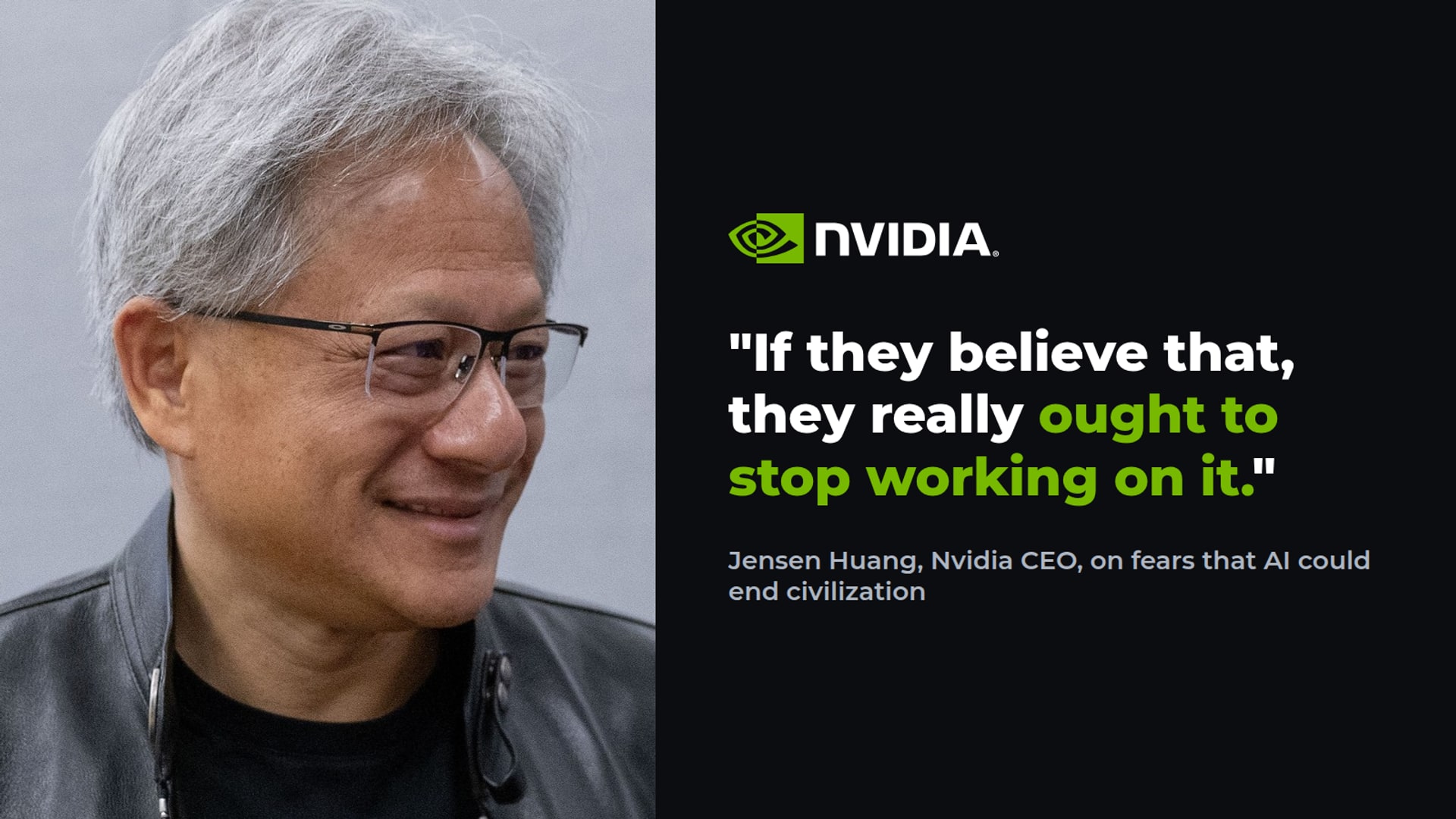
Nvidia (NVDA) chief executive Jensen Huang said he would halt chip supply to a customer developing unsafe AI software, and that people who think AI could end civilization "ought to stop working on it." He made the comments in separate interviews in London with Bloomberg and Fortune, both published Wednesday.
Emily Chang asked whether he'd stop supplying an irresponsible developer. "It's a hypothetical, but yes," Huang said. "But before you do so, you would have a conversation. We don't run other people's companies, and there's a limit to the judgment we apply to other companies' use of our technology. Our technology is general-purpose." He also said he doesn't believe the current level of concern about AI is warranted.
In the second interview, Huang called the technology "completely in our control." "I don't know why anybody would want to support the advancement of a technology that's going to result, you know, in the end of human civilization as we know it. And so, if they believe that, they really ought to stop working on it," he said.
Huang wants zero AI security incidents
Huang also said the industry shouldn't accept any cybersecurity incidents caused by AI. "I'm willing to accept no incidents of cybersecurity. We should not accept any of them," he said. "We should do everything we can to avoid them."
He said the incidents so far could have been avoided with stronger containment and monitoring of AI agents. Huang compared the problem to the early consumer internet, when visiting a website could infect a PC with a virus, until browsers began running websites in isolation from the rest of the computer. He said AI agents should similarly run inside secure containers that restrict which systems they can access and what actions they can take.
Huang has pushed back on warnings that AI could end humanity before. In a CBS News interview that aired Sept. 20, he called extinction warnings "not grounded in science" and said, "There is 0% chance that's going to be the end of the world," as we reported at the time. Nine days later, he was one of six AI leaders who signed a voluntary safety accord at the White House, which President Donald Trump called "morally binding."
Huang is in London as part of a European tour that began in Paris on Tuesday, where Huang said Nvidia would announce $2 billion in European AI deals over the next week. The tour also includes Berlin, where he gives a keynote at Nvidia's GTC Berlin conference on Oct. 21.
Nvidia shares were down 3.8% at $219.73 at 3:05 p.m. Eastern on Wednesday. They were already down 3.1% at 1:30 p.m., before either interview was published.