Key points
- Nvidia's Rubin makes its MLPerf training debut
- CoreWeave tests Rubin across four racks
- Nvidia's Kimi K3 result awaits verification
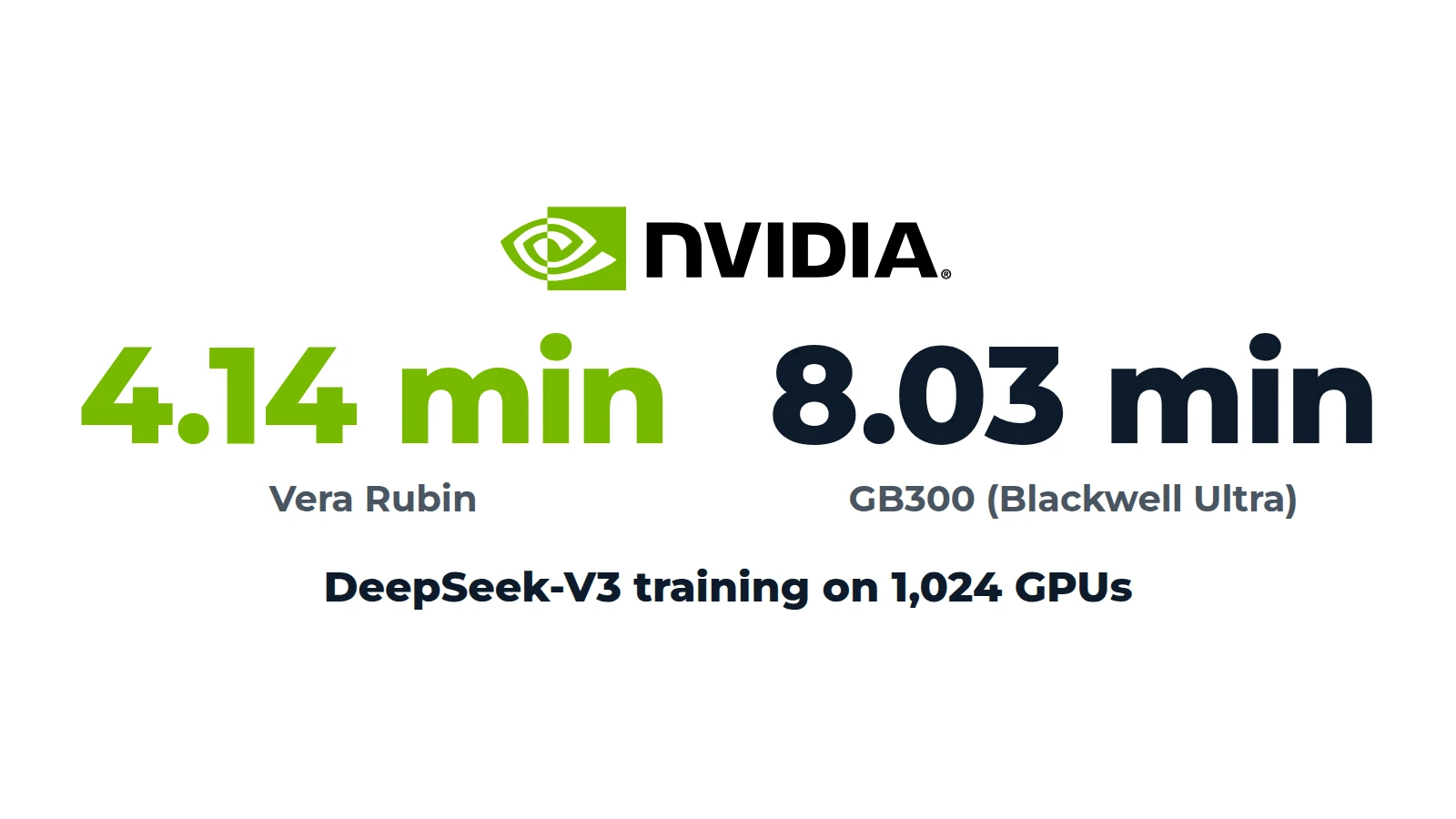
Nvidia (NVDA) says its new Vera Rubin NVL72 system delivered up to twice the per-GPU training performance of Blackwell Ultra in its first MLPerf training round. The biggest gain came on a DeepSeek-V3 test, where the two systems each ran on 1,024 GPUs.
Rubin posted the round's fastest training time on six of seven tests, according to Nvidia. The exception was DeepSeek-V3, where a much larger system using Nvidia's older GB300 chips finished first.
The industry group MLCommons published the Training v6.1 results on Nov. 16, a day before Nvidia reports quarterly earnings. Twenty-four organizations submitted 153 systems. The round included Nvidia's Rubin GPUs and Google's TPUv7, also called Ironwood, for the first time.
Where Nvidia's 2x claim comes from
MLPerf's training tests measure how long a system takes to train a model to a set quality target. On DeepSeek-V3, a 671-billion-parameter model, a Vera Rubin system with 1,024 GPUs finished in 4.14 minutes. A GB300 NVL72 system with the same number of GPUs took 8.03 minutes.
Nvidia calls that its largest per-GPU gain over GB300, its Blackwell Ultra system. The company puts Rubin's gain on the other six tests at 1.4x to 1.6x.
Nvidia also ran DeepSeek-V3 on 256 Rubin GPUs. Increasing the count fourfold to 1,024 cut the training time from 16 minutes to about four. Nvidia puts the result at about 97% scaling efficiency. Perfect scaling would reduce the time to one-quarter of the original.
The company published faster reruns using newer software, too. Nvidia says those reruns haven't been verified by MLCommons and aren't part of the official results.
A larger GB300 system finished DeepSeek-V3 first
Rubin's lead over GB300 on DeepSeek-V3 compares systems with the same number of GPUs. The fastest DeepSeek-V3 time in the round came from a much larger Nvidia GB300 system: 10,240 GPUs finished in 1.38 minutes. Microsoft (MSFT) also ran the test on 10,240 GPUs in its Azure cloud, using GB200 systems, the generation before GB300.
Across its platforms, Nvidia says its systems held the fastest time on all seven tests and were the only ones entered in all seven. AMD (AMD) entered five tests, according to its folder in the MLCommons results repository. Google (GOOGL) entered TPUv7 in two: DeepSeek-V3 and a Qwen3.5 reinforcement learning test.
CoreWeave ran Rubin across four racks
CoreWeave (CRWV) said it was the only cloud provider to submit multi-rack Vera Rubin results in the round.
CoreWeave's 256 Rubin GPUs, spread across four racks, trained DeepSeek-V3 in 17.65 minutes. CoreWeave's GB200 NVL72 systems took 48.40 minutes with the same number of GPUs, which the company calls a 2.7x improvement.
CoreWeave also ran Llama 3.1 8B on a single 72-GPU rack, finishing in 7.16 minutes. The company says that was the fastest 72-GPU submission in the round. Each Vera Rubin NVL72 rack pairs 72 Rubin GPUs with 36 of Nvidia's Vera CPUs.
Nvidia's 10x claim uses a different benchmark
Nvidia also says Vera Rubin delivered more than 10 times the throughput per watt of GB300 on Kimi K3, an open model built for agent workflows. That claim comes from a different benchmark, MLPerf Endpoints v1.0, which tests systems running AI agents on coding and business tasks. The results were published on Nov. 9.
The Rubin result is provisional. Nvidia says it is pending MLCommons verification and could change after peer review.
The comparison used 32 accelerators in the Rubin system and 48 in the GB300 system. Nvidia measured output per kilowatt at a minimum response speed of 50 tokens per second per user.
Nvidia reports earnings on Nov. 17
The results arrive ahead of Nvidia's fiscal third-quarter report, due Nov. 17 at about 4:20 p.m. ET. It will be the company's first earnings report since Jensen Huang resigned as CEO.
The Rubin-versus-GB300 and Rubin-versus-GB200 speedups are Nvidia's and CoreWeave's comparisons of results published by MLCommons.