Key points
- Situational Awareness reports a call-heavy 13F
- Why its SharonAI share count rose
- The gap in Situational Awareness's Nebius filings
- What the filing shows about SK Hynix
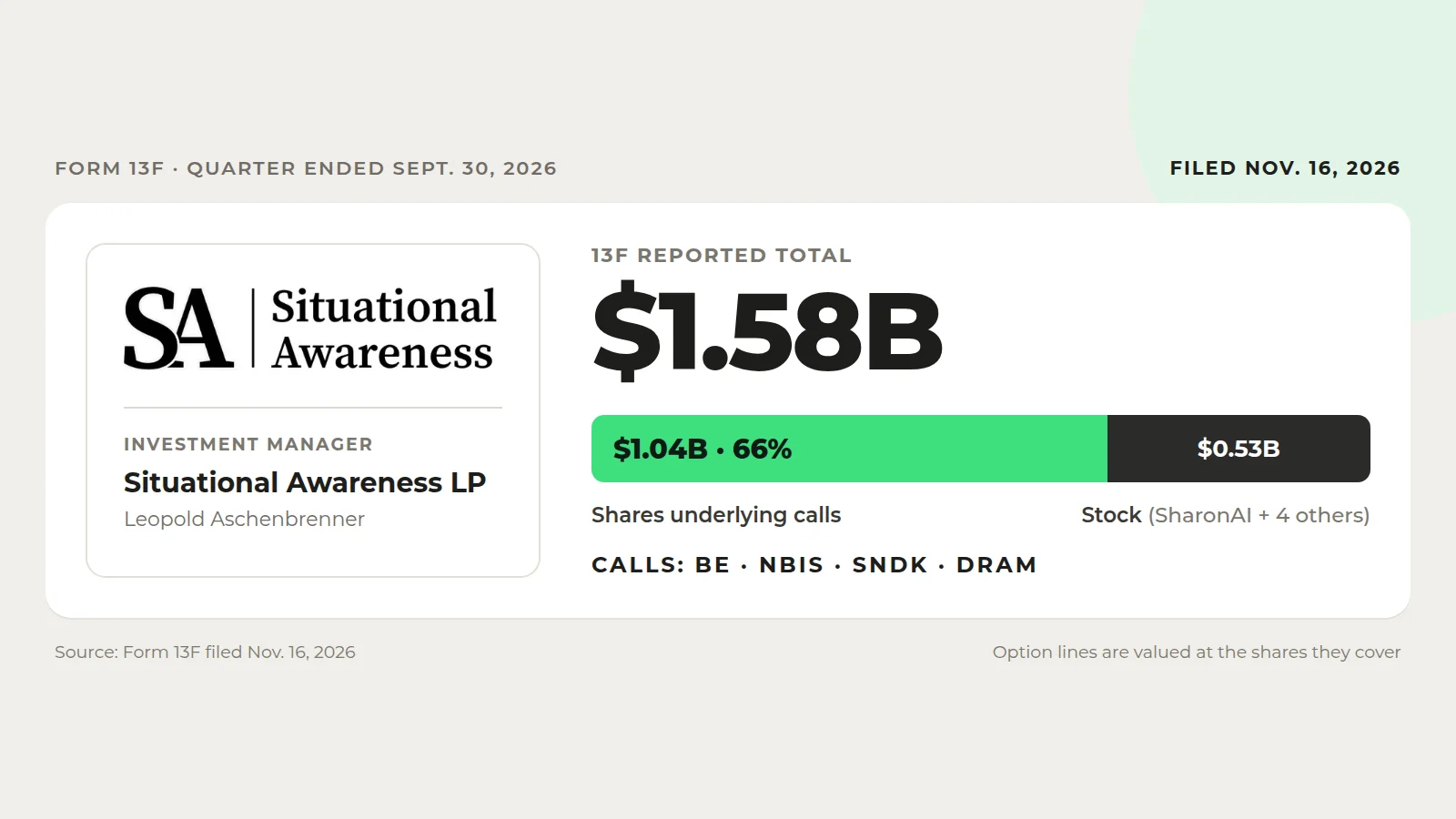
Situational Awareness LP's first 13F since selling its public stock book to Citadel shows a much smaller portfolio on paper, with most of the reported value tied to call options.
The fund, run by Leopold Aschenbrenner, reported a $1.58 billion total as of Sept. 30, down from $20.24 billion in June. But those figures aren't directly comparable as investment values. The new filing counts $1.04 billion of shares underlying calls on Bloom Energy (BE), Nebius (NBIS), SanDisk (SNDK), and the Roundhill Memory ETF (DRAM). It doesn't say what the fund paid for those options or what they were worth.
Bloom, Nebius, and SanDisk fell between 36% and 55% from Sept. 30 through Nov. 16. The filing doesn't show whether the fund still held the calls as those stocks fell.
I expected the rebuild to look more like the old book. Instead, the September filing has nine positions, down from 26 in June, and only five are ordinary stock. Micron, Taiwan Semiconductor, CoreWeave, and Core Scientific no longer appear. Our Situational Awareness tracker has the full filing.
What did the fund report for Sept. 30?
Here's what the fund reported at the end of September, along with each stock's move through the Nov. 16 close.
| Holding | Type | Shares | Reported value, Sept. 30 | Stock since Sept. 30 |
|---|---|---|---|---|
| SharonAI (SHAZ) | Stock | 8,070,950 | $440.7M | -63.1% |
| Bloom Energy (BE) | Calls, 6 lines | 1,405,000 | $389.2M | -36.0% |
| Nebius (NBIS) | Calls, 6 lines | 1,410,000 | $332.6M | -54.6% |
| SanDisk (SNDK) | Calls, 2 lines | 105,000 | $182.7M | -53.5% |
| Roundhill Memory ETF (DRAM) | Calls, 4 lines | 2,325,000 | $140.3M | -34.9% |
| CleanSpark (CLSK) | Stock | 3,019,029 | $38.9M | -51.1% |
| IREN (IREN) | Stock | 527,864 | $21.6M | -59.9% |
| Bitdeer (BTDR) | Stock | 1,934,618 | $20.3M | -57.1% |
| Fermi (FRMI) | Stock | 2,671,898 | $11.2M | -41.1% |
For the call lines, the shares column is the number of shares the contracts cover. Over the same stretch the Nasdaq Composite fell 8.8%, so every name in the filing did several times worse than the broad market. CleanSpark, IREN, and Bitdeer were all larger in June. IREN went from 9.47 million shares to 527,864.
What are the calls actually worth?
A call option gives its holder the right to buy a stock at a set price, called the strike, until a set date. The part of a 13F that trips people up is how it values one. The SEC has managers report the value of the shares underneath the contract, not what the fund paid for it. So $389.2 million of Bloom calls means the calls covered 1,405,000 Bloom shares at Bloom's $276.98 close on Sept. 30.
The fund's actual outlay could have been a small fraction of that.
The filing doesn't give a strike price or an expiration date for any line, and it doesn't say why Bloom and Nebius are each split six ways. That leaves the real exposure out of reach from the outside. What I can measure is the shares underneath. Those four call positions covered $1.04 billion of stock on Sept. 30. At Monday's closes, the same share counts come to about $576 million, a 44.8% drop.
A call's price doesn't track its stock one for one. It also depends on how much time is left and how much the stock tends to move, so a call can fall faster or slower than the stock. A call held to expiration generally expires worthless if the stock finishes below the strike. None of that is a read on these contracts, which the filing doesn't describe. In September the Financial Times reported the fund was using customized flex options for leveraged upside exposure through a new broker, Clear Street. Bloom and SanDisk were also on the list of names CNBC said the fund was buying options on at the time.
Where did the new SharonAI shares come from?
SharonAI is the largest line in the filing, and the jump in shares looks like fresh buying until you line it up with the other paperwork. The June 13F listed 5,396,127 shares. A 13G amendment for June 30 described the same holding as those shares plus warrants for another 2,674,823. Then the fund's 13D amendment filed Sept. 17 reported that it exercised those pre-funded warrants on Sept. 15 at $0.0001 a share. Add them together and you get 8,070,950, the exact count in the September 13F.
So the fund converted something it already held.
The 13D puts the stake at 21.1% of SharonAI's Class A shares, the same figure we wrote about when the fund filed its first 13D on SharonAI in August.
SharonAI is also the one holding with a filing trail after Sept. 30, though it has limits. A 13D holder has to amend within two business days of a material change. SEC rules treat a change of 1% or more of the class as material, which is about 383,000 shares here, and smaller changes can count too. The fund hasn't filed an amendment since Sept. 17, which on its own doesn't prove the stake is unchanged. At SharonAI's $20.13 close on Monday, the 8,070,950 reported shares would be worth about $162.5 million, compared with $440.7 million on Sept. 30.
Why do the Nebius numbers disagree?
Nebius is the strangest line in the filing. The fund filed a 13G amendment on Nebius the same day as the 13F, reporting 8,010,000 Class A shares, or 3.4%, as of Sept. 30. The 13F for that same date lists no Nebius stock at all, only calls covering 1,410,000 shares.
The two forms count differently. A 13G counts beneficial ownership, which includes shares a holder can acquire within 60 days, so some option positions can show up there. A 13F lists securities held, line by line. Neither filing explains the gap of about 6.6 million shares, and I'd rather leave it open than guess. The trend is clear, though. The fund's original Nebius 13G reported 12,410,060 shares, or 5.6%, as of May 19. At 3.4%, the fund is below the 5% level that brings on 13G reporting. That doesn't end every disclosure obligation it has, but the next regular snapshot of its Nebius position is the year-end 13F.
Which reported names aren't in the filing?
Two September reports named the stocks the fund was rebuilding around. The Financial Times listed AMD, Intel, SK Hynix, SanDisk, and CoreWeave. CNBC's list was AMD, Bloom, CoreWeave, SK Hynix, SanDisk, and the memory ETF. The 13F has SanDisk, Bloom, and the ETF. It has no AMD, Intel, CoreWeave, or SK Hynix. SK Hynix is the one I was waiting on. When SK Hynix listed its shares on Nasdaq in July, Situational Awareness Partners was one of three cornerstone investors named in the prospectus, along with Baillie Gifford and Coatue. We wrote at the time that this November filing would be the first document that could speak to it. It lists no SK Hynix shares.
Those Nasdaq shares can be reported on a 13F, so the gap isn't a technicality. Thirteen of the funds in our tracker reported SK Hynix shares for Sept. 30, Coatue among them. The filing can't say whether Situational Awareness never bought at the listing, sold before the end of September, or holds the exposure in a form a 13F doesn't capture.
What can't this filing tell us?
The snapshot is from Sept. 30, and the filing arrived 47 days later, after an October in which every stock on the list fell hard. Nothing in it says whether the fund still owns these positions. Outside SharonAI, the next full look is the year-end 13F, due in mid-February.
The filing also leaves out some of the fund's investments. A 13F covers US-listed securities only. The private stakes, Anthropic among them, aren't in it. Neither is anything listed abroad, which is how its Taiyo Yuden stake in Japan stayed out of view. The fund kept around $10 billion in assets after the sale to Citadel, including private holdings. Its 13F shows only reportable positions, and its $1.58 billion total isn't directly comparable with the fund's asset value because it includes the shares underlying options. Our guide to 13F filings covers what else the form leaves out.