Key points
- SpaceX filed its S-1 on May 20. Space stocks ripped, peaked May 27 and 28, then broke.
- Every name in the group now trades below its pre-filing price. SPCX itself is down 46%.
- Rocket Lab (RKLB) is my pick: $2.2B backlog, $1.2B cash, and no need to raise.
- Three dates: Aug. 4 SPCX earnings, Aug. 6 unlock, Aug. 10 RKLB and ASTS report.
Nine straight weeks of red in space stocks. And the damage didn't start on the day SpaceX (SPCX) listed. It started on the day it filed.
SpaceX put its S-1 on the SEC's site on May 20. Everything with a rocket or a satellite in it went vertical. Redwire (RDW) gained 86% in six sessions. AST SpaceMobile (ASTS) gained 51%. Intuitive Machines (LUNR) gained 41%. The group topped out on May 27 and 28, about a week after the filing, and it has been coming apart ever since.
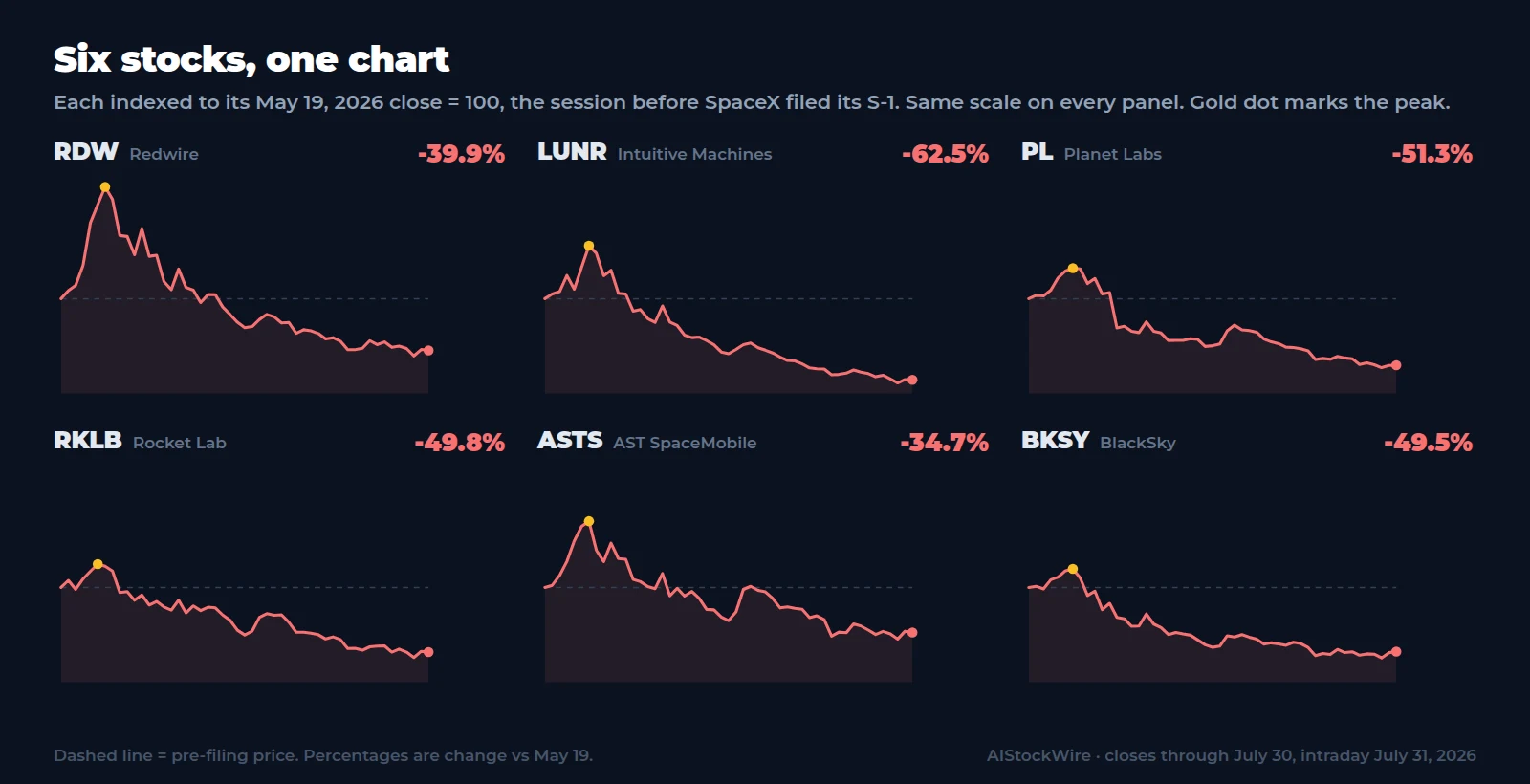
| Stock | May 19 close | Peak close | Now | vs. peak | vs. pre-filing |
|---|---|---|---|---|---|
| Intuitive Machines (LUNR) | $32.46 | $45.70 | $12.19 | -73.3% | -62.5% |
| Redwire (RDW) | $13.91 | $25.90 | $8.37 | -67.7% | -39.9% |
| Planet Labs (PL) | $41.59 | $51.40 | $20.24 | -60.6% | -51.3% |
| Rocket Lab (RKLB) | $127.31 | $150.23 | $63.85 | -57.5% | -49.8% |
| AST SpaceMobile (ASTS) | $88.10 | $133.09 | $57.56 | -56.8% | -34.7% |
| BlackSky (BKSY) | $45.17 | $51.63 | $22.83 | -55.8% | -49.5% |
Look at that last column. Every one of these is worth less today than it was the day before anyone had read the filing. The melt-up was fear of missing the biggest listing in history, and it round-tripped in nine weeks.
Line the six of them up and it's one picture repeated six times. Every peak lands in the last week of May and every line finishes under the dashed baseline. Different customers, different hardware, different balance sheets, and the chart can't tell them apart.
The money had to come from somewhere
SpaceX priced at $135 a share on June 12. Against roughly 13.3 billion shares that put it near $1.8 trillion at the offer. A raise that size doesn't get funded out of thin air. Fund managers who wanted space exposure already owned space exposure, so they sold what they had to buy the real thing. You can see it in one session. Rocket Lab fell 10.8% on the debut, AST SpaceMobile 15.5% and Intuitive Machines 13.1%, and we ran through what each of these companies actually does that week.
Then the index buyers had to show up. Nasdaq said on June 26 that SpaceX would enter the Nasdaq-100 before the open on July 7, under a new rule that cut the post-IPO wait from three months to 15 days. CNBC put the forced buying from QQQ alone near $4.3 billion. More money into one ticker, none of it into the rest.
The irony is that SpaceX has been the worst of them since. It trades at $108.74 against a June 16 close of $201.80, so it's down 46%, and roughly $1.2 trillion of market value is gone. Bespoke Investment Group called it a "violent crash in space-related stocks." Bespoke counted 17 new-space names, found the median one was up 134% at its 2026 peak and now sits 58% below it, with 14 of the 17 cut in half.
The AST dilution panic is only half right
AST SpaceMobile priced $1 billion of convertible notes on July 15 and closed $1.15 billion on July 21. The stock dropped 17% the next session, from $66.31 to $55.01, and we covered the sale the night it broke.
The terms are better than the reaction was. AST spent $96.9 million on a capped call to push the conversion math out of reach. CFO Andy Johnson laid it out: "The notes have our lowest coupon ever at 1.625% and have an effective conversion price of $149.20 per share, well above our all-time high stock price, providing cost-efficient capital with effective dilution of less than 2%." The stock has never traded at $149.20.
The selling had a different cause, and it sat lower in the same release. AST now targets about 45 BlueBird satellites in early 2027, after guiding to late 2026 for commercial service. Revenue last quarter was $14.7 million against a $191 million net loss. A slipped launch campaign costs that company far more than 2% of its share count. It held $3.5 billion of cash on March 31 and raised anyway, because a constellation costs what it costs.
Rocket Lab is the one I'd own
For me it's the only one in the group worth buying, and it comes down to who has to sell paper. Q1 revenue hit $200.3 million, up 63.5%. Gross margin was 38.2%. Adjusted EBITDA came in at negative $11.8 million. Backlog is $2.2 billion and grew 20.2% in one quarter. Cash sits at $1.2 billion, with access to more than $2 billion of liquidity.
Put that against a $14.7 million quarter funded by a $1.15 billion note sale. Rocket Lab doesn't need to ask the market for anything right now. In a tape this bad that beats any story about the future. It keeps winning work too, including a $266 million Space Force contract on July 21.
Neutron is the risk and it's a real one. First launch slipped to Q4 2026 after a first-stage tank ruptured in January. A contractor had hand-laid the defective part while Rocket Lab's own fiber placement machine was still being commissioned. Peter Beck spent most of the May call on test-stand progress, then landed on this: "So, if you see something broken on the test stand from here on, know that's completely intentional."
Beck also told analysts the slip doesn't push every follow-on flight back a full 12 months. Take that for what it's worth. If Neutron slides into 2027 this stock goes lower, and I'd expect it to.
Three dates, ten days
- Aug. 4: SpaceX reports for the first time as a public company, after the close.
- Aug. 6: two trading days later, up to 911.5 million shares unlock for insiders and employees. The tradable float today is about 646 million.
- Aug. 10: Rocket Lab and AST SpaceMobile both report, after the close.
Aug. 6 is the one to sit with. S3 Partners puts SpaceX short interest at $26 billion, about 35% of the float. Shorts are up $7.3 billion on the trade. Only Tesla (TSLA) has paid better this year at $9.1 billion. Ihor Dusaniwsky of S3 said "we've seen continued SPCX short selling since its inception." A supply shock landing on a short base that size can break either way.
I don't own any of these. If I buy one it's Rocket Lab, and I'd rather wait until after Aug. 10. The $2.2 billion backlog and the $1.2 billion of cash will still be there. Neutron's date is the only thing that changes the story, and Beck has to address it on that call.
Disclosure: I hold no position in any stock mentioned. Not investment advice.
Sources
- Prices computed from daily closing prices through July 30, 2026 and intraday quotes at about 12:10 p.m. ET on July 31, 2026. SpaceX filed its Form S-1 publicly on May 20, 2026 per SEC EDGAR (CIK 1181412, accession 0001628280-26-036936) and listed on Nasdaq on June 12, 2026 at $135 a share.
- Nasdaq-100 inclusion announced June 26, 2026, effective before the open on July 7, 2026, under the revised 15-day post-IPO eligibility rule. QQQ forced-buying estimate per CNBC, June 26, 2026.
- Bespoke Investment Group, July 2026: 17 new-space stocks, median up 134% at the 2026 peak and 58% below it, 14 of 17 cut in half.
- AST SpaceMobile releases, July 15 and July 21, 2026: $1.0 billion priced and $1.15 billion completed, 1.625% coupon due 2034, $149.20 effective conversion price after a $96.9 million capped call, plus CFO Andy Johnson's quoted comment. First quarter 2026 results: revenue $14.7 million, net loss $191.0 million, cash $3.5 billion at March 31.
- Rocket Lab first quarter 2026 results, May 7, 2026, and Peter Beck's remarks on that call: revenue $200.3 million, gross margin 38.2%, adjusted EBITDA negative $11.8 million, backlog $2.2 billion, cash $1,205.5 million.
- S3 Partners via Benzinga, July 29, 2026: $26 billion short interest, about 35% of float, $7.3 billion mark-to-market profit, and Ihor Dusaniwsky's comment. SpaceX lockup terms and the Aug. 4 earnings date per company disclosure and CNBC, July 21, 2026.