Key points
- $5,000 to 245 million adult citizens is $1.225 trillion
- No eligibility rules have been published
- The Supreme Court voided the IEEPA tariffs in February
- The $1,776 precedent was already-approved housing money
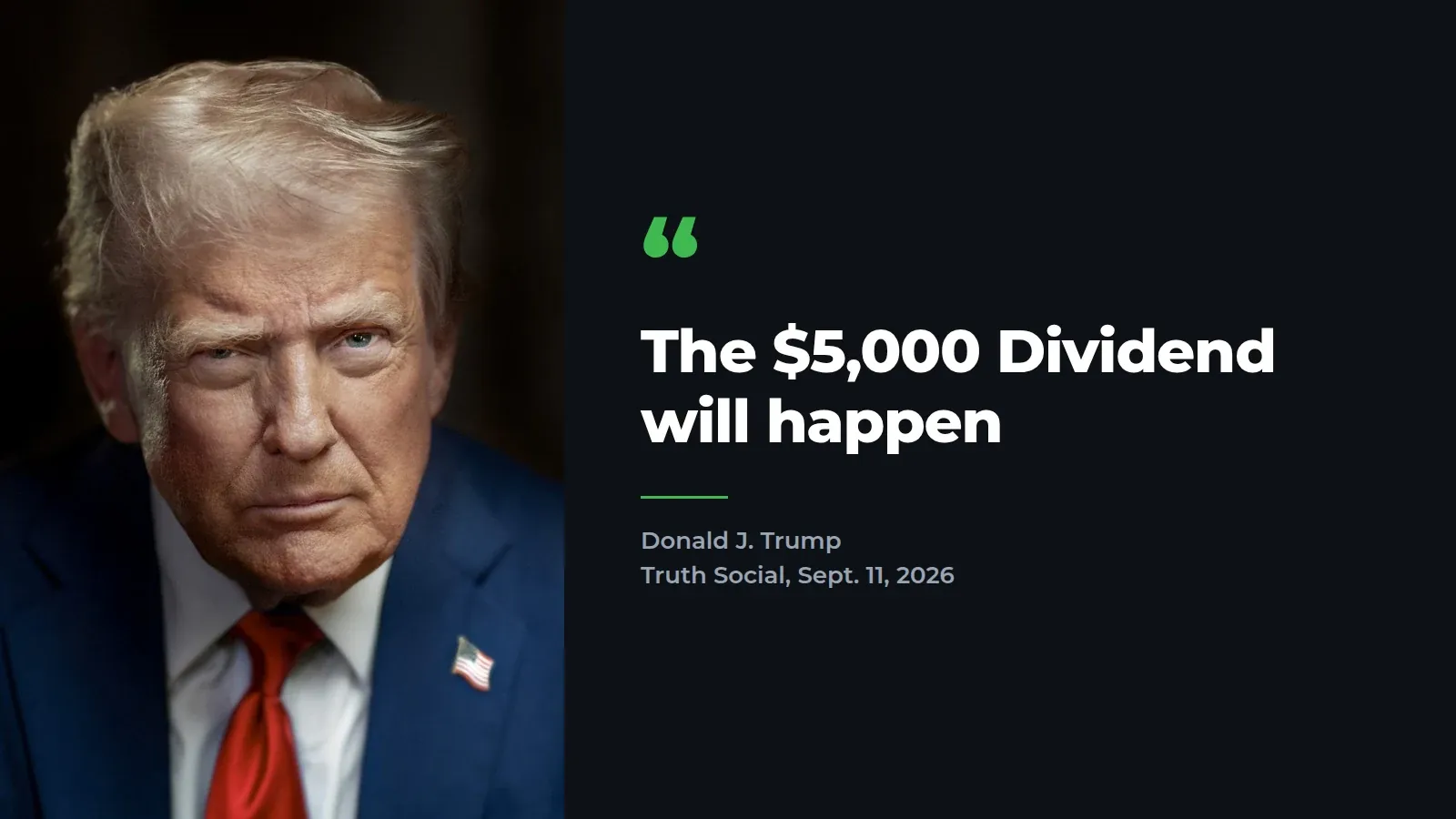
On Friday afternoon, Donald Trump repeated his promise of a $5,000 "Trump Dividend." "When I say something, I mean it!" he wrote on Truth Social. "The $5,000 Dividend will happen because the People of our Country deserve it." He announced the proposal Wednesday night at the Republican midterm convention in Dallas, saying the payment would depend on Republicans retaining the House and Senate in November.
I want to look at one specific part of that post, because it's the part doing the persuading. To prove he follows through, Trump points at a payment he already made. That payment was real. It was also about $2.6 billion, and Congress had already approved the money.
The receipt he's holding up
Last December, some 1.45 million service members got $1,776 each, tax-free. Trump calls it the Gift of $1776 and says everyone told him it couldn't be done. It got done. About 1.28 million active-duty and 174,000 Reserve Component members in pay grades O-6 and below were paid before Christmas.
The funding source is the part that matters. As Federal News Network reported, the money came out of Basic Allowance for Housing supplemental funds that Congress appropriated in the One Big Beautiful Bill Act in July 2025. A Defense official said the Secretary of War directed the department "to use some of the Basic Allowance for Housing funds to provide a one-time payment to service members during this holiday season to help improve their housing and quality of life." Trump has suggested tariff revenue paid for it. Congress had already appropriated that money, and Treasury Secretary Scott Bessent had addressed the idea of sending Americans checks out of tariff revenue on Nov. 16. "We need legislation for that," he said.
So the proof on offer is a $2.6 billion reallocation of funds Congress had already voted. The new one is a different order of magnitude, and nobody has said precisely how large.
Paying $5,000 to an estimated 245 million adult US citizens would cost $1.225 trillion. Trump has not published eligibility rules, and his reference to "all Adults in the United States" leaves the intended population unclear. JD Vance has since suggested wealthy Americans wouldn't qualify, which would push the number down, and Trump said the money would have to be spent domestically without saying how that gets enforced. For scale, the federal deficit ran near $1.8 trillion in fiscal 2025 and the national debt passed $40 trillion in August.
What the tariffs have brought in
Vance told Fox after the speech that tariffs "have generated a lot of revenues. They've helped us pay down debt."
The Penn Wharton Budget Model puts gross revenue from new tariffs at $298.5 billion between January 2025 and July 2026. But part of that revenue is subject to refunds.
The Supreme Court struck down the IEEPA tariffs on February 20 in a 6-3 decision written by Chief Justice John Roberts. About $166 billion had been collected under that authority.
The resulting figures measure different things:
| Measure | Amount |
|---|---|
| Gross revenue from new tariffs, January 2025 to July 2026 | $298.5 billion |
| Gross revenue minus $107 billion in certified refunds | $191.5 billion |
| Penn Wharton's net figure, assuming all $166 billion is refunded | $132.5 billion |
Customs had certified about $107 billion in refunds through August 21, approximately 64% of the IEEPA collections. Certification does not mean all that money has been paid.
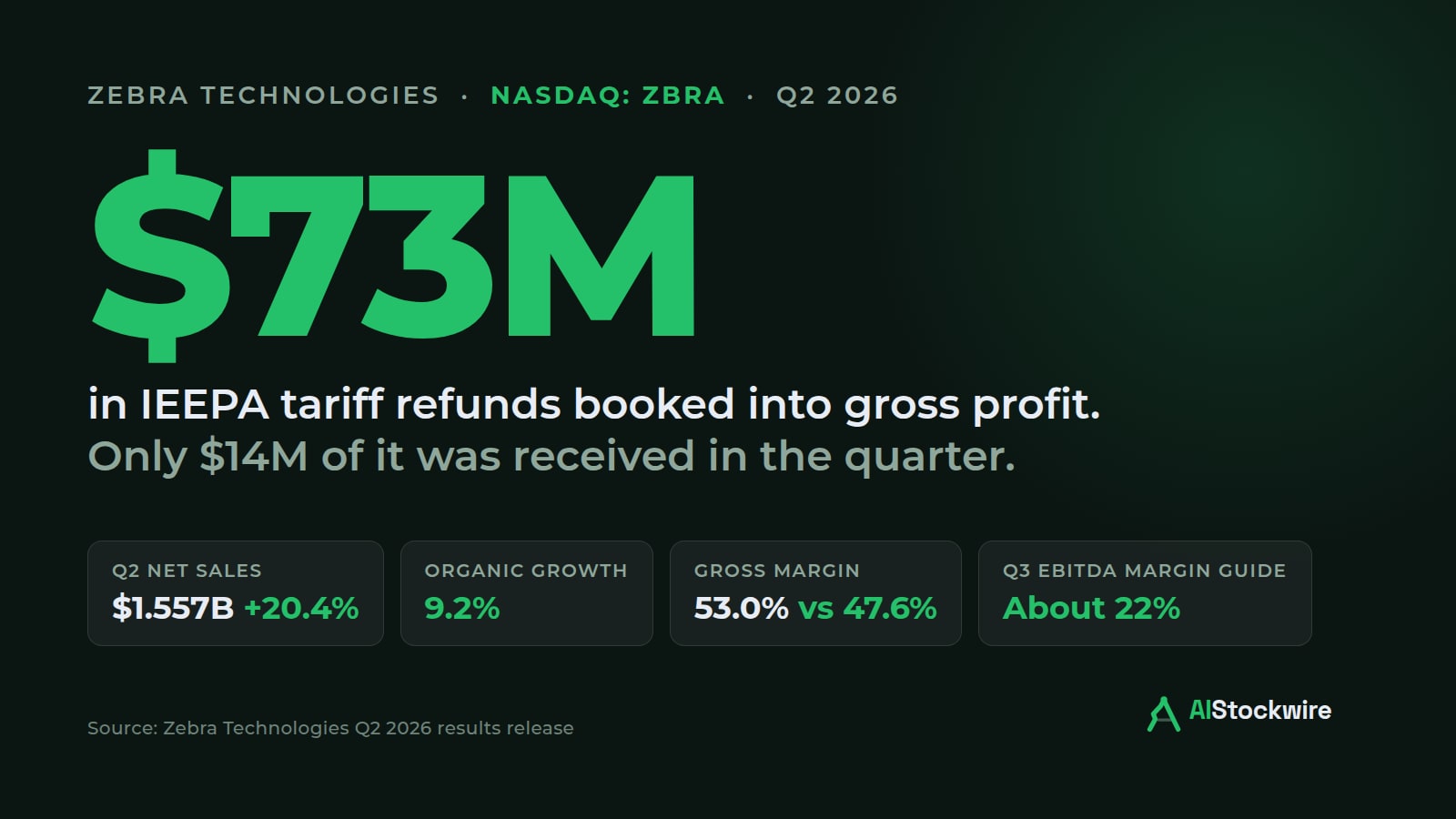
We covered that gap when Zebra Technologies (ZBRA) reported in August: the company booked $73 million of IEEPA recoveries into gross profit and had actually received $14 million of it by the end of the quarter.
Take the largest of the three figures, the gross $298.5 billion, and a $1.225 trillion payment still costs four times the revenue collected from those new tariffs over that period. On Penn Wharton's net figure it's closer to nine.
The post names a second source, "Trillions of Dollars of Economic Development, Investment, and Pure SUCCESS." Trump put that at $21 trillion of US investment in a Fox News interview, a figure CNBC reports has been repeatedly fact-checked as false and that runs nearly $10 trillion above the tally on the White House's own site. Either number runs into the same problem: private investment is money companies spend building things here, so it never reaches the Treasury and Congress can't appropriate it.
Where I come down
The dividend is the third version of this promise. Early in 2025 it was the DOGE dividend, $5,000 from government savings. That never arrived. Then it was the $2,000 tariff dividend, promised for the middle of this year. There's no law, no Treasury mechanism and no checks. The IRS has spent the tax season warning people about tariff-refund scams, which is what fills a vacuum like this.
The pushback this time is coming from Republicans. Joe Lonsdale, who co-founded Palantir and donates to the party, wrote that he's "strongly against bread and circus bribes." Representative Chip Roy told Politico, "I would like to know how they would plan to pay" for it. Former Freedom Caucus chair Bob Good called it a "socialist vote-buying scheme."
I don't think this happens, and I'd rather say that now than hedge it.
A payment on that scale would require congressional funding. The fiscal conservatives in his own party are already on record against it. The revenue story behind it lost its largest component at the Supreme Court in February. Asked why the money waits until after the election, Trump told Fox "Because the Democrats can't do it." He did not name a funding source.
The market question is what happens if I'm wrong. The three rounds of Covid stimulus checks came to a little over $800 billion combined, and those get blamed for the inflation everyone's voting on. A payment in the trillion-dollar range would be bigger than all three. Its effect on spending and inflation would depend on who qualifies, when the money arrives and how it is financed. We've written about rate-hike odds climbing this summer, and money like that lands on top of that setup, not into a quiet one.
If Congress does authorize a payment, I'd prefer an investment-account option that encourages long-term saving. That would change how recipients use the money, but it wouldn't solve the funding problem.
So I'm not positioning for a check. I'm watching whether anyone in Congress writes the bill, because until somebody does, this is a speech.