Key points
- Workday asked a judge to deny class status to potentially millions of job applicants
- Workday also wants the age bias group of 15,000-plus applicants in the case thrown out
- Workday says its customers, not its AI tools, made the hiring decisions
Workday (WDAY) asked a federal judge on Nov. 10 to block job applicants from suing the company as a group over its AI screening software, Reuters reported. The applicants allege the software discriminated against them by race, sex, age, and disability.
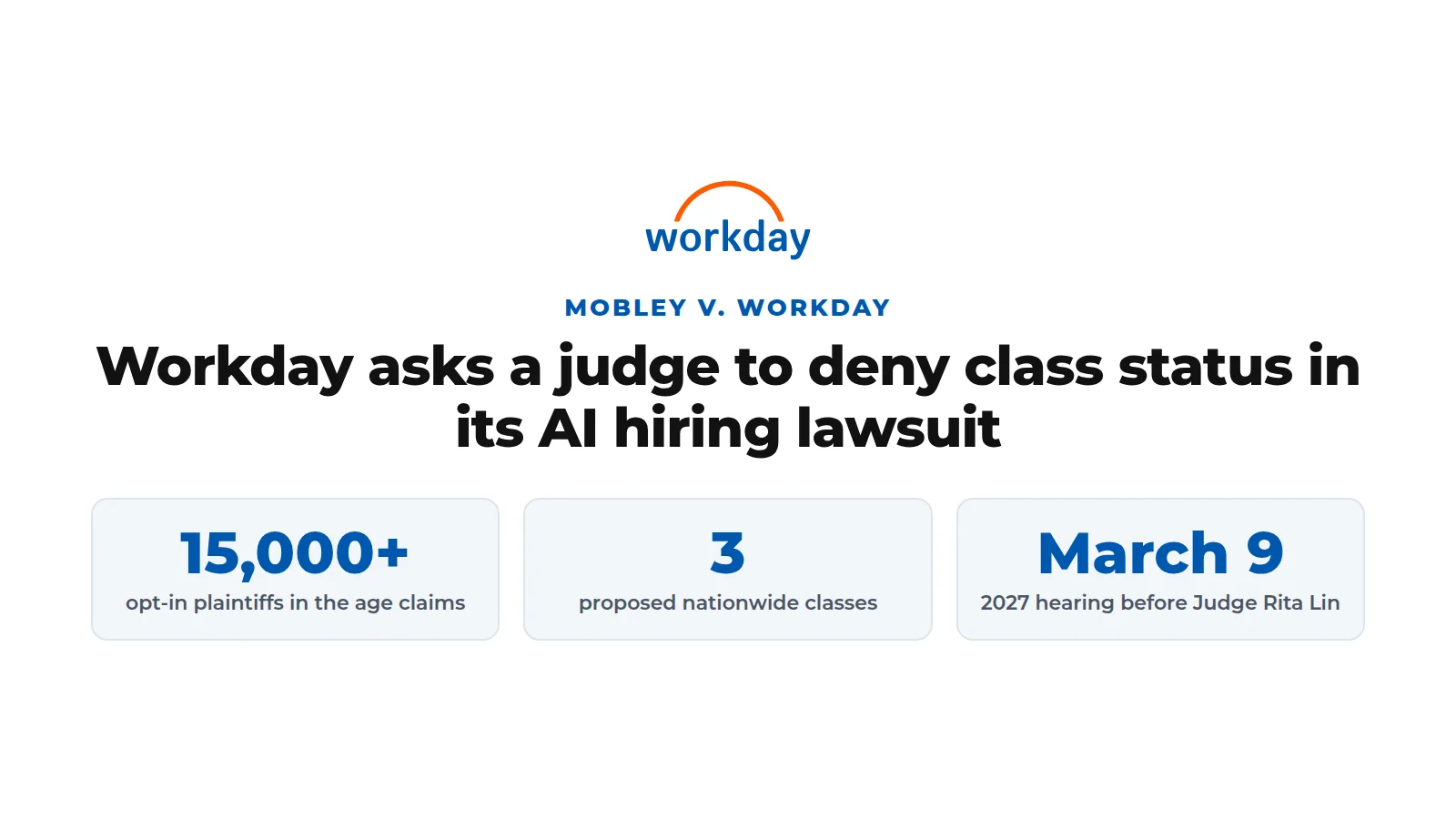
Workday made the request in two filings in San Francisco federal court. One opposes the applicants' bid for class certification. The other asks the judge to decertify a group of more than 15,000 people who joined the case to claim age discrimination. U.S. District Judge Rita Lin is set to hear both on March 9, 2027.
The case, Mobley v. Workday, is the first lawsuit to broadly target the AI screening software that large employers now commonly use, according to Reuters. Lawyers for the applicants didn't immediately respond to Reuters.
The applicants want three nationwide classes
Derek Mobley, who filed the case in February 2023, is joined by Faithlinh Rowe, Jill Hughes, and Sheilah Johnson-Rocha as named plaintiffs. They want three nationwide classes, with subclasses of applicants who are Black, disabled, female, or 40 and older, according to Workday's filing.
The lawsuit targets three Workday features:
- Candidate Skills Match. A tool in Workday's recruiting software that compares the skills on a resume with those in a job posting.
- Spotlight. A tool that grades how closely an application matches a posting's requirements, such as years of experience, degrees, and certifications.
- Fetch. A tool that searches an employer's own database for past applicants to suggest for open jobs.
Spotlight and Fetch were built by HiredScore, an Israel-based company that Workday bought in 2024.
Workday says no common evidence ties the claims together
To certify the proposed classes, the applicants must meet legal requirements that include showing the claims raise sufficiently common questions. Workday argued the claims require too many individual inquiries. "The question is not whether Plaintiffs raise common questions, but whether a classwide proceeding can 'generate common answers,'" Workday said in its filing.
Workday's main argument is that its customers make the hiring decisions. Each claim depends on the idea that employers handed hiring functions to Workday as their agent. Workday said that can only be answered employer by employer and job by job, because each customer chooses which features to turn on, who can see the results, and how to use them.
Workday made several other arguments in the filing:
- None of the four named plaintiffs has evidence that a challenged feature scored or graded any of their applications.
- The three features were built by two different companies, trained on different data, and changed over time.
- The applicants' data on disparities comes from 12 months of Spotlight grades at a single employer: Workday itself.
- The applicants' expert didn't give an opinion on whether the software caused any differences in grades.
Workday has said its technology looks only at job qualifications, not protected traits such as race or age, and that its products are tested for bias, Reuters reported.
The age discrimination group passed a lower bar in 2025
The age claims are on a separate track. The federal age discrimination law lets a court conditionally certify a group, called a collective, so that people can be told about a lawsuit and opt into it.
Lin granted preliminary certification on May 16, 2025, under a lenient first-stage standard that the court compared to a plausibility test, according to Workday's motion. The collective covers people 40 and older who applied for jobs through Workday's platform since Sept. 24, 2020, and were denied employment recommendations. Public notice ran from Jan. 6 to March 7, 2026, and more than 15,000 people opted in, according to Workday's motion.
Workday now says the applicants haven't shown those people belong in the group. Under Lin's definition, each member's application had to be scored, sorted, ranked, or screened by Workday's AI. Workday said there's no evidence of that for most of the 15,000-plus people. Workday asked Lin to decertify the collective and dismiss all of the opt-in plaintiffs without prejudice, which would leave them free to refile their claims individually.
Four motions to dismiss have narrowed the case
Lin has ruled on four motions to dismiss, according to Workday's filing. She rejected Workday's first attempts to dismiss the case in 2024 and in June mostly denied Workday's bid to throw out claims under California law that were added to the lawsuit, Reuters reported. After the first two rounds, the court dismissed the applicants' intentional discrimination claims, which the law calls disparate treatment, according to Workday's motion. The only remaining age claim alleges disparate impact, meaning the software's effect fell harder on older applicants even if no one intended that result.
| Date | What happened |
|---|---|
| February 2023 | Derek Mobley sues Workday in federal court in California |
| 2024 | Lin rejects Workday's first attempts to dismiss the case |
| May 16, 2025 | Lin preliminarily certifies the age discrimination collective |
| Jan. 6 to March 7, 2026 | Public notice runs, and more than 15,000 people opt in |
| June 2026 | Lin mostly keeps the California law claims in the case |
| June 29, 2026 | The court orders the opt-in plaintiffs to answer Workday's discovery requests |
| Nov. 10, 2026 | Workday opposes class certification and moves to decertify the collective |
| March 9, 2027 | Hearing on class certification and decertification |
The ruling could shape other AI hiring cases
Workday said more than 11,500 organizations use its software to manage functions such as human resources, payroll, and procurement, and that customers opened more than 39 million job requisitions on its platform in 2025.
The case could help shape how lawsuits over AI in hiring are fought, Reuters reported. Government agencies and worker advocates have raised concerns that AI tools built on biased data can discriminate against applicants, but there has been little litigation so far. Experts have said that could be because many applicants don't know when an employer uses AI.
If Lin certifies the classes, the case would go forward on behalf of a group Workday says could number in the millions. Lin could rule differently on the two requests or grant only part of what Workday wants.