Key points
- Fractile's $7 billion valuation comes before the UK startup has launched a commercial chip
- The UK government invested in Fractile to strengthen Britain's own AI hardware capabilities
- Anthropic's IPO filing doesn't name Fractile, which reportedly agreed in August to sell Anthropic about $250 million of chips
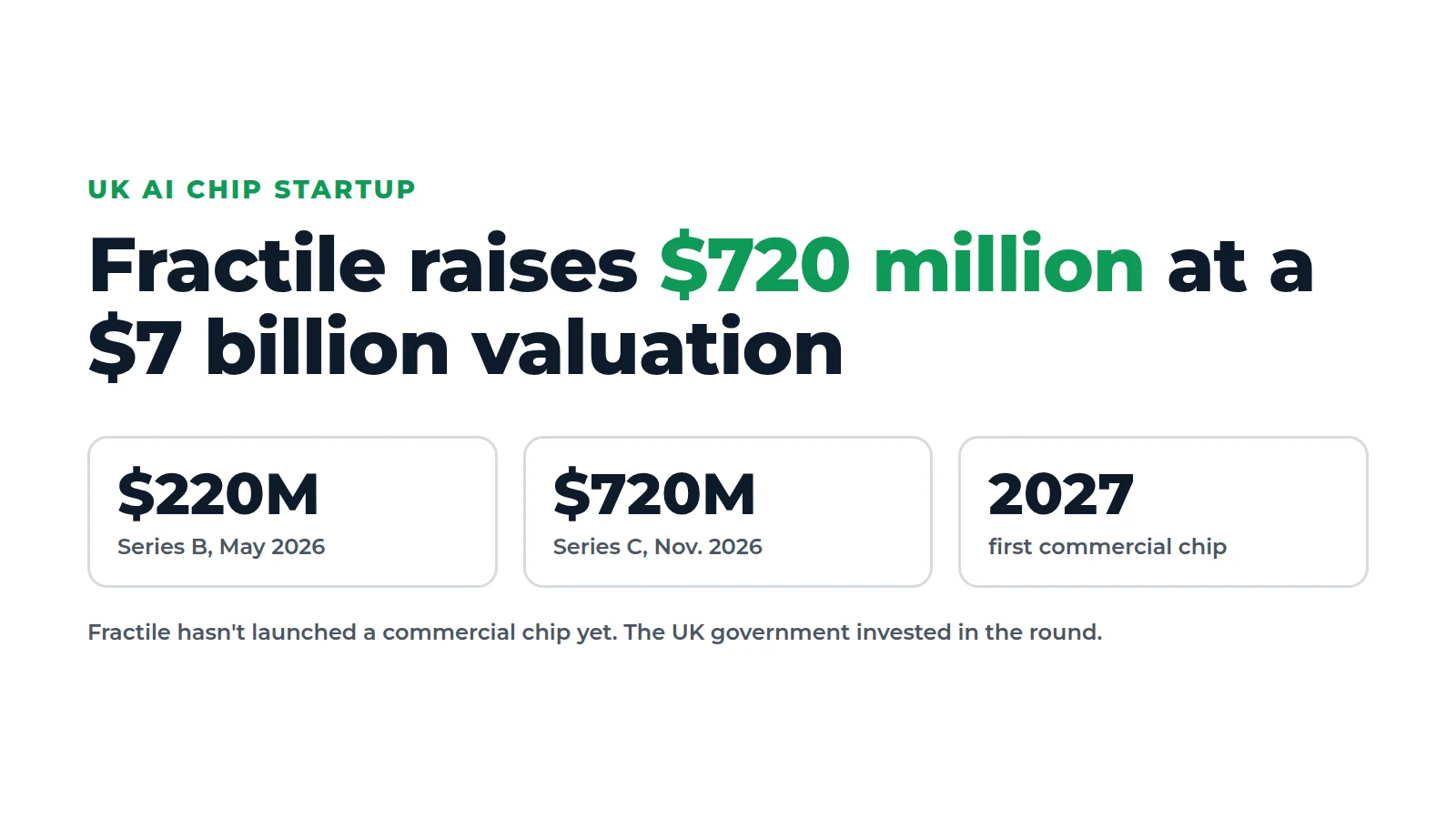
Fractile, a British startup developing chips to run AI models, raised $720 million in a Series C round that valued it at $7 billion, Reuters reported on Nov. 11. Fractile confirmed the round’s size to Reuters. Fractile hasn’t launched a commercial chip yet; its first is planned for next year.
Thrive Capital, Founders Fund, Lightspeed Venture Partners, and Redpoint led the round. The UK government also invested and put the valuation at more than £5 billion.
The UK government wants to strengthen domestic AI hardware
The government's Sovereign AI fund and the British Business Bank joined the round, which the government put at more than £500 million, according to its announcement. The announcement didn't say how much either one put in.
The government said the investment would strengthen Britain's sovereign capabilities and reduce reliance on overseas technology. UK AI Minister Kanishka Narayan put it more directly in a statement on the round: "For too long, Britain has produced some of the world's best scientific ideas, only to see too much of the technology, industry and wealth they create built elsewhere."
Britain is home to chip designer Arm (ARM), but its chip manufacturing industry is small next to those of the US and Asia. Business Secretary Jonathan Reynolds said Fractile plans to expand in Bristol.
Private investors include CapitalG, BlackRock, and Shopify
Other investors include CapitalG, the venture arm of Alphabet (GOOGL), as well as BlackRock, DST Global, and investor Elad Gil, according to Reuters. New investors also include Dragoneer, T. Rowe Price, and Shopify, BusinessCloud reported. Accel, Conviction, Factorial, and Felicis invested again.
Accel, Founders Fund, and Factorial Funds led the $220 million Series B in May, Verdict reported at the time.
Anthropic's IPO filing doesn't name Fractile
In August, Bloomberg reported that Fractile had reached an initial agreement to sell about $250 million of chips to Anthropic (ANT), and that the chips wouldn't be ready until 2027. Fractile and Anthropic declined to comment at the time. Neither Reuters nor the government mentioned Anthropic on Nov. 11.
Anthropic's IPO filing, last updated Nov. 10, doesn't name Fractile. The filing does list Anthropic's largest computing contracts, including a commitment to spend at least about $121.3 billion with Google from April 2026 to July 2033, regardless of actual usage. The filing's silence doesn't show whether the Fractile agreement still stands.
Anthropic also buys chips and computing from Amazon, Nvidia, and AMD, and Anthropic has its own chip design team, which the company confirmed in August. The reported agreement would give Anthropic another potential chip supplier, though neither company has confirmed the deal. We track Anthropic's disclosed compute deals in our AI compute commitments tracker.
Fractile puts memory on top of its chips
Fractile designs chips for inference, the work an AI model does each time it answers a request. Fractile says its technology can deliver faster performance while cutting energy use and costs.
Fractile is stacking DRAM memory directly on top of its logic, an approach meant to move data closer to where it is processed. Fractile is aiming for more memory bandwidth than high-bandwidth memory, or HBM, the stacked memory that sits beside most AI processors, and more capacity than SRAM, the fast memory built into a chip, BusinessCloud reported. Fractile's website says the company is working on how to "efficiently generate output at thousands of tokens per second."
Fractile was founded in 2022, and Walter Goodwin is its founder and CEO. The company has offices in London, Bristol, Palo Alto, and Taipei.
Chip startups are raising at higher valuations
Fractile is one of several startups trying to win inference work from Nvidia (NVDA). Earlier this month, Nvidia-backed Groq was reported to be seeking an $8 billion valuation, about 2.5 times its August value.