Key points
- The 10-year yield closes at a 24-year high
- Softer-than-expected inflation failed to keep yields down
- AI borrowing is part of the supply story
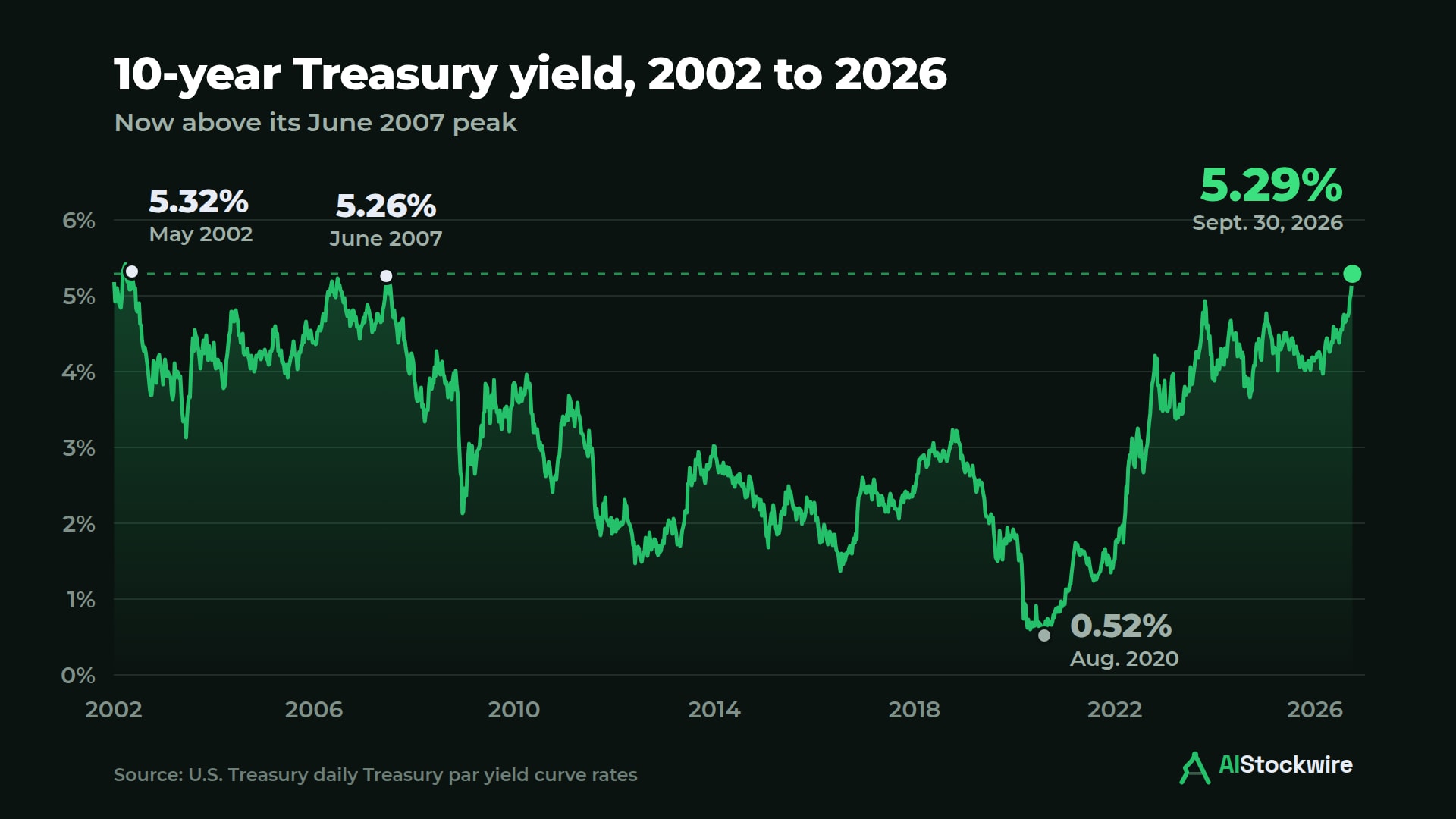
The 10-year Treasury yield closed at 5.29% on Wednesday, its highest since May 2002, according to Treasury Department data. The yield also surpassed its June 2007 peak. CBOE data on Yahoo Finance confirms the closing milestone and shows an intraday high of 5.306%.
Higher Treasury yields help explain two stories we've followed this month: losses in junk bonds and rising borrowing costs for AI companies. Companies generally pay a premium over Treasury yields to compensate lenders for credit risk. When that benchmark rises, new financing can become more expensive even without a change in the borrower's creditworthiness.
Why didn't softer inflation keep yields down?
Wednesday's inflation figures came in below expectations. The personal consumption expenditures price index, the Federal Reserve's preferred inflation gauge, rose 3.4% from a year earlier in August, against a forecast of 3.7%. Core PCE, which excludes food and energy, rose 3%, below the 3.3% economists expected.
"Net, net, the inflation fire is not burning as hot as markets expected in August," Christopher Rupkey, chief economist at FWDBONDS, wrote after the release. Traders cut the odds of a quarter-point Fed rate hike in October to about 37%, from more than 80% at one point this month, according to CME Group's FedWatch tool.
Yields dipped on the data and then climbed back as traders looked ahead to Friday's September jobs report. Economists expect 84,000 new jobs. The 30-year Treasury yield rose to 5.644%, around its highest level since 2002.
Why are yields this high?
The Fed raised rates on Sept. 16, its first increase since 2023. But some strategists think rate expectations explain only part of the climb.
"I think this year it has more to do with the bond issuance than the inflation story," Thierry Wizman, global FX and rates strategist at Macquarie Group, told CNBC last week. The federal government is borrowing to fund a large deficit, and companies are borrowing heavily to build AI infrastructure. Both add to the supply of bonds that buyers have to absorb.
Vanguard estimates that Alphabet (GOOGL), Amazon (AMZN), Meta Platforms (META), Microsoft (MSFT), and Oracle (ORCL) issued about $132 billion of debt through July, up from a roughly $35 billion annual average between 2020 and 2024. It estimates broader AI-related debt issuance could reach $300 billion to $570 billion this year. Wizman expects hyperscaler spending to keep issuance elevated into next year. "So these yields could go higher," he said.
What does it mean for AI borrowers and IPOs?
Higher Treasury yields can make new borrowing more expensive for AI companies, depending on the bond's maturity, structure, and credit spread. Credit investors have already been asking for more. Oracle's five-year credit default swap spread hit a record on Sept. 24, and we compared its debt with CoreWeave's the same week.
I'd be careful about tying the IPO calendar to rates, though. Reuters reported that Anthropic's listing is likely to come after the November midterm elections, and OpenAI CEO Sam Altman ruled out a 2026 listing, citing safety concerns. Neither company has cited interest rates as a reason for its IPO timing. But a Treasury yield near 5.3% raises the return available from government debt, giving investors another benchmark when weighing the risks of an AI IPO.
Friday's jobs report could add to that pressure. Stronger-than-expected hiring could increase expectations for an October rate hike and push borrowing costs higher. AI companies relying on debt to fund expansion would then face a bigger financing bill.