Key points
- Galaxy Helios bonds weakened the most
- What Goldman's "credit is ahead" note said
- What ZeroHedge's 15% Goldman figure leaves out
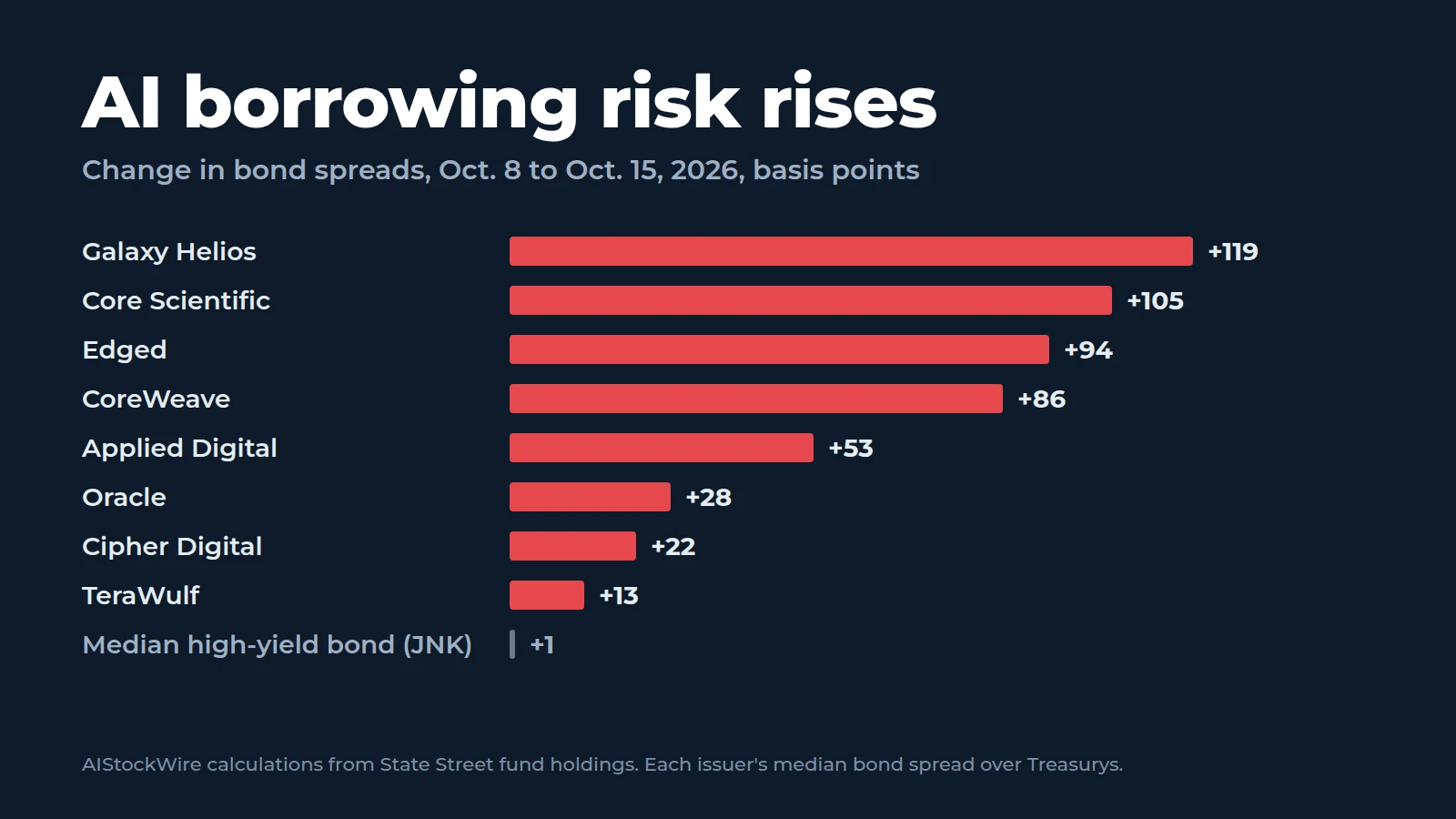
Our AI Bubble Index pulls daily bond prices for companies borrowing to build AI data centers. Between Oct. 8 and Oct. 15, spreads widened for all eight borrowers that were in our sample on both dates. The median issuer spread rose from 334 to about 413 basis points, while the median bond in the SPDR Bloomberg High Yield Bond ETF (JNK) moved just 1 basis point, to 232.
A spread is the extra yield a bond pays over a US Treasury that matures around the same time. A basis point is a hundredth of a percentage point, so 100 basis points is 1 percentage point. When a bond's price falls, its yield rises. Its spread widens if that yield rises relative to the Treasury benchmark. CoreWeave (CRWV) shows how that works. State Street valued CoreWeave's 9% notes due February 2031 at 84.36 cents on the dollar on Oct. 15, down from 86.99 cents a week earlier. By our math, the notes' yield rose from 13.03% to 13.95%, and their spread went from 808 to 906 basis points.
Our calculations use the same 53 bonds on both dates, drawn from State Street's daily fund holdings. We calculate each issuer's median spread, then take the median across the eight issuers. The JNK comparison uses individual bonds, not issuer medians.
Which AI borrowers moved the most?
Galaxy Helios, the data center unit of Galaxy Digital (GLXY), widened the most, by 119 basis points to 736. Core Scientific (CORZ) widened 105 basis points, data center developer Edged 94, and CoreWeave 86, to 934. Those are each company's median spread across its bonds in State Street's files. The smaller moves came from Applied Digital (APLD) at 53 basis points, Oracle (ORCL) at 28, Cipher Digital (CIFR) at 22, and TeraWulf (WULF) at 13. Oracle's the only investment-grade name in the group, meaning credit rating firms see it as a safer borrower. Its 38 bonds come from State Street's investment-grade corporate bond fund, SPBO.
SoftBank's bonds joined our sample this week, after its record high-yield bond sale. Its median spread was 441 basis points on Oct. 15. SoftBank wasn't in the Oct. 8 reading, so I've left it out of the comparison above. The index's own figure includes it, which is why the index shows a bigger jump than the same-bond numbers do.
Including SoftBank, the median issuer spread in our AI sample was 209 basis points above JNK's median bond spread on Oct. 15. The index smooths that over a five-reading median, which stood at 171 basis points, and that sub-score was 52 out of 100. The full index read 59 on Oct. 16.
What did Goldman's desk actually say?
Louis Miller of Goldman Sachs (GS) sent clients a "Global Reflections" note on Friday evening, Oct. 16, with a chart pack he described as "in the spirit of mid October," according to ZeroHedge. The note opened with the line "Credit Is Ahead Of Equities, Again."
That post's headline says Goldman's charts show AI credit pricing in a 15% drop for hyperscaler stocks. The free part of that post doesn't show the charts or explain how the 15% was worked out, and the note itself went to Goldman's clients. So I can't tell you which stocks, which bonds, or what period the figure covers.
Hyperscalers are the biggest spenders on AI data centers, such as Microsoft, Alphabet, Amazon, and Meta. Our sample covers mostly high-yield companies building AI data centers, plus Oracle. Goldman Sachs Asset Management said in September that it was allocating less of its portfolio to hyperscaler bonds than its benchmark because of the wave of new debt the firm expects.
One caution about our own numbers. The prices in State Street's files are pricing-service quotes, and many of these bonds trade rarely, so a quote can move without a trade behind it. That's why the index uses a five-reading median, and why CoreWeave's bond yields in other reports may not match ours exactly.