Key points
- Developers get access to DeepSeek's search engine
- How DeepSeek's search price compares with rivals
- Where DeepSeek's V4.1 Flash scores rank
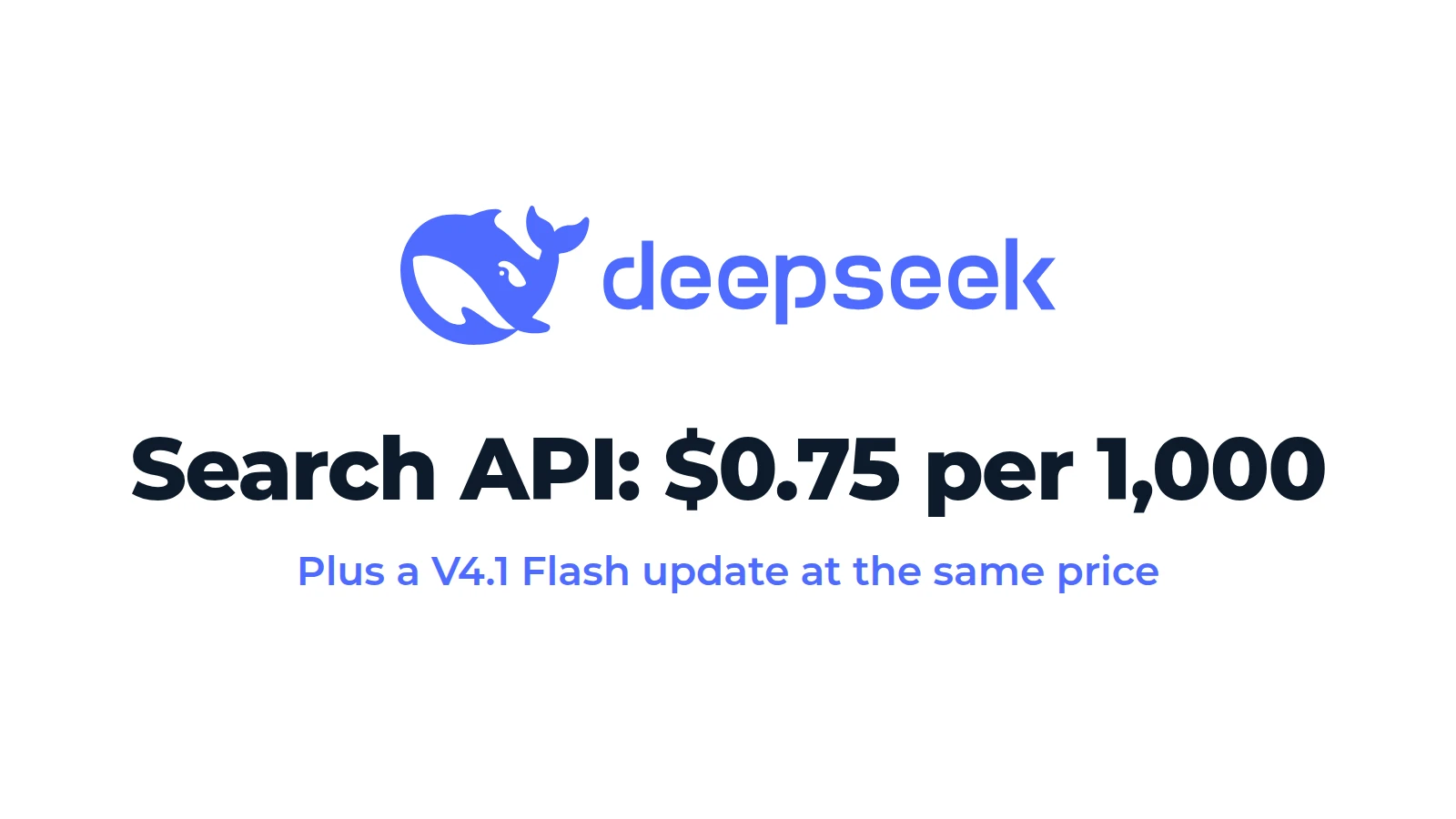
DeepSeek opened its in-house search engine to outside developers on Saturday at a lower listed price than some rival search services. Developers pay $0.75 per 1,000 successful searches. Brave lists $5 per 1,000 requests for its search API, and Exa's search starts at $4, though the services' features differ.
DeepSeek also updated V4.1 Flash, saying the model completes tasks faster and scores higher on coding and agent benchmarks without an increase in API prices. The new version, DeepSeek-V4.1-Flash-1017, also produces shorter answers, the company said. Both releases are listed in its Oct. 17 API change log.
DeepSeek on X
DeepSeek opens its search engine
DeepSeek's chatbot and API already used the company's own search engine, which DeepSeek said "reliably handles hundreds of millions of search requests from around the world every day" and "indexes hundreds of billions of web pages." The company said it filters out "SEO spam, GEO manipulation, and low-quality AIGC." AIGC stands for AI-generated content. GEO refers to generative engine optimization, efforts to influence how AI systems present information.
DeepSeek said the filtering is meant to provide "authoritative and trustworthy information for users and LLMs." Search APIs like these let AI models and agents pull live web results into their answers.
Outside developers can now use the engine directly through two APIs. DeepSeek charges $0.75 per 1,000 successful requests for Search and the same for Fetch, which pulls content from web pages, according to its pricing page. Brave lists its search API at $5 per 1,000 requests, and Exa's search starts at $4 per 1,000 requests.
What changed in V4.1 Flash
The update improves on the original Sept. 10 release across all six benchmarks shown below, according to DeepSeek's own testing. The largest score increases were on Terminal-Bench 4.0 and ProgramBench.
| Benchmark | Sept. 10 version | Oct. 17 version |
|---|---|---|
| DeepSWE v1.1 | 74.2 | 77.0 |
| Terminal-Bench 4.0 | 31.2 | 42.3 |
| ProgramBench | 20.3 | 29.1 |
| NL2Repo-Bench | 65.4 | 68.2 |
| Agents' Last Exam | 31.8 | 35.4 |
| Humanity's Last Exam, no tools | 36.8 | 42.6 |
DeepSeek said it tested Terminal-Bench 4.0 through Anthropic's Claude Code and DeepSWE through Mini-SWE-V2, a framework for running the tasks.
V4.1 Flash is the smallest model in DeepSeek's new architecture family, according to the company. DeepSeek said it optimized the update for its own DeepSeek Harness, Tencent's CodeBuddy, and WorkBuddy.
The model's weights are available on Hugging Face under the MIT license, which permits commercial use.
How the scores compare
On DeepSWE v1.1, DeepSeek's 77.0 would trail only Google's Gemini 4 Argon, at 77.9%, among scores on the benchmark's public tracker. OpenAI reported 75.2% for GPT-6.1 Sol, and Anthropic reported 74.2% for Claude Opus 5.5. Those scores, like DeepSeek's, are the companies' own results, and the labs ran the tasks in different setups.
On Terminal-Bench 4.0, DeepSeek's 42.3% trails the leaders on the benchmark's public leaderboard. Claude Opus 5.5 scored 64.8% running in Claude Code, the same tool DeepSeek used, and OpenAI's GPT-6 Astra and GPT-6.1 Sol each scored 58.2% in Codex. Z.ai's GLM-5.3 scored 41.8% in Claude Code. DeepSeek's new result isn't listed on that leaderboard.
V4.1 Flash's API prices stay unchanged
During peak hours, DeepSeek charges $0.30 per million uncached input tokens and $1.20 per million output tokens. Off-peak rates are half that, and peak hours run from 01:00 to 04:00 and 06:00 to 10:00 UTC on weekdays.
Developers who still call the older V4 Flash model names are now routed to the new version and billed at the Flash price.
The release comes as DeepSeek raises money. DeepSeek was close to raising at least 80 billion yuan, about $11.9 billion, in early October, with Tencent and CATL among its biggest backers. The Standard reported on Oct. 13 that the round had reached 100 billion yuan. DeepSeek hasn't confirmed the figures.