Key points
- What Huang said about CoreWeave's finances
- The cost of default protection hit a record
- ARK bought during Wednesday's drop
Nvidia (NVDA) CEO Jensen Huang said Thursday that he doesn't think CoreWeave (CRWV) will need a bailout from Nvidia, as the AI cloud company's stock and bonds extended their slide. CoreWeave shares were down 2.5% at $64.16 at 12:42 p.m. ET, after falling 15.5% on Wednesday.
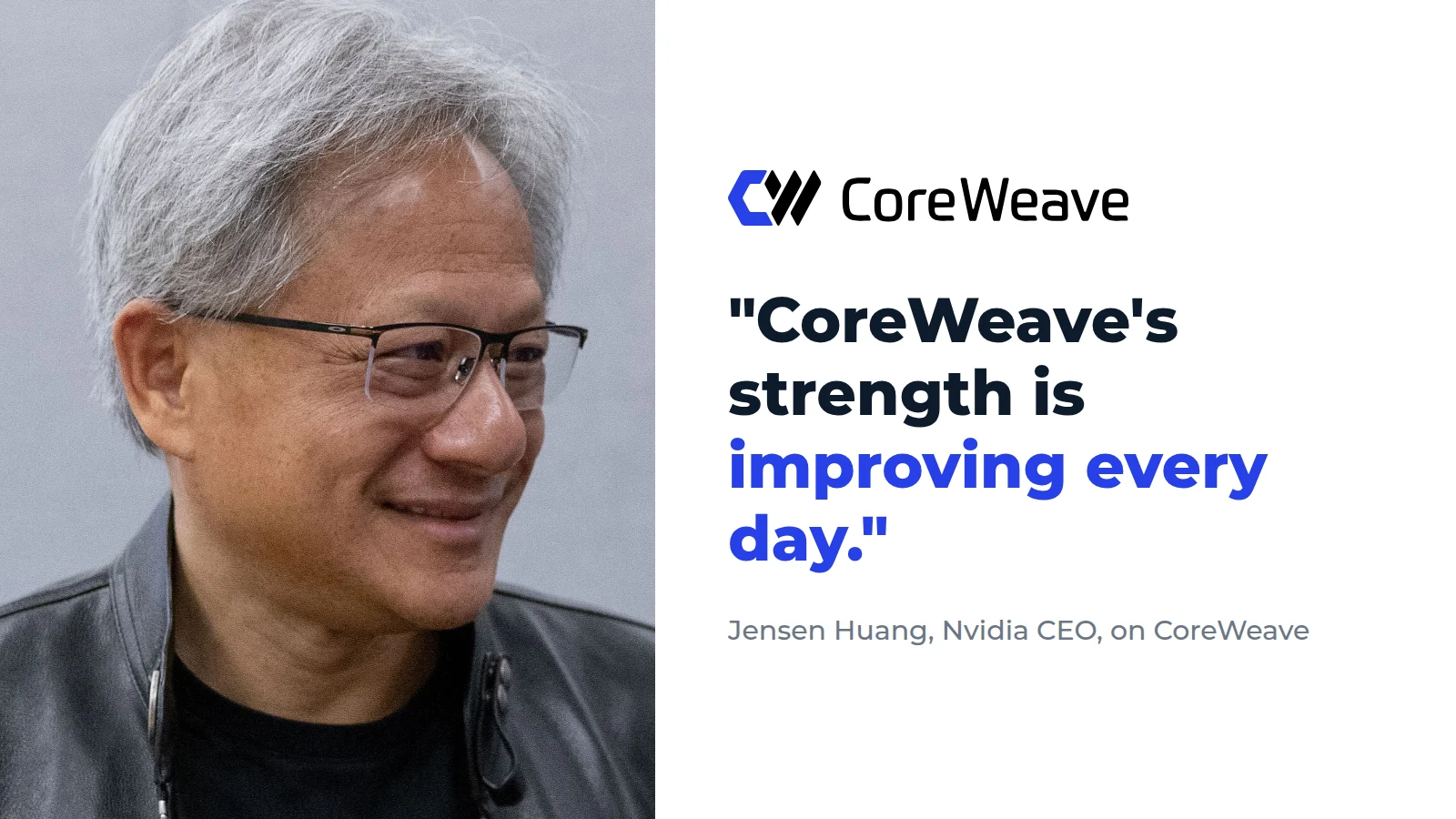
"CoreWeave's strength is improving every day," Huang told Bloomberg at an event in Stockholm. "I'm optimistic. Their cost of capital is actually decreasing."
Nvidia supplies the computing equipment CoreWeave rents to its customers. It also held 47.2 million CoreWeave shares at the end of June, according to its latest 13F filing.
Default protection on CoreWeave's debt hit a record
The cost of insuring CoreWeave's debt against default for five years rose as much as 74.5 basis points to a record intraday high of 1,194.5 basis points, according to ICE Data Services. That level implied a more than 60% chance of default over five years, a figure that rests on an assumption about how much lenders would recover.
That insurance is a credit default swap. The buyer pays a yearly fee, quoted in basis points of the amount covered, and gets paid if the borrower defaults. At 1,194.5 basis points, covering $10 million of CoreWeave debt works out to about $1.19 million a year, though actual payments depend on how the contract is structured.
CoreWeave's bonds fell too. The $2.75 billion of 9.75% bonds the company issued in April traded at 79.5 cents on the dollar on Wednesday, for a yield above 15%, according to BondCliQ data. On Wednesday, co-founder Brannin McBee said CoreWeave wants to borrow from insurers' "unlimited" pools of capital to fund its AI build-out more cheaply.
CoreWeave's bonds are one input to our AI Bubble Index, which read 60 out of 100 on Thursday morning.
Cathie Wood's ARK bought during the drop
ARK Invest, led by Cathie Wood, bought 188,665 CoreWeave shares on Wednesday. The ARK Innovation ETF (ARKK) bought 145,319 of them, and the ARK Next Generation Internet ETF (ARKW) bought 43,346. At Wednesday's close of $65.78, the shares were worth about $12.4 million.
Nebius fell, while Oracle rose
Shares of Nebius (NBIS), which also rents out AI computing, were down 5.0% at $176.70 at 12:42 p.m. ET. Nvidia was down 2.1% at $216.68. Oracle (ORCL), which we compared with CoreWeave on debt last month, was up 1.5% at $132.57.